

Inside the Vintage Kitchen Store Scene: A Complete Guide
 July 24, 202622 Minutes
The first time you step into a vintage kitchen store, you're usually doing two things at once, admiring the prettiness and trying not to buy the wrong thing. Brass handles, stacked enamelware, old cast iron, and glassware in colors you don't see in modern kitchens can make even a seasoned shopper move too fast. That's how people end up paying collector prices for tired pieces, or walking away from real finds because they didn't know what to look for. The smart buyer slows down, reads the room, and treats the shop floor like a working archive. Flexwork Studios would call that good production discipline. In vintage shopping, it's just good taste.
Walking Into a Vintage Kitchen Store for the First Time
The first thing you notice is how much history is packed into a small space. A good vintage kitchen store feels like a museum that still has price tags on the shelves, with iron skillets hanging near enamel canisters and old serving pieces stacked in tight little clusters. The best shops don't just sell “old stuff,” they sell a version of domestic life that changed fast in the early 20th century, when kitchens moved from manual workspaces to appliance-centered rooms. That shift matters because so many collectible kitchen goods, from ice boxes to early stoves and refrigerators, belong to the era when American homes were being remade around convenience and cleanliness. GE introduced a refrigerator in 1911, refrigerators reached American homes in 1927, and by the 1940s, 85% of American homes had a refrigerator in the kitchen, which is why the late 1800s through the 1940s remains the strongest hunting ground for serious buyers. World Copper Smith's kitchen history timeline puts that transition in plain view.
What that first walk-through should feel like
Do not shop like a tourist. Shop like someone trying to tell the difference between decoration and documentation. If a piece looks beautiful but you can't place its era, material, or use, it probably needs a longer look before money changes hands.
Practical rule: if you can't say why the item belongs in a kitchen history conversation, you probably shouldn't pay a premium for it.
That doesn't mean you need to be rigid. It means you need a frame of reference. Once you understand that many shelves are built around the pre-war transition from hand labor to appliances, the whole store makes more sense. The enamelware, the early electric pieces, the advertising tins, and the old wooden tools are not random antiques, they're artifacts from a kitchen economy that was changing in real time.
A smart first visit ends with three questions. Is the piece historically interesting? Is it physically sound? Is the price justified by rarity, condition, or both? If you can answer those three, you're already shopping better than other customers on the floor.
What Vintage Kitchen Stores Actually Stock
Walk into a serious vintage kitchen store and the shelves will look busy before they look organized. That clutter is not random. The inventory usually falls into a few lanes, cast iron, wood-handled tools, copper cookware, jadeite and Fire-King glassware, enamelware, ice boxes and early refrigerators, canisters, advertising pieces, and the occasional mid-century electric. Those categories track the shift in kitchen design as households moved toward electric appliances and mass production, and that is why pre-war pieces still draw the strongest authenticity premium.
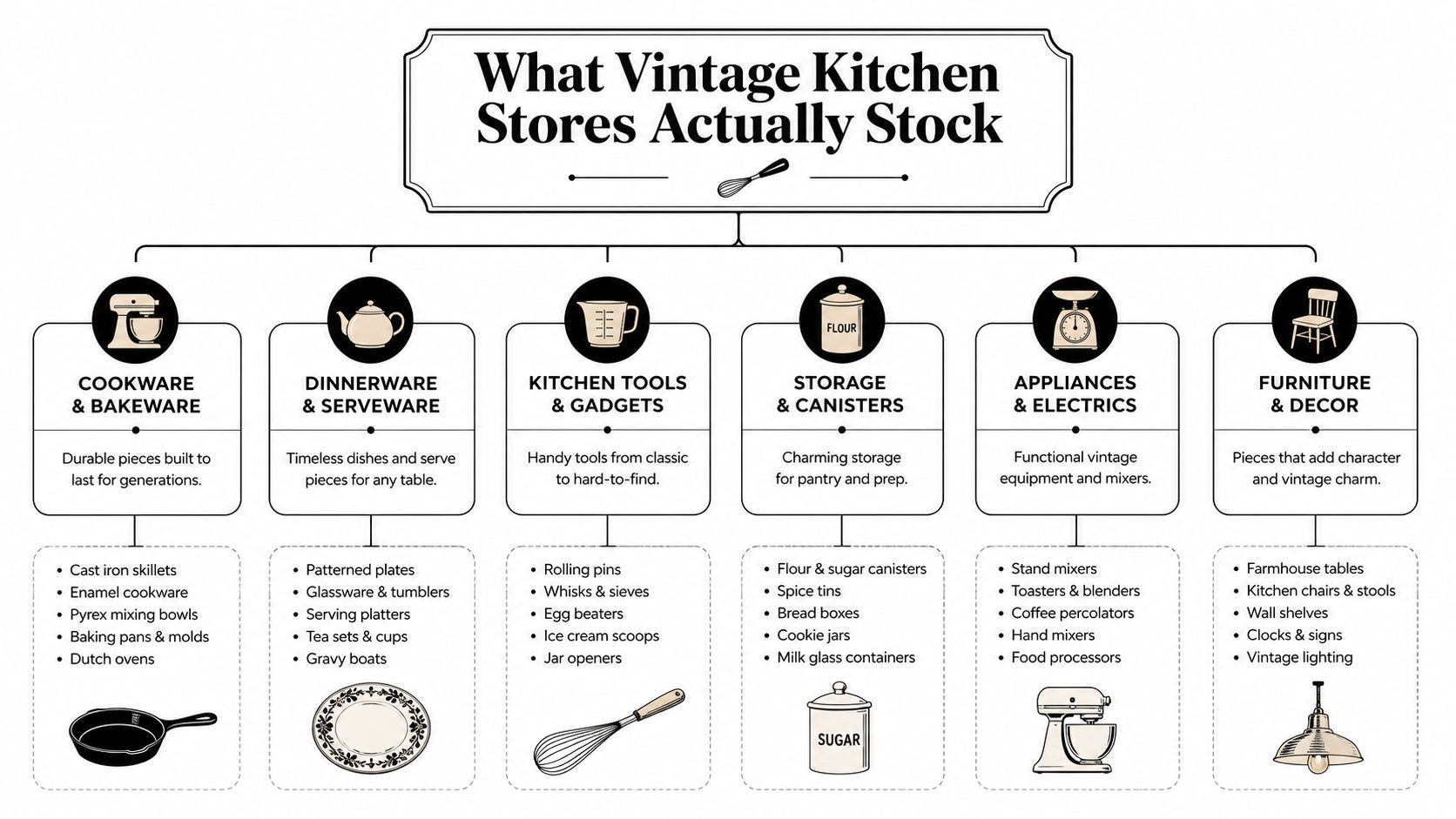
Learn the categories before you learn the prices
Cast iron is where many buyers start, because the shape is familiar and the upside is easy to understand. Copper is the opposite. It reads as valuable at a glance, but it rewards careful inspection and punishes sloppy assumptions. Glassware is where color, maker's marks, and pattern knowledge do the essential work, while enamelware rewards anyone who knows the difference between honest wear and damage that kills value.
Read a shelf by use, not by style:
- Cooking tools: skillets, molds, spoons, graters, and rolling pins. These should show honest wear, not abuse.
- Serving and display pieces: canisters, pitchers, mugs, bowls, and advertising ware. These often sell on visual cohesion.
- Material-heavy pieces: copper pots, enamelware, cast iron, and wood. These need the most inspection.
- Era markers: early electrics, ice boxes, and branded kitchen ephemera. These anchor a collection in time.
If you are trying to match a vintage kitchen look with period-appropriate surfaces and visual texture, the Original Mission Tile showroom guide is a useful reference. It helps connect the objects to the room around them, which matters more than many buyers admit. A vintage kitchen only works when the finishes, the hardware, and the objects agree with each other.
What separates good stock from junk is not the word “vintage” on the tag. It is whether the dealer understands condition, replacement parts, safety concerns, and which pieces still make sense for real use. A shop that groups stock by function, material, and era usually knows what it has. A shop that just piles old cookware together is selling decoration first and history second.
Where to Find the Best Vintage Kitchen Stores
Every sourcing channel has a personality, and the buyer who ignores that usually overpays or underbuys. Dedicated vintage kitchen stores and strong local antique shops are best for focused browsing, because the inventory is already filtered and the staff usually knows what they're looking at. A Philadelphia example, Kitch-n Collectibles, is open seven days a week, which tells you the category can support steady foot traffic and daily sales, not just weekend curiosity. WHYY's coverage makes that point clearly.
Match the channel to the job
Flea markets and estate sales are better when you want odd-lot discovery, lower prices, and the chance to find a piece the seller doesn't fully understand. Online marketplaces widen the net, but they add shipping risk and a lot more bad photography. Auctions are where the rarest pieces surface, but that's also where the market gets sharpest and least forgiving.
| Sourcing Channel | Selection | Typical Pricing | Authentication Confidence |
|---|---|---|---|
| Dedicated vintage kitchen stores | Focused, curated | Usually mid to higher, depending on rarity | Higher, because the stock is pre-screened |
| Antique shops | Broad, uneven | Mixed, often negotiable | Moderate, depending on the dealer |
| Flea markets and estate sales | Wide but unpredictable | Often lower | Variable, buyer has to verify fast |
| Online marketplaces | Huge reach | All over the map | Lower unless photos and details are strong |
| Auctions | Rare and concentrated | Often highest for prime pieces | Higher on provenance, lower on ease |
Straight advice: if you want a matching set, buy where the seller has already done the sorting. If you want a bargain, buy where the sorting hasn't happened yet.
For buyers who also sell or liquidate odd pieces, sell your cookie jar on DIYAuctions is a useful example of how specific vintage categories get handled in the resale world. That's the reality of this market, supply is fragmented, and the best finds often move through estate channels before they ever reach a polished storefront.
The cleanest strategy is usually a mix. Use shops for confidence, markets for opportunity, and auctions only when you already know the piece, the maker, and the ceiling you're willing to hit.
How to Authenticate and Inspect Before You Buy
Decoration lies. Materials usually don't. That's why the first pass on any piece should be physical, not aesthetic. Look at moving parts, handle geometry, sharpness, overall size, and material composition to figure out how the object was made and what kind of use it survived. If provenance is fuzzy, compare it to known examples before you convince yourself it's special. LoveToKnow's identification guidance is useful here because it keeps the focus on diagnostics, not vibes.
The inspection workflow that saves money
Start with the joints. On wood, check whether the construction is solid or loose. On metal, look for warping, cracking, and any repair work that doesn't belong. Then move to the surface, because surface condition tells you whether the item was stored well or neglected hard.
- Cast iron: look for minimal rust and legible markings on the bottom.
- Copper cookware: check for heavy weight, even lining, and minimal pitting inside the pot.
- Enamelware: inspect for chips along the rim and obvious rust spots.
- Wooden items: look for solid construction, minimal cracking, and a well-oiled finish.
The point is not perfection. The point is honest condition. A piece with light wear and clean markings can still be an excellent buy. A piece with fake shine, hidden pitting, or sloppy repairs can be a headache even if it looks good from three feet away.

The buyer's mistake is usually emotional. They see a shiny surface and assume “restored,” when they should be asking “restorable.” That one word can save you from overpaying. If a seller won't let you inspect the bottom, test the weight, or check the handle, walk away. There are too many pieces in this category to gamble on a bad one.
Dealer's habit: I buy with my hands first, my eyes second, and the story last.
Understanding Price and What Drives Value
Price in a vintage kitchen store comes down to four levers, age and era, material composition, rarity and pattern, and condition. Buyers get burned when they only look at age. Age matters, but it's not the whole story. Two pieces from the same decade can trade at wildly different levels if one has a scarce maker's mark, a desirable color, or near-perfect preservation.
The hard examples make that obvious. A rare #2 Griswold skillet with a slanted logo reportedly sold for $1,200 on eBay, a Griswold spider skillet was listed for $8,000, and a vintage Wagner skillet recently sold for $999. Tasting Table also notes that prices vary widely depending on the pattern, condition, and piece type, and that full sets can go for several hundred dollars. Those numbers are useful not because every piece will match them, but because they show how quickly value can jump when the variant is right. Tasting Table's cookware valuation roundup is a strong example of this pricing logic.
Why variants matter more than labels
A green or amber glass piece can command up to $800 per piece in the antiques market, which tells you how strong the scarcity premium can be when color, condition, and survival line up. Taste of Home's value guide ties that premium to rarity, smaller production runs, and condition-sensitive collectors. That's why two bowls that look nearly identical can sit in completely different price tiers.
The right move is to sort inventory by tier, not by the word “vintage.” A clean common piece belongs in one bucket. A scarce color, maker's mark, or exceptional condition belongs in another. If you're selling, that structure protects your margin. If you're buying, it keeps you from paying collector money for a common example.
Best pricing rule: rarity gets rewarded only when condition doesn't kill the story.
The dealer's edge is simple. Learn the maker's mark, the pattern, the finish, and the wear level. Then ask whether the piece is merely old, or hard to replace.
Restoration, Care, and Food Safe Use
Vintage does not automatically mean food safe, and that's the part too many glossy guides skip. Older ceramics can raise lead or cadmium concerns, chipped enamelware can expose raw edges, and older non-stick or aluminum cookware may come with coating questions. A good vintage kitchen store should separate display pieces from working pieces more clearly, because buyers need to know whether they're buying something for the shelf, the table, or the stove.
Split your collection into three use tiers
The smartest kitchens treat vintage goods in layers. Some pieces are display-only, some are serving-safe, and some are cook-safe. That's the cleanest way to keep beauty and utility from colliding.
- Display-only: decorative tins, damaged enamel, fragile glass, and anything with visible structural problems.
- Serving-safe: intact bowls, pitchers, and platters that can handle dry or room-temperature use.
- Cook-safe: sound cast iron, well-maintained copper, and sturdy wooden tools that pass inspection.
Cast iron can be re-seasoned. Wooden boards can be re-waxed. Copper can be polished carefully, but don't strip the patina just because it looks old. Handles on cast iron or copper should be checked for looseness before they ever touch heat. For wooden pieces, structural integrity matters more than shine. A gorgeous spoon with loose joints is still a bad tool.
Restoration should preserve, not erase
The goal is not to make every item look new. It's to keep the object honest and functional. If you're cleaning aggressively enough to remove the character, you're probably doing too much. That's especially true with copper and wood, where over-restoration can wreck the very qualities collectors are paying for.

The best pieces earn their place by being both beautiful and safe. If they can't do both, be honest about the category they belong in and price them accordingly.
Styling, Sourcing Replacements, and Negotiating Smart
Once you've bought the right pieces, styling turns a pile of finds into a kitchen with a point of view. Open shelving works because it lets the good stuff breathe. Range-top displays are useful when you want cast iron and copper to read as part of the room instead of stored clutter. Glass-front cabinets and the open pantry look make mismatched vintage pieces feel deliberate instead of accidental.
Replacement logistics matter just as much. Matching lids, brand-specific inserts, knobs, and small hardware are the parts that separate a finished collection from a partial one. The market is fragmented, so the smartest buyers stop chasing perfect sets at retail and start learning how to source the missing parts after the fact. That's where the genuine collecting skill lives now.
For a useful parallel on how collectors think about matching materials and tradeoffs, Blade Master's comparison of Japanese steel vs Western kitchen knives is a good reminder that design, performance, and maintenance all shape long-term ownership.
Negotiation is part of the game too. Most independent shops and nearly every market expect some back-and-forth, especially on bigger pieces or mixed lots. Keep your asks respectful, point to condition where it matters, and don't negotiate just to feel clever. If a price is already fair, pay it and move on. If shipping enters the equation, remember that fragile glassware and heavy cast iron can change the cost fast, which is another reason local sourcing still has an edge.
The strongest collections aren't built by one big score. They're built by a buyer who knows how to style, restore, replace, and negotiate without losing the thread.
Bringing the Vintage Kitchen Home
A great vintage kitchen store visit is never just shopping. It's history, inspection, and taste, all working together in the same cart. The buyers who win in this category know what to chase, what to leave, and what needs a second life before it earns a spot in the kitchen. That's the same discipline behind any premium creative project, strong curation, clear standards, and an environment that makes the work better.
If you want your next project to have that level of polish, book a tour with Flexwork Podcast Studios and see how a professional studio can support content that feels as carefully assembled as a great collection.