

Podcast Show Notes Template That Gets Results in 2026
 April 14, 202630 Minutes
Meta description: Podcast show notes template strategies that improve SEO, retention, and workflow, plus copy-ready formats for serious creators.
URL slug: /podcast-show-notes-template
Primary keyword: podcast show notes template
Secondary keywords: podcast show notes, podcast SEO, podcast episode notes
You finished recording. The conversation was sharp, the guest was excellent, and the episode has the kind of momentum that should travel.
Then you open the show notes field.
That’s where a lot of strong podcasts lose energy. The episode is polished, but the written layer is rushed. A vague summary goes up, a few links get pasted in, and the publish button gets hit. It feels minor. It isn’t. A weak podcast show notes template turns a valuable episode into a hard-to-find asset. A strong one turns each release into a searchable, skimmable, conversion-ready page that keeps working after launch.
For creators building serious brands, show notes shouldn’t be treated like admin. They should be treated like distribution infrastructure.
Your Podcast Deserves More Than an Afterthought
A familiar pattern shows up after great recording sessions. The audio is clean. The delivery feels natural. Everyone leaves the studio thinking, “That one’s going to land.”
Hours later, the energy changes. Someone has to write the episode title, clean up the summary, pull links, add timestamps, check spelling, and figure out what the actual call to action should be. Many podcasts then start operating below the quality of the content itself.
That gap matters.
Listeners notice when the notes are thin, messy, or missing the obvious details. Search engines notice when there’s no meaningful text supporting the episode. Guests notice when their appearance gets little more than a line of filler. Sponsors notice when links and framing feel careless.
A podcast show notes template fixes the part of the process that usually gets treated as an afterthought. It creates consistency, protects quality, and gives every episode a professional finish. The goal isn’t to make the notes longer for the sake of length. The goal is to make each episode easier to find, easier to trust, and easier to act on.
Why Your Show Notes Are a Hidden Growth Lever
Most creators think of show notes as packaging. In practice, they function more like a landing page attached to every episode.
That shift in thinking changes how you write them. Instead of asking, “What do I have to include?” you start asking, “What job does this page need to do?”

They help people find you before they know you
Audio alone is hard to surface in search. Written context changes that.
Long-form show notes have become a serious growth tool, with formats reaching up to 1000 words or more. After SEO updates in June 2024, the True Crime Junkie podcast saw a 42% increase in organic traffic and a 15% increase in new listeners, as noted in Buzzsprout’s guide to podcast show notes. That result didn’t come from “doing more content.” It came from making existing content easier to discover.
For creators who want audience growth without relying only on social spikes, this is one of the most practical upgrades available.
They reduce DIY burnout
Bad systems create repetitive work. Good templates remove decisions.
Without a template, every episode starts from zero. Someone rewrites the same intro structure, forgets a recurring link, changes formatting, and ends up spending too much time on low-value cleanup. Over time, the friction adds up. Not because show notes are hard, but because inconsistency makes them annoying.
A reusable podcast show notes template solves that.
It gives you a stable framework for episode title, summary, guest info, links, timestamps, and CTA. That means less mental load on publish day. It also means your team can hand off parts of the workflow without quality dropping.
Practical rule: If you’re rewriting your structure every week, you don’t have a writing problem. You have a workflow problem.
They improve the listener experience
A good episode can still feel inconvenient.
When listeners can’t skim topics, find the guest, grab the book recommendation, or jump to the section they care about, the experience becomes passive. That’s fine for casual listening. It’s weak for growth.
Strong notes make a podcast easier to use. That matters more than many hosts realize. Some listeners want to sample before they commit. Some want to revisit one segment from a long episode. Some need a direct link to a resource mentioned halfway through the conversation. Show notes remove friction for all three.
They signal professionalism
This part doesn’t get discussed enough. Show notes are part of your brand presentation.
Messy notes make a polished show feel amateur. Thin notes can make a smart conversation feel disposable. Generic summaries tell the audience you published because the schedule said so, not because the episode deserved support.
By contrast, strong notes tell a different story:
- You respect the audience’s time: You help them scan, choose, and return.
- You support the guest properly: Their expertise isn’t buried in a wall of text.
- You understand conversion: Your CTA appears with intention, not as a random add-on.
- You think beyond the upload: Each episode works as a long-tail asset.
If you’re trying to build authority, this isn’t a cosmetic detail. It’s part of the operating standard.
They support repurposing across channels
Show notes aren’t only for podcast apps. They can also become the source document for clips, newsletters, website copy, quote graphics, and social captions.
That’s one reason creators who care about growth usually benefit from a written system. Once the summary, takeaways, timestamps, and links are organized, the rest of the distribution stack gets easier. Your editor can see the moments worth clipping. Your social team can pull language from the summary. Your website can host a cleaner version of the episode page.
For a deeper look at audience-building mechanics beyond the episode itself, how to market your podcast and grow a loyal audience is worth reviewing alongside your notes process.
The Anatomy of a High-Performing Show Note
A strong podcast show notes template doesn’t try to say everything. It organizes the right things in the right order.
That order matters because readers don’t all behave the same way. Some skim for value. Some want proof the episode is worth their time. Some are looking for one link, one quote, or one section. Your notes need to work for all of them without becoming cluttered.
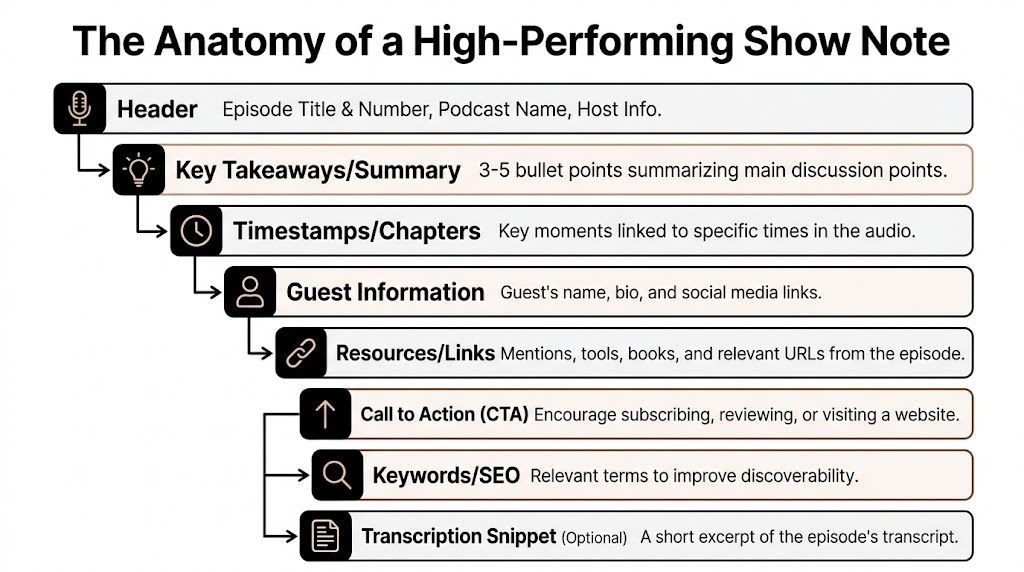
Start with a clear header
The header is simple, but it anchors everything.
Include the episode number, episode title, and, where useful, the show name. If the platform already displays some of that information, don’t repeat it awkwardly. But on your website or in exported formats, having the full context helps.
A weak title is usually either too vague or too cute. It may sound clever in your internal planning doc, but it doesn’t tell a new listener what they’ll get. A better title makes a promise without sounding like clickbait.
Use language tied to the actual subject of the episode. If the conversation covers client acquisition, creative burnout, or launching a video podcast, the title should say so plainly.
Write a summary that earns the click
Your summary has one job. Make the episode feel worth listening to.
This usually works best when it answers three questions fast:
| Element | What it should do |
|---|---|
| Topic | Tell the reader what the episode is about |
| Value | Explain what they’ll learn or gain |
| Context | Identify who’s speaking and why they matter |
For many episodes, a short paragraph is enough. Loyal listeners often don’t need a full article. They need a clean, confident synopsis that helps them decide quickly.
What doesn’t work is generic filler. Phrases like “we had a great conversation” or “we covered a lot” waste prime real estate. Readers need specifics.
Don’t summarize the recording session. Translate the outcome for the listener.
Timestamps do more work than most hosts realize
Timestamps aren’t decoration. They are navigation.
In January 2024, Buzzsprout’s Podcasting Q&A show added detailed timestamps to show notes and saw a 32% increase in average listen time, according to Pro Podcast Solutions’ guide on engaging podcast show notes. That’s one of the clearest examples of a formatting choice affecting retention.
If your episodes run long, timestamps become even more important. They let new listeners sample the conversation without committing blindly. They also make your best moments easier to revisit.
A practical timestamp list usually works like this:
- 00:00 Introduction
- 03:12 Why most creators underuse show notes
- 11:45 How to structure guest bios
- 21:08 When long-form notes make sense
- 34:50 The CTA mistake that kills response
Keep them accurate. Keep them scannable. Don’t timestamp trivial filler just to make the list look longer.
Add guest information with restraint
Guest bios matter, but they shouldn’t read like a conference program pasted into your notes.
The best bios are short, credible, and relevant to the episode. Include the person’s name, role, and one or two details that explain why their perspective matters. If they want a specific website, social profile, or book link included, place it neatly under their bio or in the resources section.
What works:
- concise credentials
- clear relevance to the topic
- one or two destination links
What usually fails:
- oversized bios
- every social platform they’ve ever joined
- achievements unrelated to the conversation
This is also where many creators miss a relationship opportunity. Clean guest notes make guests more likely to share the episode because the page reflects well on them.
Organize resources like an editor, not a scrapbook
Resource links are where usefulness becomes tangible.
If you mention a tool, article, product, event, or prior episode, list it cleanly. Don’t bury links inside a giant paragraph when a bullet list would be easier to scan.
Try a grouped structure:
- Tools mentioned: Production software, scheduling apps, AI drafting tools
- Books or articles referenced: Reading that extends the conversation
- Related episodes: Back-catalog links for deeper listening
- Guest links: Website or social destination chosen by the guest
This section builds trust because it proves the episode has substance beyond talk. It also helps your own content ecosystem if you link to related episodes or resources.
If you’re building a broader toolkit around your content operation, the ultimate toolkit for content creators pairs well with a more systematic notes workflow.
End with one strong CTA
Most show notes ask for too much. Subscribe. Review. Share. Follow. Download. Join. Buy. Book. Watch.
That’s a recipe for diluted attention.
Pick the action that fits the episode’s role in your funnel. If it’s a trust-building interview, maybe the CTA is to subscribe. If it’s a tactical episode, maybe the CTA is to visit a related page or join a newsletter. If the episode supports a launch, use the notes to point there directly.
Keep it singular. Keep it visible. Put it near the end unless the page structure calls for an earlier mention.
Choose short-form or long-form based on the goal
Not every episode needs the same treatment.
Here’s the simplest way to decide:
| Format | Best for | Usually includes |
|---|---|---|
| Short-form notes | Existing listeners, fast weekly publishing | Title, summary, timestamps, links, CTA |
| Expanded notes | Guest interviews, brand-building episodes | Stronger hook, guest bio, detailed outline, resources |
| Long-form notes | Search traffic, website SEO, evergreen education | Blog-style paragraphs, keywords, timestamps, transcript excerpt, internal links |
The mistake isn’t choosing one style over another. The mistake is using the same format regardless of purpose.
Three Downloadable Show Notes Templates for Every Creator
You don’t need another theory-heavy explanation when what you really need is a usable format. The best podcast show notes template is the one you’ll publish consistently.
Start with the version that matches your workflow now. You can always expand later.

The Quick-Hit template
This one is for creators who publish often, move fast, and need structure without drag. It works well for solo episodes, shorter interviews, and loyal audiences that already know your show.
Copy-ready template
Episode Title:
Episode Number:
Primary Topic:
Summary
Write a short paragraph that explains what the episode covers, why it matters, and who it’s for.
In this episode
- Key point one:
- Key point two:
- Key point three:
Timestamps
- 00:00 Intro
- 00:00 Topic one
- 00:00 Topic two
- 00:00 Closing thoughts
Links and resources
- Main resource:
- Related episode:
- Guest or host link:
Call to action
Choose one next step.
Use this when speed matters more than search depth. It keeps the page clean and still gives listeners enough direction to act.
The Storyteller’s Deep Dive template
Interview shows, narrative formats, and layered conversations need more than a summary paragraph. They need shape.
This template gives the reader a way into the episode before they commit to the full listen. It’s especially useful when the guest’s perspective is part of the draw.
Copy-ready template
Episode Title:
Episode Number:
Featuring:
Hook
Open with a sharp line that makes the episode feel timely or useful.
Episode summary
Write two or three short paragraphs explaining the central conversation, tension, lesson, or transformation.
Guest bio
Include a short, relevant bio with one preferred link.
What you’ll hear
- Opening context:
- Main challenge discussed:
- Breakthrough or key insight:
- Closing takeaway:
Chapter markers
- 00:00 Welcome and setup
- 00:00 Guest background
- 00:00 Core lesson
- 00:00 Tactical application
- 00:00 Final takeaway
Resources
- Book, tool, or article mentioned:
- Guest website or profile:
- Related episode:
CTA
Invite one next action.
If you want another perspective on structuring notes that support growth, Podcast Show Notes Template: A Guide to Creating Notes That Grow Your Show is a useful reference point, especially for creators pairing notes with transcription workflows.
A template like this also works well when you’re recording multiple episodes in one session and need consistency across a batch. That’s part of why creators planning a more efficient production schedule often benefit from a dedicated Content Day for podcasters. The notes become easier to standardize when the recording process is standardized too.
A quick walkthrough can help before you build your own version:
The SEO Engine template
This is the long-form version. Use it when the episode targets a searchable topic and you want the page to stand on its own beyond the podcast app.
It takes more effort, but it gives the episode a longer runway.
Copy-ready template
SEO Title:
Include the primary phrase naturally.
Episode Subtitle or Hook:
One sentence that creates interest.
Introduction paragraph
State the topic, audience problem, and value of the episode.
Expanded summary
Write several short paragraphs covering the main themes in clear, natural language.
Key takeaways
- Takeaway one: A clear lesson from the conversation
- Takeaway two: A practical idea the audience can apply
- Takeaway three: A perspective shift or decision point
Detailed timestamps
- 00:00 Intro
- 00:00 Section one
- 00:00 Section two
- 00:00 Section three
Guest section
Short bio and one or two links.
Resources and references
- Mentioned tool or platform:
- Related episode or article:
- Additional learning:
Transcript snippet or full transcript
Include a useful excerpt or the full transcript if that fits your publishing model.
CTA
Close with one action only.
The best long-form notes don’t read like keyword stuffing. They read like a helpful article that happens to support an episode.
Use this format when the episode addresses a recurring problem your audience searches for. Skip it when the topic is too casual, too timely, or too inside-baseball to justify a bigger page.
From Template to Transformation with Flexwork Studios
A template solves the consistency problem. It doesn’t solve the capacity problem.
That distinction matters once a show starts gaining traction. At first, many creators can manage the notes themselves. Later, the process starts competing with recording, guest outreach, editing reviews, clip approvals, distribution, and everything else tied to publishing. That’s when show notes stop being a simple writing task and start becoming one more production obligation.

Why professional execution changes the result
Long-form, keyword-optimized notes published on dedicated websites are associated with 20-30% increases in organic search traffic, according to Sweet Fish Media’s podcast show notes template guide. The same source also notes that 40% of podcasters overstuff keywords, which leads to ranking penalties. That’s the trade-off in one line. Good strategy helps. Clumsy execution hurts.
A lot of podcast teams know enough about SEO to be dangerous. They add repetitive phrases, flatten the writing, and turn useful notes into awkward copy that nobody wants to read. The page becomes technically “optimized” but practically weaker.
Professional handling usually looks different:
- The title is written for both humans and search
- The summary sounds natural
- Keywords appear because they belong there
- Links support the episode instead of cluttering it
- The CTA reflects the business goal behind the release
That combination is hard to maintain when notes are being written at the end of a long production day.
Delegation becomes a growth decision
Creators often wait too long to delegate because the task feels small. But the small repeatable tasks are exactly where bottlenecks grow.
If every episode needs a title, summary, timestamps, links, repurposing notes, and website formatting, then your show notes workflow is no longer a minor detail. It’s part of the publishing system. Once that’s true, outsourcing isn’t indulgent. It’s operational.
That’s particularly relevant if your podcast also includes video, shorts, branded assets, and a website. The show notes sit at the center of all of it. They influence discoverability, page quality, guest presentation, and post-launch repurposing.
Strong podcasts usually don’t scale because the host works harder. They scale because the workflow gets sharper.
Where Flexwork fits for serious creators
For creators who want a done-for-you route, a podcast studio that handles editing changes the equation because the publishing work doesn’t stop when the cameras do.
The value isn’t just cleaner audio or better visuals. It’s the removal of fragmented post-production tasks that eat the week after recording. Show notes sit inside that same category. They’re easy to postpone, easy to rush, and surprisingly costly when they stay inconsistent.
That’s why end-to-end support tends to outperform piecemeal fixes. When the same team understands the episode, the clips, the messaging, the website, and the release plan, the show notes become part of a cohesive content strategy instead of a rushed summary in a dashboard.
For creators investing at a higher level, that alignment matters. Flexwork’s Market, Manage & Produce My Podcast package starts at $1500 per episode with a 20-episode growth commitment, and podcast websites are $5000 plus hosting. Those services make sense when the goal is larger than publishing. They’re built for creators treating the show like a growth asset.
Your Optimization and Distribution Checklist
Writing the notes is only half the job. Publishing them properly is what gives the page range.
An underused advantage sits in video podcasting. According to Podsqueeze’s analysis of podcast show notes templates, video podcast consumption surged 110% year-over-year in 2025, and 62% of top podcasts include video, yet most show notes templates still don’t account for dual audio-video optimization. That’s an opening for creators who want their notes to support more than a podcast app listing.
Before you publish
Use this pass to tighten the page:
- Check the title: Make sure it describes the actual payoff of the episode.
- Read the first paragraph aloud: If it sounds stuffed or vague, rewrite it.
- Verify every timestamp: A broken chapter marker damages trust fast.
- Trim the guest bio: Keep only details that support the topic.
- Choose one CTA: Don’t turn the page into a menu of competing asks.
After the episode goes live
Now the notes become a distribution asset:
- Pull three social angles: Use the summary and takeaways to create caption ideas.
- Turn timestamps into clip prompts: Editors can identify strong short-form moments faster.
- Link from related pages: If you have older relevant episodes, connect them.
- Use the notes in newsletters: A well-written summary often becomes the core of an email intro.
If you want a model for stretching one recording across multiple formats, how to repurpose a single podcast episode into 10 pieces of content is the natural next read.
For video podcasts and multimedia shows
Most templates still feel outdated in this regard.
Add elements that reflect the visual side of the episode:
- Video-specific chapter moments: Note segments where the visual setup, demo, or reaction adds context.
- Clip links: If you publish edited highlights, send listeners to them.
- Behind-the-scenes references: Especially useful when recording a batch session or branded series.
- Platform-aware CTAs: A YouTube viewer and an audio-only listener may need different next steps.
The strongest notes today don’t just support listening. They support the whole media stack around the episode.
Stop Administering Your Podcast and Start Building It
A podcast that feels premium usually has premium systems behind it. Not complicated systems. Intentional ones.
A smart podcast show notes template turns a loose publishing habit into a repeatable growth asset. It helps each episode travel further, present better, and create more value after release. That matters whether you’re building a founder brand, a client-facing show, or a media property with real business goals behind it.
Show notes won’t fix a weak episode. But they will stop strong episodes from being wasted.
And if your distribution strategy also includes audience growth on social, outside resources can help fill that gap. For podcasters evaluating platform support, this roundup of an Instagram growth service for podcasters is one example of how creators are thinking beyond audio alone.
If you’re ready to stop treating podcast publishing like a patchwork process, explore Flexwork Podcast Studios. Book a session, plan a Content Day, or build a full production system that gives every episode the polish and reach it deserves.