

Mission 50 Hoboken: A Guide for NJ Content Creators
 April 17, 202620 Minutes
Meta description: Mission 50 Hoboken offers polished coworking for business use, but creators need more. See what works, what doesn’t, and what to choose instead.
URL slug: mission-50-hoboken-creators-guide
Primary keyword: mission 50 hoboken
Secondary keywords: Hoboken coworking for podcasters, podcast studio New Jersey, content creator workspace Hoboken
Your apartment setup worked when the goal was to get started. Now it’s getting in the way.
You’re taking calls between laundry cycles. Your guest hears hallway noise. Your video background looks improvised even when your ideas are sharp. If you’re building a podcast, a branded video series, or thought leadership content in Hoboken, the room you create in starts to shape how people judge the brand itself.
That’s why so many local founders, consultants, and creators start looking at spaces like Mission 50. On the surface, it seems like a smart upgrade from home. And for some kinds of work, it is. But content creation has stricter requirements than general business productivity. If you’re weighing a coworking membership against a production-ready environment, this guide will help you make the right call without wasting time or money.
The Search for a Professional Space in Hoboken
A lot of creators hit the same wall at the same time. The audience is growing, the clients are getting better, and the content still looks and sounds like it was made in a spare bedroom.
In Hoboken, that usually leads to a practical search. You want somewhere local, polished, easy to access, and professional enough to support your next phase. You start comparing coworking options, meeting rooms, and flexible offices. You may even look at guides for coworking space in Hoboken, NJ just to figure out what counts as a real upgrade.
A better space doesn’t just improve your day. It changes how seriously your work is perceived.
That’s where mission 50 hoboken enters the conversation. It has visibility, a strong local reputation, and the kind of amenities that appeal to entrepreneurs. The primary question isn’t whether it’s a nice place to work. It is. The crucial question is whether it’s the right place to record work that has to look polished, sound clean, and hold up under scrutiny.
What is Mission 50 A Modern Workspace Profile
Mission 50 is a known name in the local workspace scene because it wasn’t built as a niche creative studio. It was built as a business environment first.
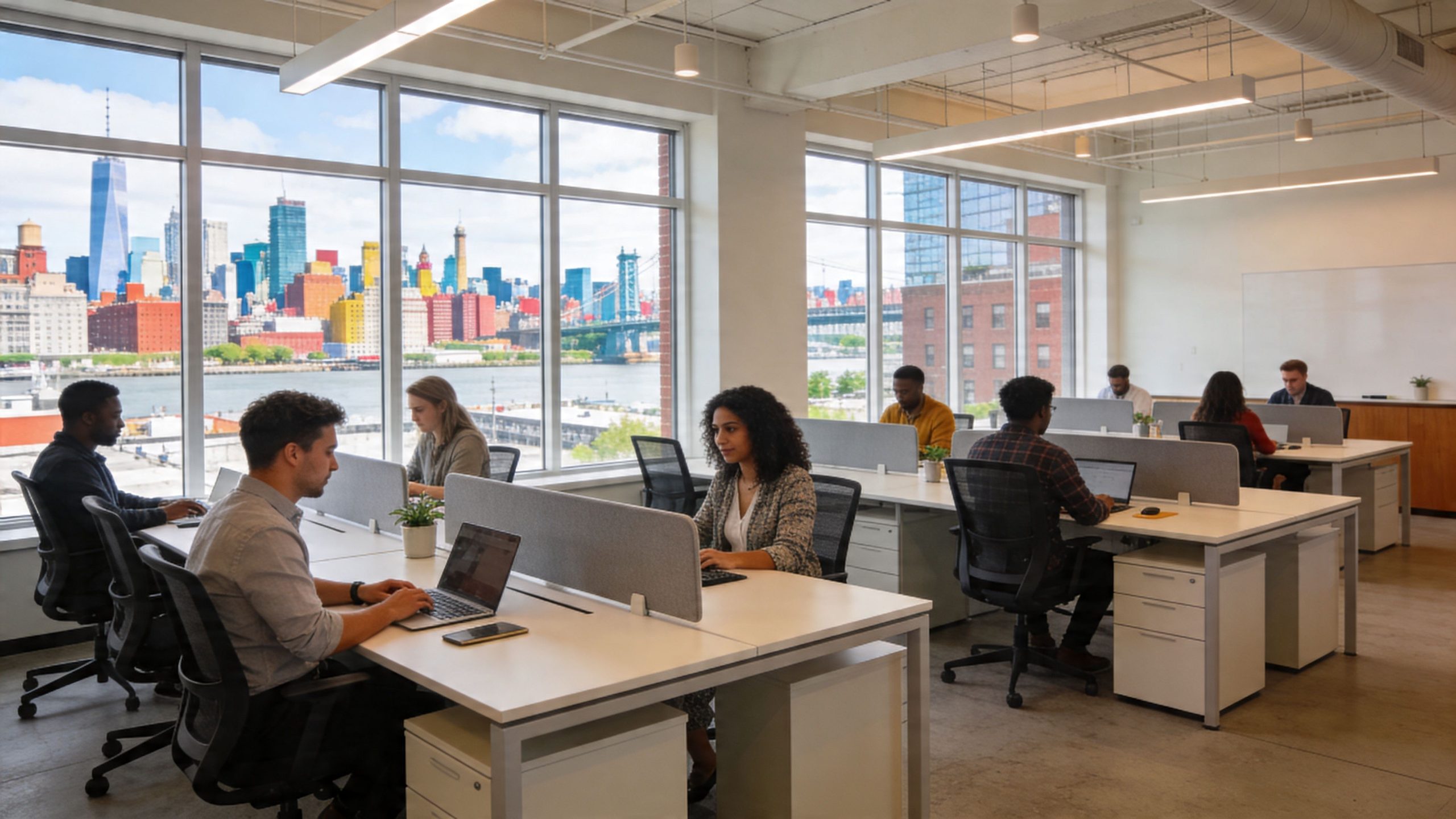
According to NJBIZ coverage of Mission 50’s rebrand, the property began a major transformation in early 2020 when JDA Group LLC CEO Greg Dell'Aquila launched a year-long initiative to rebrand and renovate the Hoboken Business Center into a unified Mission 50 community. That process ended with an official ribbon-cutting on June 24, 2021. The building is an 80,000-square-foot property at 50 Harrison Street in southwest Hoboken, and it evolved from a traditional office setting into a premium coworking community.
Why the rebrand matters
This wasn’t a cosmetic rename. The building had earlier roots as the Hoboken Business Center, originally developed in 2003 for small to mid-sized firms. In 2011, a 3,000-square-foot penthouse coworking space called the original Mission 50 was added for entrepreneurs, freelancers, and small businesses. The later rebrand brought the full property under one identity and repositioned it for modern flexible work.
That tells you exactly who Mission 50 is for:
- Small businesses that want a more polished base than a coffee shop
- Entrepreneurs who need flexibility without a traditional lease
- Teams that want meeting rooms, shared amenities, and a business address
- Remote professionals who need structure and separation from home
What kind of place it is
Mission 50 is best understood as a premium generalist workspace. That’s a compliment, not a criticism.
It offers the kind of environment many professionals want: refined, flexible, and superior to a basic coworking floor. If your workday is built around meetings, laptop work, client calls, and occasional collaboration, the concept makes sense. The brand is clearly designed around professional convenience and a community-driven office experience.
Bottom line: Mission 50 solved a business workspace problem. It did not set out to solve a production problem.
That distinction matters if you’re a creator, because a space that works beautifully for consulting or operations work may still fall short for audio and video capture.
Core Services and Amenities at Mission 50
This is why Mission 50 earns its reputation. For business use, the amenity package is strong and practical.
Mission 50 offers high-speed WiFi, unlimited printing, soundproof phone booths, and 24/7 access options, with hot-desk memberships starting at $475/month and private offices from $599/month, according to Mission 50 conference room and workspace information. That pricing structure puts it in the category of flexible professional workspace rather than casual drop-in coworking.
What works well for business users
If your day looks like email, Zoom, client meetings, admin work, and team coordination, the setup is solid.
A few highlights stand out:
- Private offices: Better for focus, privacy, and maintaining a business presence.
- Phone booths: Useful for sales calls, recruiter screens, or private conversations.
- Meeting rooms: Helpful when you need a client-ready environment instead of improvising in a café.
- Always-on access: Valuable for founders and operators who don’t keep standard hours.
Mission 50 also promotes conference rooms with business-oriented presentation features and hospitality touches. That matters if your goal is to run a workshop, host a planning session, or meet clients in a room that feels credible.
Where the framing starts to shift for creators
There’s a difference between a workspace that supports productivity and a room designed for capture.
A soundproof phone booth is not the same as an acoustically treated recording environment. A conference room with a big display is not automatically a usable set for long-form video. Fast internet is useful, but it doesn’t fix room echo, lighting inconsistency, or background interruptions.
If you’re evaluating space through a creator lens, it helps to understand the distinction between business amenities and production essentials. This breakdown of top podcast studio features creators in NJ should look for in 2025 is a better framework than a standard coworking checklist.
| Need | Mission 50 strength | Creator concern |
|---|---|---|
| Daily work | Strong | Good fit |
| Client meetings | Strong | Good fit |
| Private calls | Good | Limited for long recordings |
| Podcast recording | Unclear | Missing specialist setup |
| Video production | Unclear | Not built around controlled capture |
Coworking amenities help you run the business. They don’t automatically help you produce the media.
That’s the key filter to apply before you commit.
The Creator's Dilemma Can You Really Record a Podcast Here
Yes, you can record a podcast almost anywhere. That’s not the right standard.
The right question is whether the environment helps you produce content that sounds consistent, looks intentional, and reflects a premium brand. On that front, mission 50 hoboken has a clear limitation. Its rooms are built for professionals at work, not for creators in production mode.
The difference between quiet and record-ready
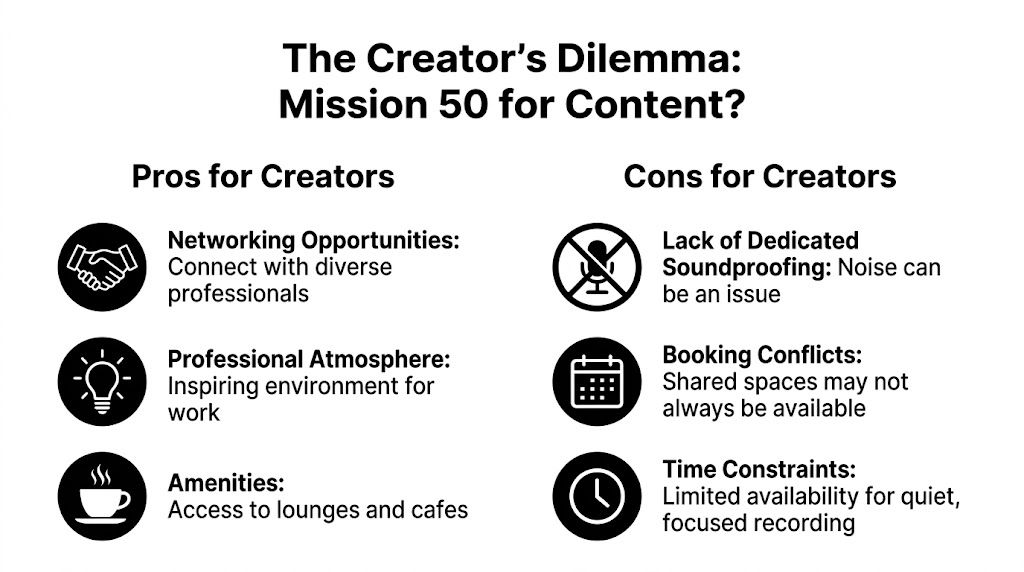
Mission 50’s meeting rooms include 85-inch Samsung whiteboards and air scrubbers, which are great for corporate presentations and in-person comfort. But existing coverage and reviews don’t mention acoustically treated rooms, professional audio equipment, or soundproofing beyond standard phone booths, which are exactly the features podcasters need for broadcast-quality output, as noted in this overview of Mission 50 Hoboken.
That gap is bigger than it sounds.
A creator doesn’t just need a room that feels calm. A creator needs control over:
- Room tone
- Echo and reflections
- Microphone placement
- Lighting consistency
- Visual framing
- Recording reliability across multiple episodes
A nice office can still ruin a great interview if the room rings, the HVAC is audible, the neighbor takes a loud call, or the framing looks like a borrowed boardroom.
What usually goes wrong
Creators often assume they can “make it work” in a coworking environment because the space looks elevated. But elevated isn’t the same as engineered.
You may run into practical problems like these:
- Audio bleed: Shared environments create unpredictable noise. Even when a room seems fine at first, the take can get compromised.
- Set limitations: Corporate rooms often look corporate on camera. That’s not ideal if you want a modern media brand.
- Gear gaps: If the space doesn’t provide production equipment, you’re carrying the burden yourself.
- Scheduling friction: Recording works best when timing, quiet, and setup are repeatable.
Practical rule: If you need to test the room before every episode, it’s not a dependable recording solution.
A lot of creators also underestimate the prep side. Even with a strong room, weak structure leads to weak episodes. If you’re tightening your process, these podcast script template resources are useful for organizing solo shows, interviews, and recurring segments before you ever hit record.
For a broader look at actual recording options, this guide on where to record a podcast in NJ is a more relevant decision tool than a standard coworking comparison.
The honest verdict
Mission 50 can work as a prep space. It can work as a place to write, plan, edit lightly, or take meetings around a content project.
It is not the place I’d recommend if your priority is high-quality podcast recording or polished video production. That’s not because it’s a bad workspace. It’s because it’s solving a different problem.
The Specialist Solution for Ambitious NJ Creators
When the content matters, general-purpose space stops being enough.
A specialist environment changes the workflow in ways creators feel immediately. You stop worrying about whether the room will behave. You stop patching together gear, hunting for quiet windows, and settling for visuals that look “fine for now.” Instead, you focus on delivery, storytelling, and consistency.

What a purpose-built studio solves
A proper production studio is designed around outcomes creators need:
- Clean audio without the unpredictability of a shared office
- Controlled lighting that flatters the host and keeps the look consistent
- Camera-ready sets that feel intentional on YouTube, clips, and branded assets
- Professional support when the creator doesn’t want to engineer every detail alone
That’s why serious podcasters, founders, and agency teams outgrow coworking as a recording solution. Business spaces support operations. Studios support output.
The package question creators should ask
A lot of people only think about the room. The room matters, but the service layer matters just as much.
If you’re producing at a high level, ask these questions:
Can someone help with production, not just provide space?
Many creators don’t need another empty room. They need workflow support, technical confidence, and someone who can keep the session moving.Can the content be repurposed efficiently?
One episode should feed clips, shorts, reels, visuals, and a cleaner publishing pipeline.Can the brand scale without adding chaos?
That’s where producer support and growth-focused packages become valuable.
For creators who want more than room rental, Flexwork’s service structure is built around that wider need. Its Content Day is $3000/day and includes 20 edited reels or 60 pro photos. Its podcast websites are $5000 plus hosting. Its Market, Manage & Produce My Podcast tier starts at $1500 per episode with a 20-episode growth commitment, based on the publisher brief provided for this article.
The cheapest place to record often becomes the most expensive place to fix.
That’s the part many creators learn late. If the footage needs heavy cleanup, the sound feels inconsistent, or the show never develops a usable visual identity, the savings disappear fast.
A sharper recommendation
If you need a place to work between meetings, Mission 50 is a credible local option.
If you need to build a show, a creator brand, or a repeatable media engine, choose a specialist studio and a team that understands production from capture through distribution. That’s the smarter investment for ambitious NJ creators.
How to Plan a High-Impact Content Day
Most creators waste studio time before they ever arrive. They show up with a loose idea, a few topics, and no shot list. The result is predictable. Too many takes, too little usable content, and no real system for repurposing.
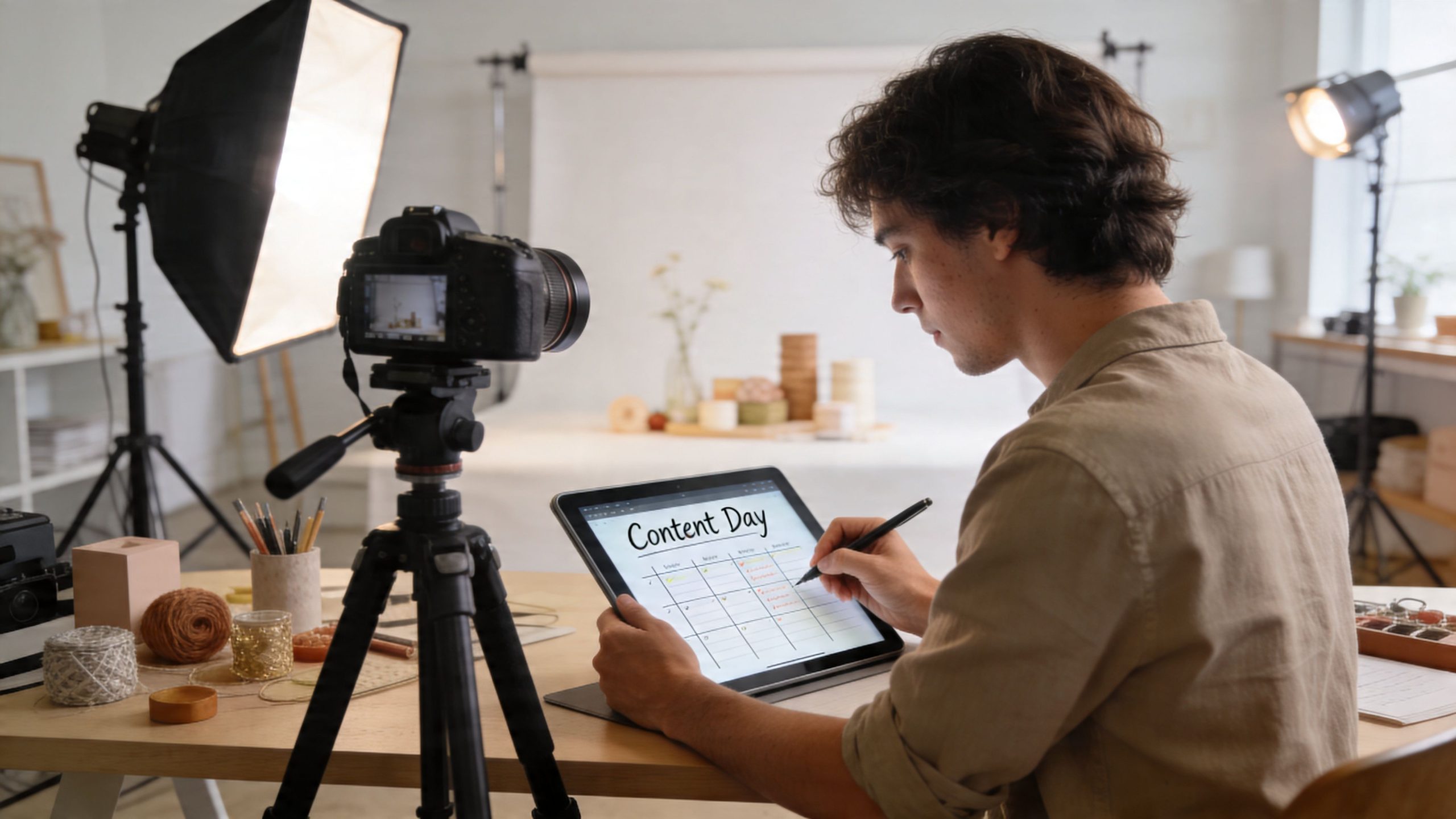
A strong Content Day fixes that by turning one session into a month of assets.
Start with three content pillars
Don’t plan around random inspiration. Plan around repeatable categories your audience already expects from you.
A practical setup looks like this:
- Authority content: Your strongest ideas, frameworks, opinions, or industry takes
- Trust content: Behind-the-scenes moments, founder perspective, lessons learned
- Conversion content: Direct answers to buyer questions, objections, and next steps
If your strategy feels fuzzy, this guide on Mastering Social Media and Content Strategy is a useful planning reference before you book time.
Build the day around outputs, not hours
The best production days are output-driven. Decide what must exist by the end of the session.
For example, you might want:
- One long-form podcast episode
- A batch of short-form clips
- Fresh branded photos
- A few direct-to-camera promos
- One landing-page video
That’s the logic behind a dedicated Content Day for podcasters. It pushes you to think in deliverables, not vague effort.
Prep what the camera will notice
Creators often over-focus on topics and ignore presentation. The camera notices everything you skipped.
Use a quick pre-flight checklist:
- Wardrobe: Bring options that fit your brand and won’t distract on video.
- Talking points: Outline the beats. Don’t memorize every sentence.
- Visual references: Know your set mood, examples, and framing preferences.
- Call to action: Decide what you want viewers or listeners to do next.
Great content days don’t feel rushed. They feel pre-decided.
That’s why professional environments outperform improvised ones. They let you execute the plan instead of rebuilding it on the fly.
Choose the Right Space for Your Creative Ambition
Mission 50 Hoboken is a smart workspace for professionals who need flexibility, polish, and a stronger alternative to working from home. For business operations, it makes sense.
For creators, the standard has to be higher. Your recording environment affects the sound, the visuals, the confidence of your delivery, and the way your audience reads your brand. A polished coworking space can support planning and admin. It usually won’t deliver the consistency serious media production demands.
Use mission 50 hoboken for what it does well. Don’t force it into a job it wasn’t designed to do. If your goal is a show that looks established and sounds credible from day one, choose a purpose-built production environment. This guide to choosing the best NJ podcast studio for your format is a strong next step before you book anything.
If you’re ready to stop compromising on audio, video, and brand presentation, book a tour with Flexwork Podcast Studios. It’s built for creators who want more than a desk and a meeting room. You’ll get a production-ready environment, experienced support, and clear options for studio rentals, Content Days, producer packages, and long-term podcast growth.