
10 Essential Podcast Interview Tips for a Flawless Show
 January 28, 202637 Minutes
In a saturated podcasting landscape, a compelling interview is your most powerful asset. For upwardly mobile creatives and entrepreneurs in the NJ/NY metro, it’s not just about asking questions—it's about crafting a memorable experience that captivates listeners and elevates your brand. Many creators struggle with generic conversations, awkward pacing, or subpar audio that undermines their authority. They invest hours in DIY setups only to produce content that fails to connect, missing the mark on creating a truly engaging show that reflects their professional standards.
This guide breaks down 10 essential podcast interview tips, moving beyond the basics to deliver actionable strategies for creating polished, professional conversations. We'll explore how to transform your interviews from standard Q&As into dynamic storytelling sessions, a process we specialize in at Flexwork Studios. Our professional spaces and production services empower creators to produce broadcast-quality content without the technical burnout. Get ready to learn the techniques that separate amateur podcasters from industry leaders and turn every guest appearance into an unforgettable episode.
1. Master Pre-Interview Research and Preparation
Showing up to a podcast interview unprepared is the fastest way to signal disrespect to your guest and bore your audience. Top-tier hosts don’t just wing it; they invest hours in meticulous research to uncover unique conversational threads. This deep-dive approach transforms a basic Q&A into a memorable, insightful dialogue. Mastering pre-interview preparation is a non-negotiable podcast interview tip that separates amateur content from professional-grade productions that build credibility and command attention.
The goal isn't just to learn about your guest’s career; it's to understand their perspective, recent talking points, and what they haven't been asked before. This foundation allows you to guide the conversation with confidence, ask smarter follow-up questions, and create a truly engaging experience that respects everyone's time.
How to Implement Pro-Level Research
- Create a Guest One-Sheet: At least 48 hours before recording, compile a one-page document with key details: bio, recent projects, notable quotes, and links to their work. This is your cheat sheet for the conversation.
- Listen to Their Past Appearances: Dedicate time to listening to 2-3 of their recent podcast interviews. Note the questions they are always asked, and brainstorm how you can approach those topics from a fresh angle.
- Set Up Google Alerts: Stay informed about any last-minute news or achievements by setting up alerts for your guest's name. This ensures your questions are timely and relevant.
- Schedule a Pre-Call: A brief 15-minute chat a week before the recording builds rapport and aligns expectations. This simple step can dramatically improve on-mic chemistry.
At Flexwork Studios, our Be My Podcast Producer package handles this entire process for you. Our team builds comprehensive guest dossiers, prepares insightful question outlines, and manages all pre-interview coordination, ensuring you can walk into our New Jersey studio focused solely on hosting a brilliant conversation.
2. Ask Open-Ended Questions Instead of Yes/No Questions
Nothing kills conversational momentum faster than a one-word answer. Asking a guest "Did you enjoy that project?" invites a simple "yes" or "no," effectively ending a potential story before it begins. Great interviewers build entire conversations around open-ended questions that demand detailed, narrative answers. This technique transforms a stiff interview into a natural, flowing dialogue, inviting your guest to share anecdotes and deeper insights that make for compelling content.
The goal is to shift from data-gathering to storytelling. Instead of asking questions that confirm facts, you should pose prompts that explore feelings, motivations, and experiences. Using phrases like "Tell me about…" or "What was going through your mind when…" is one of the most effective podcast interview tips for unlocking authentic, compelling content that keeps your audience captivated.
How to Implement Open-Ended Questioning
- Swap Closed Questions for Open Prompts: Review your question list. Replace any question that can be answered with "yes" or "no" with a "how," "why," or "what" question. For example, change "Was that a difficult decision?" to "What factors made that decision so challenging?"
- Use Curiosity-Driven Follow-Ups: When a guest gives an interesting but brief answer, don't move on. Use simple follow-ups like, "Tell me more about that," or "How did that feel?" to encourage them to expand.
- Embrace Strategic Silence: After you ask a powerful open-ended question, resist the urge to fill the silence. Giving your guest a few extra seconds to think often results in a more thoughtful and comprehensive response.
- Start Broad, Then Get Specific: Begin with a wide-angle question like, "Tell me about the moment you decided to start your company." Use their answer to guide you toward more specific, targeted follow-up questions.
At Flexwork Studios, our Market, Manage & Produce My Podcast package includes expert show-running and question development. We craft conversational arcs designed to pull the best stories from your guests, ensuring every episode recorded in our NJ studio is rich with engaging, memorable dialogue that drives audience growth. This tier starts at $1500 per episode with a 20-episode commitment.
3. Active Listening and Responsive Follow-Up Questions
A scripted interview feels rigid and predictable, while a truly great conversation is a dance of spontaneous discovery. The difference lies in active listening: the art of fully engaging with your guest’s words in real-time instead of just waiting for your turn to ask the next pre-written question. Acclaimed hosts have built loyal followings because they listen intently, creating a space for authentic, unscripted moments that audiences crave. This is one of the most vital podcast interview tips for elevating your show from a simple Q&A to a dynamic, human experience.
The goal isn't to abandon your questions, but to use them as a starting point. By truly hearing what your guest shares, you can ask responsive follow-up questions that probe deeper, clarify a point, or uncover an entirely new and fascinating story. This technique builds powerful rapport and signals to your guest that they are genuinely being heard, encouraging them to open up even more.
How to Practice Active Listening
- Jot Down Key Phrases: Keep a notepad handy to write down a specific word or phrase your guest uses. Referencing it later shows you’re paying close attention (e.g., “You mentioned feeling ‘untethered’ earlier, can you tell me more about that moment?”).
- Embrace the Pause: Don't rush to fill the silence. A brief pause after your guest finishes speaking gives you a moment to process their answer and formulate a thoughtful follow-up, rather than a reactive one.
- Use Verbal Affirmations: Simple cues like, “That’s fascinating,” or “Help me understand that better,” encourage your guest to elaborate and show you're engaged with their narrative.
- Maintain Digital Eye Contact: On a remote video call, looking into the camera when you listen makes your guest feel seen and connected, just as eye contact would in person.
When you're trying to manage audio levels, check cameras, and think about your next question, true active listening is nearly impossible. At Flexwork Studios, our producer-led sessions handle all technical aspects. This frees you to focus 100% on the conversation, ensuring you never miss an opportunity to capture a compelling, unexpected moment in our NJ studio.
4. Create a Comfortable Guest Environment and Build Rapport
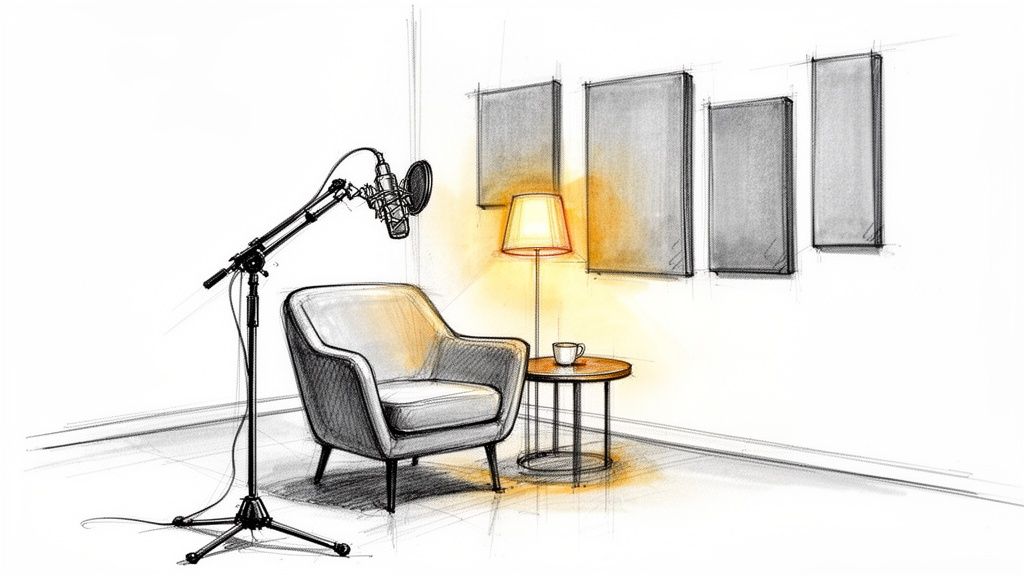
A sterile, intimidating, or uncomfortable recording space can make even the most seasoned guest clam up. The physical and emotional environment directly impacts your guest's openness, leading to either a stilted, guarded conversation or an authentic, memorable dialogue. Top hosts create a deliberately casual atmosphere, not just for aesthetics, but to disarm guests and encourage candidness. This is a critical podcast interview tip because a relaxed guest provides more genuine, engaging content.
The goal is to remove any friction that might distract your guest from the conversation. From the moment they arrive, every detail should communicate professionalism and care. This approach transforms a transactional recording session into a collaborative experience, fostering trust and making your guest feel like a valued partner, not just a content source.
How to Build a Welcoming Atmosphere
- Offer First-Class Hospitality: Greet your guest 15-20 minutes early. Offer them water, coffee, or a snack, and show them where the restroom is. These small gestures make a huge difference.
- Conduct a Conversational Sound Check: Instead of robotic "testing, 1-2-3" commands, use the sound check to chat casually. Ask about their trip to the studio or a recent project to warm them up.
- Set Clear Expectations: Briefly walk them through the episode's structure and estimated length. Knowing what to expect reduces anxiety and helps them settle in.
- Connect Before You Record: Spend a few minutes making small talk about non-interview topics. Compliment their work or a recent accomplishment to build genuine rapport before hitting record.
At Flexwork Studios, our New Jersey facilities are designed to impress and comfort. Our acoustically treated rooms and premium amenities ensure every guest feels at ease. When you book our Hourly Studio Rentals, you get more than a space; you get a professional environment that elevates the entire experience for you and your guest.
5. Master Pacing and Establish Clear Structure
A great podcast interview feels like a natural, flowing conversation, but the best ones are rarely completely spontaneous. Hosts who master pacing intentionally balance deep dives with a clear, guiding structure. This prevents conversations from meandering into dead ends or rushing past goldmines of insight. Establishing this rhythm is a critical podcast interview tip that respects the guest's expertise and holds the listener's attention from start to finish.
The goal is to create a reliable yet flexible framework that allows for spontaneity without sacrificing momentum. Knowing when to linger on an engaging story versus when to pivot to the next topic is what separates a good host from a legendary one. This skill ensures your interview has a compelling narrative arc, making it more memorable and much easier to edit in post-production.
How to Implement a Structured and Well-Paced Interview
- Create a Flexible Outline: At least 48 hours before recording, draft a simple outline with an intro (5 min), 3-4 core topic segments (15-20 min each), and a closing (5-10 min). Highlight the 2-3 "must-cover" points.
- Share a Topic Guide, Not a Script: Send your guest a high-level overview of the topics you plan to discuss. This helps them prepare their thoughts without making the conversation feel rehearsed. If you need help structuring this, our guide on how to write a podcast script offers a great starting point.
- Use Time Markers as Guideposts: Mentally note how much time you're spending on a topic. If a segment is sparking incredible energy and new insights, give it more room to breathe. If it feels circular, use one of your pre-planned pivot points to transition smoothly.
- Listen for Engagement Cues: Pay close attention to your guest's vocal energy and enthusiasm. When their passion is palpable, that's your signal to dig deeper. Trust your instincts; if you feel the energy dipping, your audience probably does too.
For podcasters in our Market, Manage & Produce My Podcast program, our producers craft these strategic outlines for every episode. We ensure your interviews are perfectly paced to capture the best content, which our editing team then refines to create a polished, engaging final product that keeps listeners hooked.
6. Use Strategic Silence and Pauses for Emphasis and Reflection
In a world filled with constant noise, one of the most powerful podcast interview tips is mastering the art of silence. Amateur hosts often rush to fill every dead second with filler words, fearing that a pause will be perceived as awkwardness. In reality, strategic silence is a hallmark of a confident, professional interviewer. Acclaimed hosts use it masterfully to create space for deeper reflection, add dramatic weight to a key point, and give listeners a moment to absorb complex information.
Embracing the pause transforms your interview from a rapid-fire Q&A into a thoughtful, resonant conversation. It signals to your guest that you are genuinely listening and encourages them to elaborate on their thoughts. This technique doesn't just improve the interview's depth; it also makes the final audio far cleaner and more impactful, demonstrating a level of polish that sets your podcast apart.
How to Implement Strategic Silence
- Practice the Two-Second Rule: After your guest finishes a thought, silently count to two before you respond. This simple habit prevents you from interrupting and often encourages the guest to add a valuable final insight.
- Identify Your Filler Words: Listen back to your recordings and make a note of your go-to filler words ("like," "you know," "right"). Consciously work on replacing them with a brief, silent pause.
- Embrace the Uncomfortable: Record yourself having a low-stakes conversation and intentionally hold pauses for 3-5 seconds. The more you practice, the more natural and comfortable it will feel during a real interview.
- Let the Guest Lead: When a guest trails off or pauses, resist the urge to jump in and rescue them. Give them the space to gather their thoughts; their next words are often the most profound.
At Flexwork Studios, our expert audio engineers are masters of post-production. As part of our Market, Manage & Produce My Podcast package, we meticulously edit out any remaining filler words and awkward pauses, ensuring your final episode has a clean, professional flow that captivates your audience from start to finish.
7. Tell Stories and Encourage Guest Narratives Over Data Dumps
Listeners remember stories, not statistics. The human brain is hardwired for narrative, making personal anecdotes and vivid experiences far more compelling than abstract data points. Hosts build immense loyalty by guiding guests away from generic answers and toward transformative personal stories. This approach turns a forgettable interview into an emotionally resonant experience that listeners connect with and share.
Prioritizing storytelling is a powerful podcast interview tip that creates memorable, impactful content. Instead of asking what your guest thinks, ask them to recount a specific moment. This shift from the conceptual to the concrete allows your audience to visualize the experience, feel the emotions, and absorb the lesson in a much deeper way. A single well-told story can define an entire episode.
How to Elicit Powerful Stories
- Use Narrative Prompts: Instead of asking, "What do you think about overcoming challenges?" ask, "Tell me about a time when you almost gave up. What happened?" This specific prompt forces a narrative response.
- Request Concrete Examples: When a guest makes a general statement, follow up with, "Can you give me a specific example of that?" This grounds their advice in real-world application.
- Listen for Story Arcs: Pay attention to the natural elements of a story: the setup, the conflict, the resolution, and the takeaway. Guide your guest through this arc with follow-ups like, "What happened next?" or "How did that make you feel?"
- Create Space for Reflection: Don't be afraid of a little silence. Give your guest a moment to recall details and emotions. Rushing them will only yield surface-level answers.
At Flexwork Studios, our Market, Manage & Produce My Podcast package includes post-production editing specifically designed to identify and highlight these powerful narrative moments. We create compelling social media clips from your best stories, ensuring your episode's most impactful content reaches the widest possible audience. To learn more, explore the art of storytelling in content creation.
8. Manage Your Technical Setup and Audio Quality
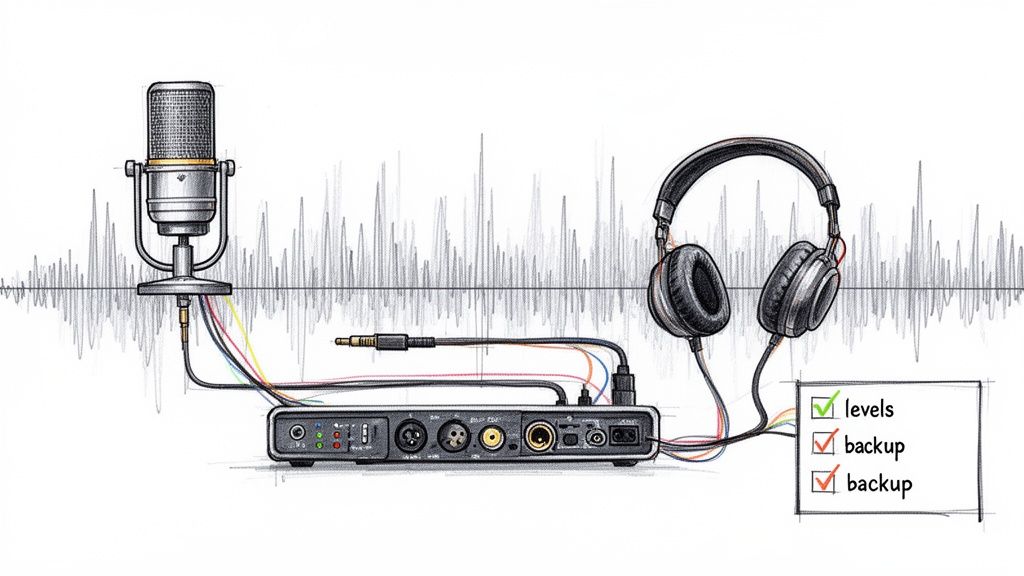
Even the most captivating conversation can be ruined by poor audio quality. Crackling, echo, and background noise are immediate turn-offs for listeners, signaling an amateur production and disrespecting your guest's time. Top-tier productions understand that pristine audio is non-negotiable. Managing your technical setup is a critical podcast interview tip that safeguards the quality of your content and protects your brand’s professional image.
Investing in the right gear and adopting a pre-flight checklist ensures your recordings sound clean, clear, and professional. This technical discipline prevents catastrophic failures and allows you to focus entirely on the conversation, confident that the final product will be polished and enjoyable for your audience.
How to Implement a Pro-Level Audio Setup
- Invest in Quality Microphones: Choose a microphone that suits your recording environment. Dynamic mics are excellent for minimizing room noise, while condenser mics capture rich detail in acoustically treated spaces.
- Master Mic Technique: Position the microphone 6-12 inches from the speaker's mouth and use a pop filter to eliminate harsh plosive sounds (like "p" and "b"). This simple adjustment dramatically improves vocal clarity.
- Always Monitor Your Audio: Wear headphones during the recording to catch issues like peaking, background hum, or connection problems in real-time. What you hear is what your audience will hear.
- Record Local Backups: Never rely on a single recording source, especially for remote interviews. Always have each participant record their audio locally as a high-quality backup in case the primary connection fails. For more on this, check out our guide on advanced recording techniques.
At Flexwork Studios, our broadcast-quality equipment and acoustically treated recording booths eliminate the technical burden entirely. We manage everything from microphone selection to audio engineering, ensuring your interview sounds flawless. Our Producer Packages provide access to the same high-end gear used by industry leaders, so you can focus on creating an incredible show.
9. Leverage Guest Networks and Booking Strategies for A-List Interviews
Your podcast's growth is directly tied to the caliber of your guests. Securing A-list talent isn't luck; it's the result of a deliberate, strategic booking process that builds credibility over time. Top shows masterfully mix world-renowned experts with emerging voices, creating a powerful guest ladder that continuously elevates the brand. This is a crucial podcast interview tip for hosts who want to transform their show from a niche hobby into an influential platform.
The core idea is to build momentum. You start by securing accessible experts in your field, which validates your show for future, higher-profile guests. Each successful interview becomes a stepping stone, providing social proof and content that makes your outreach to publicists and agents more compelling. This methodical approach is how you earn the interviews that break through the noise.
How to Implement a Pro-Level Booking Strategy
- Create a Professional Media Kit: Your media kit is your podcast's resume. It should include download statistics, audience demographics, past guest highlights, and a clear description of your show's value proposition.
- Request Guest Referrals: At the end of every great interview, ask your guest, "Who else do you think I should talk to?" A warm introduction is exponentially more effective than a cold email.
- Personalize Your Outreach: When contacting publicists or agents, demonstrate that you've done your research. Reference a specific aspect of their client's recent work and explain precisely why they are a perfect fit for your audience.
- Build Your Guest Ladder: Start with credible experts in your niche. Use those interviews to build your reputation, then progressively reach out to more established figures. This systematic approach makes landing top-tier guests an achievable goal.
At Flexwork Studios, our Market, Manage & Produce My Podcast package includes strategic guest booking as a core service. We leverage our curated network and industry relationships to secure compelling guests aligned with your brand, handling all outreach and coordination. To dive deeper into this process, explore our complete podcast guest booking strategy.
10. Repurpose Interview Content Across Multiple Formats and Platforms
Recording a great interview is only half the battle; ensuring it reaches the widest possible audience is where true growth happens. Smart hosts don’t just publish a single long-form episode and hope for the best. They treat each interview as a goldmine of content, strategically extracting clips, quotes, and ideas to share across multiple platforms. This approach transforms one recording session into a month's worth of marketing assets.
Maximizing your content's ROI is one of the most effective podcast interview tips for building a sustainable brand. By repurposing, you meet your audience where they are, whether on TikTok, LinkedIn, or their email inbox. This not only drives new listeners back to your full-length episodes but also creates a library of evergreen content that works for you long after the initial release. To significantly extend the life and reach of your interviews, exploring various content repurposing tools can provide invaluable support.
How to Implement Pro-Level Repurposing
- Identify "Golden Nugget" Moments: During the interview or edit, bookmark 3-5 of the most compelling moments. Look for surprising insights, emotional stories, or powerful, quotable soundbites that can stand alone.
- Create Short-Form Video Clips: Turn those golden nuggets into 15-60 second vertical video clips for Instagram Reels, TikTok, and YouTube Shorts. Add captions, as most users watch with the sound off.
- Develop Audiograms and Quote Graphics: For audio-only moments, create audiograms (a static image with an animated waveform) or visually appealing quote graphics. These are perfect for sharing on LinkedIn, Instagram, and Pinterest.
- Write a Companion Blog Post: Use the interview transcript to draft a blog post summarizing the key themes and takeaways. Embed the full episode player and include direct quotes to boost SEO and provide deeper value.
For creators looking for a streamlined, high-impact solution, our Content Day sessions are designed for maximum output. For $3000, you get a full day in our studio to record multiple episodes, resulting in either 20 professionally edited video reels or 60 high-resolution photos, providing a wealth of marketing material from a single booking. Discover how we can transform one episode into a dozen powerful marketing assets.
10-Point Podcast Interview Tips Comparison
| Practice | Implementation complexity | Resource requirements | Expected outcomes | Ideal use cases | Key advantages |
|---|---|---|---|---|---|
| Pre-Interview Research and Preparation | Medium–High — time-intensive preparation | Research time, background materials, brief docs, coordination | Focused, informed conversations; fewer basic questions | High-profile guests, deep-dive interviews, limited studio time | Authenticity, unique angles, efficient use of recording time |
| Ask Open-Ended Questions Instead of Yes/No Questions | Low–Medium — simple technique, needs practice | Question templates, host coaching, active listening | Longer, narrative responses and richer material | Personality-led shows, storytelling episodes | Greater engagement, quotable moments |
| Active Listening and Responsive Follow-Up Questions | Medium–High — requires host skill and agility | Note-taking, focus, host experience, possible coaching | Spontaneous insights, stronger guest rapport | Long-form interviews, emotionally nuanced topics | Authenticity, unexpected content discoveries |
| Create a Comfortable Guest Environment and Build Rapport | Medium — logistical and hospitality effort | Studio comfort, seating, hospitality, pre-call time | Relaxed, candid guest performances | First-time guests, sensitive conversations, in-person recordings | Better guest performance, higher return/recommendation rates |
| Master Pacing and Establish Clear Structure | High — judgment and real-time adjustment needed | Outlines, timing plan, editor support, host experience | Consistent episode flow; maintained listener attention | Time-limited episodes, multi-topic interviews | Focused episodes, easier post-production |
| Use Strategic Silence and Pauses for Emphasis and Reflection | Medium — practice to use silence effectively | Host discipline, editing to shape pauses | Deeper elaboration, dramatic emphasis, clearer answers | Thoughtful interviews, moments requiring reflection | Emphasis on key statements, reduced filler |
| Tell Stories and Encourage Guest Narratives Over Data Dumps | Medium — guide guests toward narrative | Story prompts, follow-ups, editorial selection | Memorable, emotionally resonant episodes | Personal journeys, lessons-learned formats | Increased shareability and listener connection |
| Manage Your Technical Setup and Audio Quality | Medium–High — equipment and skill required | Microphones, acoustics, monitoring, backup systems, engineers | Professional sound, fewer technical failures | Any published show, monetized podcasts | Credibility, platform-ready audio, sponsor readiness |
| Leverage Guest Networks and Booking Strategies for A-List Interviews | High — relationship-building and strategy | PR outreach, media kit, time, referral systems | Expanded reach, higher-profile bookings | Growth-focused podcasts seeking rapid audience gains | Audience expansion, sponsorship and credibility boost |
| Repurpose Interview Content Across Multiple Formats and Platforms | Medium–High — additional production workflow | Editors, video/motion graphics, copywriters, content calendar | Extended reach, traffic to full episodes, evergreen assets | Marketing-driven shows, cross-platform growth strategies | Maximized ROI per episode, multi-platform exposure |
Elevate Your Interviews with a Professional Partner
Mastering the art of the interview isn’t a one-time achievement; it’s a continuous cycle of refinement. We've explored the foundational elements of a remarkable show—from meticulous research and strategic questioning to the subtle power of active listening and creating a welcoming environment. These aren’t just abstract concepts; they are the tangible practices that transform a simple Q&A into a compelling narrative that captivates your audience and elevates your personal brand.
However, inconsistent content quality, DIY burnout, and limited audience reach are common roadblocks for even the most ambitious creators. The most brilliant interview can be lost to poor audio or a clunky edit, while a great recording can fail to find its audience without a solid promotion strategy. Consistently applying these strategies, from your on-mic technique to your post-production and promotional efforts, is where the real work—and the real challenge—begins.
This is where a strategic partner becomes invaluable. At Flexwork Studios, we provide the premium infrastructure and expert support that allow you to step into the role of a professional host, confident that every technical detail is handled. Our "Be My Podcast Producer" package offers a comprehensive solution, handling recording, editing, and visual storytelling to turn your interviews into high-end video content and shareable social media clips. For those committed to sustained growth, our "Market, Manage & Produce My Podcast" package (starting at $1500 per episode) provides a full-service production engine designed to build your audience and influence.
Stop letting logistics limit your vision. It's time to transform your podcast from a passion project into a polished, professional media asset that commands attention and respect.
Ready to unlock your podcast's true potential? Move beyond the limitations of your home setup and partner with Flexwork Podcast Studios to produce broadcast-quality interviews that build your brand. Explore our full-service production packages or book a tour of our state-of-the-art facility today to see how we can become your partner in podcasting excellence. Learn more at Flexwork Podcast Studios.