

How to Improve Audio Quality and Sound Like a Pro Podcaster
 February 1, 202625 Minutes
Let's be honest. We've all done it. You tap 'play' on a podcast that looks incredible, but the moment you hear that distracting room echo, buzzing mic, or inconsistent volume, you're out. Gone in thirty seconds. In a world saturated with content, poor audio quality is an instant dealbreaker, signaling to your audience that your brand isn't ready for the main stage.
Your audio is more than a technical detail; it's your brand's first impression. It's the handshake that tells a new listener you're a professional who respects their time. Bad audio immediately creates a barrier, making your message sound less credible before it's even heard. At Flexwork Studios, we see ambitious creators and entrepreneurs from across New Jersey who understand this truth: investing in broadcast-quality sound isn't an expense—it's a direct investment in your brand's authority and growth. This guide will show you how to elevate your sound, from foundational DIY tips to professional studio solutions.
The Hidden Cost of "Good Enough" Audio
When your sound quality is subpar, you're doing more than just losing a few listeners. You're creating friction. You're forcing your audience to strain to hear you, leading to listener fatigue and eventual abandonment. Every hiss, pop, and echo is another reason for them to stop listening and move on to a competitor with a more polished presentation. This perception of inexperience can undermine your authority and stall your growth.
Think of it this way: clear, crisp audio builds an instant bond of trust. It communicates a standard of excellence and tells your audience you take your craft seriously. This is the invisible thread that holds their attention and solidifies your professional reputation.
The numbers don't lie. Data shows 34% of Americans are tuning into an average of 8.3 podcast episodes a week, with a whopping 83% listening for over 9 hours weekly. But that engagement comes with a high bar for quality. If you want to dig deeper, the full research on why audio quality matters is pretty eye-opening.
Mastering Your Recording Environment and Gear
Let's get one thing straight: great audio isn't born in post-production. It's captured at the source. Before you even think about editing software, your focus must be on your recording space and the gear you're using. These two elements are the absolute bedrock of professional sound.
Many creators fall into the trap of believing an expensive microphone is the silver bullet. While a quality mic is important, even a $1,000 microphone will sound amateur in a room filled with echo and background noise. The hard truth? Your recording space is your most important piece of equipment.
Taming Your Recording Space
You don't need a custom-built, soundproofed studio to get started. What you do need is to control your acoustic environment. Hard, flat surfaces—bare walls, hardwood floors, windows—are the enemy. They bounce sound waves around, creating distracting echo that instantly signals an amateur production.
Your mission is simple: absorb those rogue reflections. Here are a few effective ways to treat your space:
- Go small and soft. A walk-in closet is the classic DIY recording booth for a reason. All that clothing is a natural sound dampener. A small, carpeted room is your next best bet.
- Bring in soft materials. Use extra blankets, pillows, or even a spare mattress to cover bare walls. The thicker and denser the material, the more sound it will absorb.
- Optimize mic placement. Face your microphone away from hard surfaces and toward an absorptive area, like an open closet or a wall covered with a heavy comforter.
If you’re wondering why this matters so much, just look at how quickly a listener bails on bad audio. It’s not a slow burn; it's an instant dealbreaker.
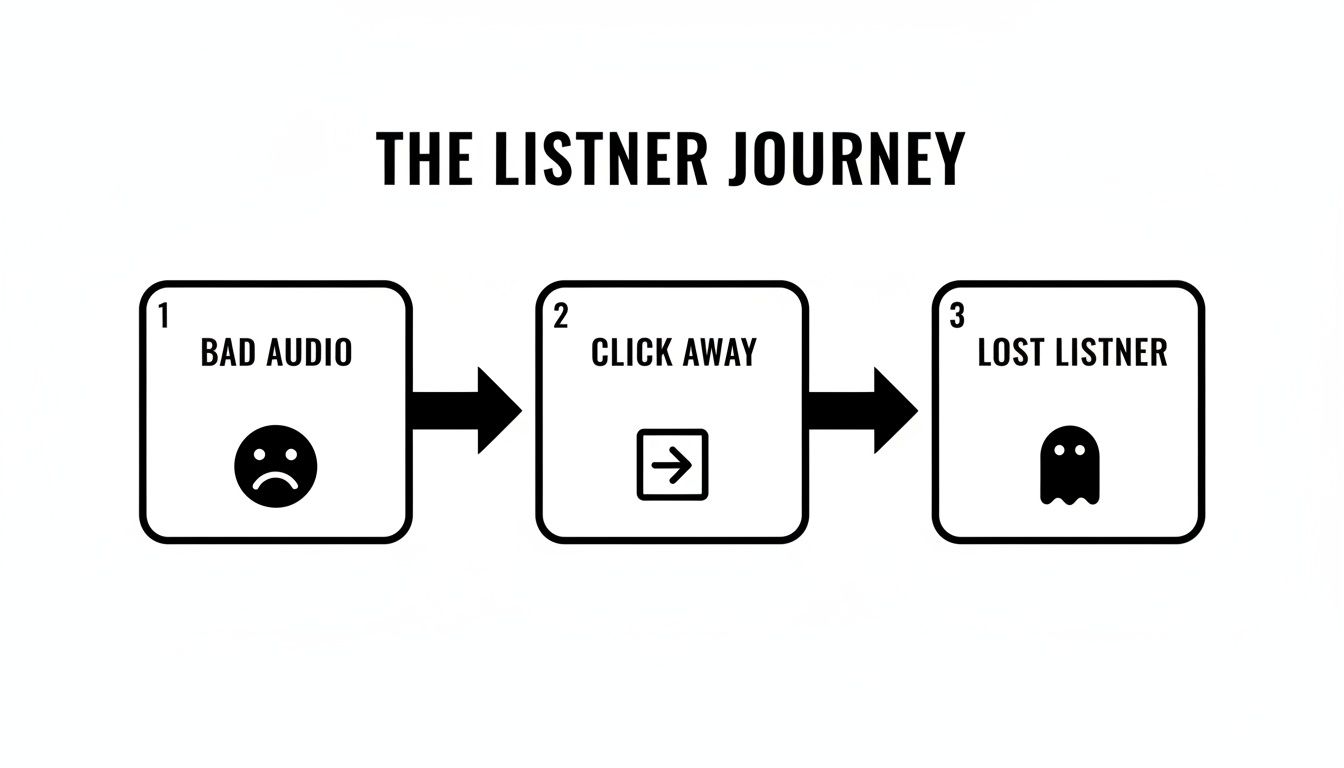
That’s a one-way ticket to a lost follower, and it happens in seconds. This is why getting your sound right from the jump is non-negotiable.
Getting the Right Gear for the Job
Once you've wrangled your room into shape, it's time to talk gear. This isn't about spending the most money; it's about making smart choices that work with your environment, not against it.
A little planning goes a long way. Before you splurge, it helps to understand what makes the biggest difference. Here's a quick look at where to focus your budget for the best bang for your buck.
Key Gear Investments for Better Audio
| Equipment | Good (DIY Setup) | Better (Professional Standard) | Why It Matters |
|---|---|---|---|
| Microphone | Quality USB Mic (e.g., Blue Yeti, AT2020) | XLR Dynamic/Condenser Mic (e.g., Shure SM7B, Rode NT1) | An XLR setup offers superior noise rejection, clarity, and flexibility for future upgrades. |
| Interface | Direct USB Connection | Audio Interface (e.g., Focusrite Scarlett 2i2, Universal Audio Apollo) | Provides cleaner preamps for better gain, phantom power for condenser mics, and pro monitoring options. |
| Headphones | Any closed-back headphones | Studio Monitoring Headphones (e.g., Sony MDR-7506, Beyerdynamic DT 770) | Accurate monitoring headphones let you hear exactly what's being recorded, flaws and all, without sound leaking into the mic. |
| Accessories | Desktop stand, built-in filter | Boom Arm, Pop Filter, Shock Mount | A boom arm allows perfect mic placement, while a pop filter and shock mount eliminate plosives and handling noise for a pristine take. |
Choosing wisely here means you won't have to fight your equipment later. Each piece plays a critical role in capturing clean, professional audio from the start.
Interestingly, industry data shows that 42% of podcasters use dynamic microphones, which are fantastic at rejecting background noise—making them a savvy choice for less-than-perfect home studios.
Here's the most important takeaway: Over 70% of podcasters record while wearing headphones. This isn't optional; it's a fundamental best practice. Monitoring your audio in real-time is the only way to catch problems like clipping, plosives ("p" and "b" sounds), or the neighbor's dog barking as they happen, not hours later when you're stuck with a ruined take.
Learning your gear is just as crucial as owning it. A simple pop filter, for example, is a cheap accessory that stops those harsh bursts of air from ruining your recording. And mastering gain staging—setting your input level loud enough to be clear but not so loud that it distorts—is the skill that truly separates clean audio from a digital garbage fire. If you really want to level up, diving into the techniques in this professional voice over guide will give you a huge leg up.
But even with the best DIY efforts, you can hit a wall. That subtle room tone, the inconsistent absorption, the rumble of a truck driving by—these things can still sneak their way into your final product.
This is where a professionally designed space changes the game entirely. Curious about what goes into a truly flawless recording environment? Take an insider's look at what makes a great podcast studio. A purpose-built, acoustically treated studio eliminates all those environmental headaches, giving you a perfectly silent canvas to capture every word with stunning clarity.
The Magic of Post-Production: Polishing Your Sound
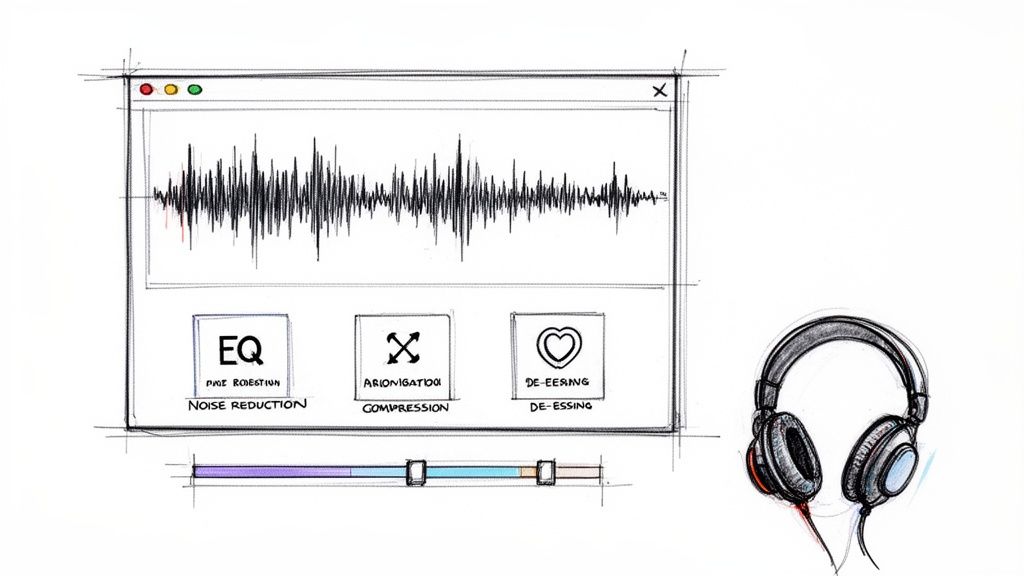
Let's be real: nailing your recording at the source is job number one. But even the cleanest audio is just the beginning of the story. Post-production is where you take that raw clay and sculpt it into a masterpiece. This is where the real audio magic happens.
This whole process, which pros call "mixing," can sound pretty technical and intimidating. Don't sweat it. It really just boils down to a few key moves that transform your recording from "good enough" into something truly professional and a joy to listen to.
Banish the Buzz with Noise Reduction
The first thing any pro does is clean up the track. No matter how quiet your room is, there's always something—the low hum of your air conditioner, the whir of a computer fan, a faint electrical buzz you didn't even notice. These little gremlins might seem minor, but they create a subtle static that can wear a listener out over time.
Noise reduction tools are designed to hunt down and eliminate that ambient "room tone" without messing with your voice. The golden rule here? Less is more. Go too hard on the noise reduction, and you'll end up with a robotic, watery sound that's arguably worse than the original hum.
Getting a handle on these environmental distractions is a huge part of sounding professional. For a deep dive, check out this excellent guide on removing background noise from audio to really nail the process.
Carve Out Clarity and Warmth with EQ
Once your audio is squeaky clean, it's time to shape its personality with an equalizer (EQ). Think of an EQ as a super-powered set of tone controls. It lets you surgically boost or cut specific frequencies to make your voice pop.
A classic move is to gently cut everything below 80-100 Hz. This is where muddy, rumbly sounds live, and getting rid of them instantly cleans up your vocal. Then, you might add a little bump in the mid-range (around 2-5 kHz) to make your words clearer and more present. A tiny bit of high-end "air" can add some sparkle, but be careful—too much and things get harsh, fast.
The point of EQ isn't to make you sound like someone else. It’s about enhancing the best parts of your own voice to give it that rich, warm, professional finish.
Tame the Volume Spikes with Compression
Ever found yourself constantly fiddling with the volume knob while listening to a podcast? One second the host is whispering, the next they're laughing their head off, and you're scrambling to adjust. That's exactly what a compressor fixes.
A compressor is basically an automatic volume-leveler. It squashes down the loudest parts of your audio, which then lets you turn the whole thing up without any one part being deafening. The result? A beautifully consistent and balanced sound. Your quietest asides are perfectly audible, and your biggest laughs won't send your listeners diving for cover.
This is one of the biggest secrets to that smooth, "radio-ready" sound. It makes for a much more pleasant, hands-free experience for your audience.
Smooth Out the Sizzle with a De-Esser
Finally, let's talk about sibilance. You know those sharp, piercing "s" and "t" sounds that can feel like a tiny ice pick in your ear? That’s sibilance, and some voices and mics are more prone to it than others.
A de-esser is a special tool that zones in on just those frequencies and turns them down. Like everything else, a gentle touch is all you need. You're just trying to soften those harsh edges so they blend in, not get rid of the "s" sound completely. It's the final coat of polish that makes your audio crisp without being painful.
These four pillars—noise reduction, EQ, compression, and de-essing—are the foundation of any great mix. It takes some practice, but it's a skill that will pay you back tenfold.
Let AI Handle the Final Polish
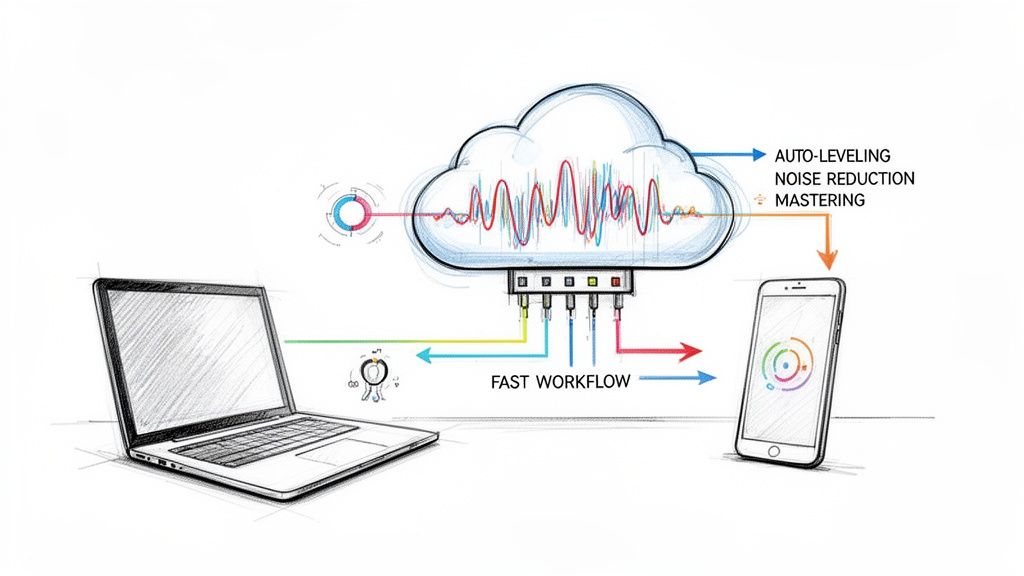
Alright, you've recorded, you've edited, you've snipped out every "um" and awkward pause. You're almost there. The final step that separates the amateurs from the pros is mastering.
Not too long ago, this was a mystical art form, a secret handshake between audio engineers with ridiculously expensive gear. But now? Technology has brought that power to the rest of us. These tools are the ultimate cheat code for getting that professional, broadcast-ready sound.
What Automated Mastering Actually Does
Services like Auphonic have become a lifeline for podcasters who want top-tier quality without spending hours tweaking endless settings. You just feed it your final mix, and it works its magic.
So, what’s happening under the hood?
- Intelligent Leveling: It listens to your whole episode and evens everything out. No more blasting your listener's eardrums when one guest gets excited or making them strain to hear a softer speaker.
- Loudness Normalization: This is a big one. It makes sure your podcast meets the loudness standards (measured in LUFS) for platforms like Spotify and Apple Podcasts. This is key to making sure your show sounds just as loud and present as the big-name productions.
- Adaptive Noise Reduction: The AI is smart enough to find and gently remove that low-level air conditioner hum or computer fan noise you didn't even notice was there, giving your audio a final, clean sheen.
This isn't just about convenience; it's a massive strategic edge. In fact, a whopping 57% of podcasters are already using AI tools in their production workflow. It's the new standard for a reason.
The Golden Rule: Garbage In, Gospel Out
Now for a dose of reality. These tools are finishers, not miracle workers. They're designed to take something good and make it great.
Here’s the one rule in audio that never, ever changes: Garbage In, Garbage Out. An AI mastering tool can’t fix a recording that's full of echo. It can’t edit out a dog barking mid-sentence. And it definitely can’t repair audio that was recorded too loud and is now a distorted mess.
It simply polishes what you give it.
This is exactly why the smartest path to incredible sound is a two-step combo. First, nail the recording. Get clean, crisp, beautiful audio from the very start by recording in a great space. Then, run that pristine recording through a smart mastering tool for the final broadcast polish.
That's the secret sauce. You get that rich, full sound that grabs a listener's attention and makes your brand sound legit. By starting with a flawless recording from a place like Flexwork, you give these amazing tools the best possible raw material, guaranteeing a stunning result every single time. And if you're looking to build out your software stack, we’ve put together a list of the best tools for content creators that perfectly complement a professional recording setup.
When to Ditch the DIY Grind and Go Pro
You’ve watched every tutorial, stuffed your closet with blankets, and spent more hours tweaking EQ settings than you care to admit. You’ve wrestled with your audio and, for the most part, won. But now you’re up against a new enemy: the clock. For an ambitious creative or entrepreneur, your time is your most valuable asset. Every hour you spend hunting down a background hum is an hour you aren't spending on what actually grows your brand—creating brilliant content, connecting with your audience, or building your business.
The DIY path is excellent for getting started, but it has a ceiling. Eventually, you hit a point where squeezing out that next 10% of quality costs you 100% more effort. This is the moment you realize your job is to craft the message, not obsess over the mix. This isn't failure; it's growth. It’s a sign that you're ready for the next level.
The Flexwork Solution: Your Strategic Upgrade
At Flexwork Studios, we’ve built our entire business around helping creators like you smash through that quality ceiling and reclaim your time. We offer more than just fancy microphones; we provide a seamless, professional workflow that elevates your entire brand.
Here’s how our packages meet you where you are:
- Instant Environment Perfection: Our Hourly Studio Rentals are the fastest way to solve your biggest audio headache: a bad room. Walk into our acoustically treated studios in Springfield, NJ, and capture pristine, broadcast-quality audio from the start, saving hours in post-production.
- Effortless Post-Production: For creators who love recording but dread the edit, our “Be My Podcast Producer” package is the answer. You send us your raw audio, and our expert team handles the mixing, mastering, and music integration, delivering a polished episode ready for the world.
- A Complete Growth Engine: When your podcast is a central pillar of your business, our “Market, Manage & Produce My Podcast” package is the ultimate all-in-one solution. Starting at $1500 per episode (with a 20-episode commitment), we become your strategic partner, handling everything from production to distribution and targeted marketing to build a world-class show and a dedicated audience.
Making the leap to professional production is a smart business decision. Want to see the numbers behind it? Our breakdown of studio versus DIY podcasting shows how a pro partnership can accelerate your growth.
Your Voice, Your Brand Authority
Ultimately, mastering your audio quality is about far more than technical tweaks. It's a direct investment in your brand's authority. It’s the handshake that tells your audience you respect their time and value their attention. While bad audio is an instant turn-off, truly great audio builds an immediate sense of trust and professionalism, making listeners far more likely to subscribe and engage with your message.
You can absolutely make huge strides on your own. But if you want to skip the learning curve and get straight to elite, broadcast-ready sound that makes people stop scrolling and listen, partnering with a professional studio is the definitive move. It separates serious creators from hobbyists.
Stop letting technical headaches hold you back. Stop fighting with room echo and losing weekends to post-production. Instead, put that energy where it belongs: crafting a killer message that connects with your audience. To see how top-tier audio fits into the bigger picture, check out our guide on how to brand your business.
Let us handle the audio perfection.