

10 Content Repurposing Strategies for Podcasters
 April 10, 202652 Minutes
Meta description: Turn one episode into weeks of assets with 10 practical content repurposing strategies for podcasters, plus a Flexwork execution plan.
URL slug: /content-repurposing-strategies-podcasters
Primary keyword: content repurposing strategies
Secondary keywords: podcast content repurposing, repurpose podcast episodes, podcast marketing strategy
You’ve just recorded a fantastic episode. The guest was sharp, the conversation moved, and the audio and video came out clean. Then the session ends, the files land in a folder, and the pressure starts. Now you have to promote it, slice it up, write about it, post it, email it, and somehow keep next week’s episode on track too.
Many creators stall at this point. They do the hardest part, recording something worth watching, then lose momentum because distribution becomes a second full-time job. The result is familiar. Inconsistent posting. Random clips. A blog that never gets updated. A great show that feels smaller than it should.
Strong content repurposing strategies fix that. They turn one recording into a system. Instead of asking, “What should I post today?” you ask, “How many useful assets can this episode produce?” That shift matters. A ReferralRock survey found that 94% of marketers already repurpose content, 6% plan to start soon, and 0% say they have no plans to do so, a sign that repurposing is now standard practice, not a side tactic (content repurposing statistics roundup).
At Flexwork Studios, that is the difference we see in the shows that grow. The strongest clients are not only recording episodes. They are building repeatable content engines around those episodes. With production support like the all-inclusive Market, Manage & Produce My Podcast service, starting at $1500 per episode with a 20-episode growth commitment, Flexwork turns a single studio session into edited video, motion graphics, distribution assets, and a sharper brand presence. If you want your show to look premium and market like a real media property, these ten strategies offer a strong starting point.
1. Podcast Episode Atomization into Short-Form Content
A full episode usually contains more usable moments than most hosts think. Not just the obvious punchy quote, but a challenge, a story turn, a surprising opinion, a clean how-to, a reaction shot, a quick disagreement. Those are your short-form assets.
This is one of the most practical content repurposing strategies because it meets audiences where they already spend time. Some people will never start with your full episode. They discover you through a reel, a short, or a tight vertical clip that earns attention fast.
Build clips around moments, not timestamps
Do not cut at random intervals. Cut around complete thoughts.
A better workflow looks like this:
- Pull the hook first: Find the strongest opening line from the moment and move it to the front if needed.
- Keep one idea per clip: If the segment covers three ideas, split it.
- Add context on screen: Many viewers watch muted first. Use captions and a headline that makes the takeaway clear.
- End with a direction: Point viewers to the full episode, your profile, or the next clip in a series.
If you want your edits to feel polished instead of homemade, a consistent visual system matters. Branded captions, lower-thirds, framing, and color treatment do a lot of heavy lifting. Flexwork’s Content Day sessions are built for this style of output. At $3000 per day, they include 20 edited reels or 60 pro photos, which is enough to turn one focused recording day into a meaningful social library.
Short-form works best when it creates curiosity, not when it tries to summarize the entire episode.
What works and what falls flat
Joe Rogan, Andrew Huberman, and creators like Hank Green all benefit from selective clipping because they isolate one high-interest idea at a time. What fails is the lazy version: a random sixty-second excerpt with no hook, no headline, and no platform-specific pacing rarely moves.
Use editing tools that make reviewing and cutting faster, then standardize your output. Flexwork has a useful breakdown of best video editing software if you are refining your stack.
2. Transcription-to-Blog Article Conversion
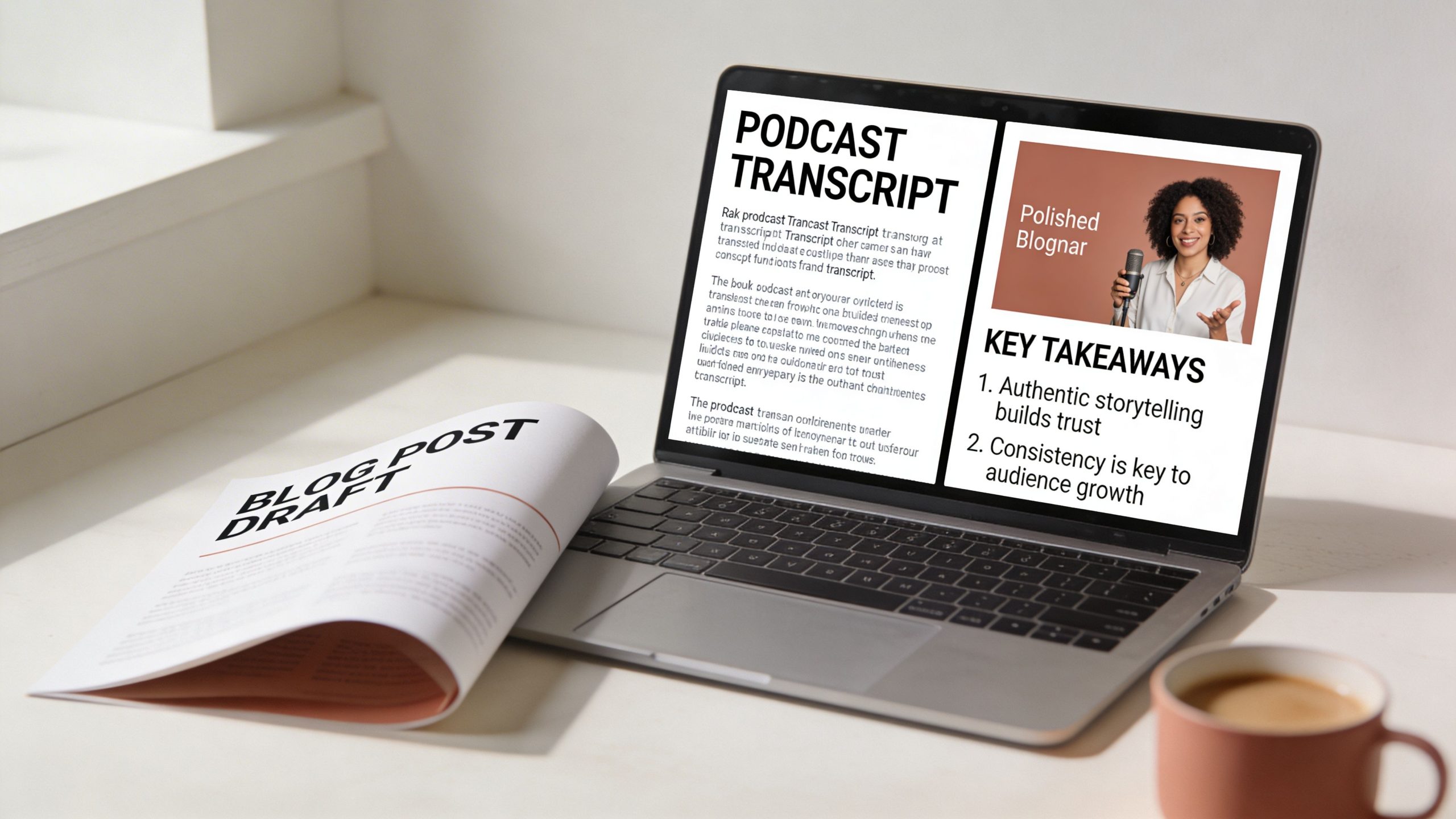
You record a strong episode, export the transcript, publish it, and expect search traffic to follow. Then the page sits there. Few clicks, weak time on page, and no real conversion path.
The problem is format. A transcript captures what was said. A blog article has to organize what matters, answer a clear question, and guide the reader toward the next step.
Build an article from the insight, not the recording
The strongest podcast-to-blog workflows start with editorial judgment. Pull the transcript into Descript or Otter.ai, read for tension, and choose one angle that deserves its own post. If the conversation wandered through pricing, hiring, and burnout, split them. One article should solve one problem well.
A practical process looks like this:
- Mark the core claim: Identify the sentence you would use as the headline or subhead.
- Pull supporting proof: Highlight the guest stories, examples, and frameworks that reinforce that claim.
- Restructure for reading: Move ideas into a logical order instead of preserving the sequence of the conversation.
- Rewrite spoken language: Cut throat-clearing, repetition, tangents, and incomplete thoughts.
- Add strategic context: Explain where the advice works, where it breaks, and who should ignore it.
- Create conversion paths: Link to the episode, a related article, and the offer that matches the topic.
That last step is where many creator teams lose value. They publish the article as a recap, not as an asset. A good repurposed post should rank, build trust, and move readers deeper into your ecosystem.
The trade-off is speed versus usefulness
Publishing raw transcripts is faster. It also creates thin pages that read like unedited speech. Readers skim, bounce, and leave without taking action.
Edited articles take more work, but they give each episode a second life in search and a cleaner format for sponsors, clients, and partners who prefer to read. I have found that the best-performing posts usually sound less like a transcript and more like a sharp point of view shaped from the conversation.
This is also where production planning matters. If you know an episode is going to feed search, record it with clean structure from the start. A session produced in a professional video podcast studio for multi-format content production gives you stronger source material, cleaner audio for transcription, and fewer editing headaches later.
Map the article to a real distribution system
One episode can produce a blog post, but one blog post should also produce supporting assets. Pull the subheads into LinkedIn posts. Turn the strongest quote into email copy. Use the FAQ section for search-focused updates later. That is the execution playbook. One source, multiple outputs, all tied to the same strategic angle.
For Flexwork clients, the website is the operational layer that holds this together. A podcast website built by Flexwork starts at $5000 plus hosting. It gives your repurposed articles a branded home, a searchable archive, and a place to connect every post back to your show, services, and lead flow.
Track this strategy with a few simple KPIs: organic entrances to episode-derived articles, average engagement time, click-throughs to the full episode, and conversions from article CTAs. Those numbers tell you whether your transcript workflow is producing content or producing outcomes.
3. Video Podcast to YouTube Long-Form Channel
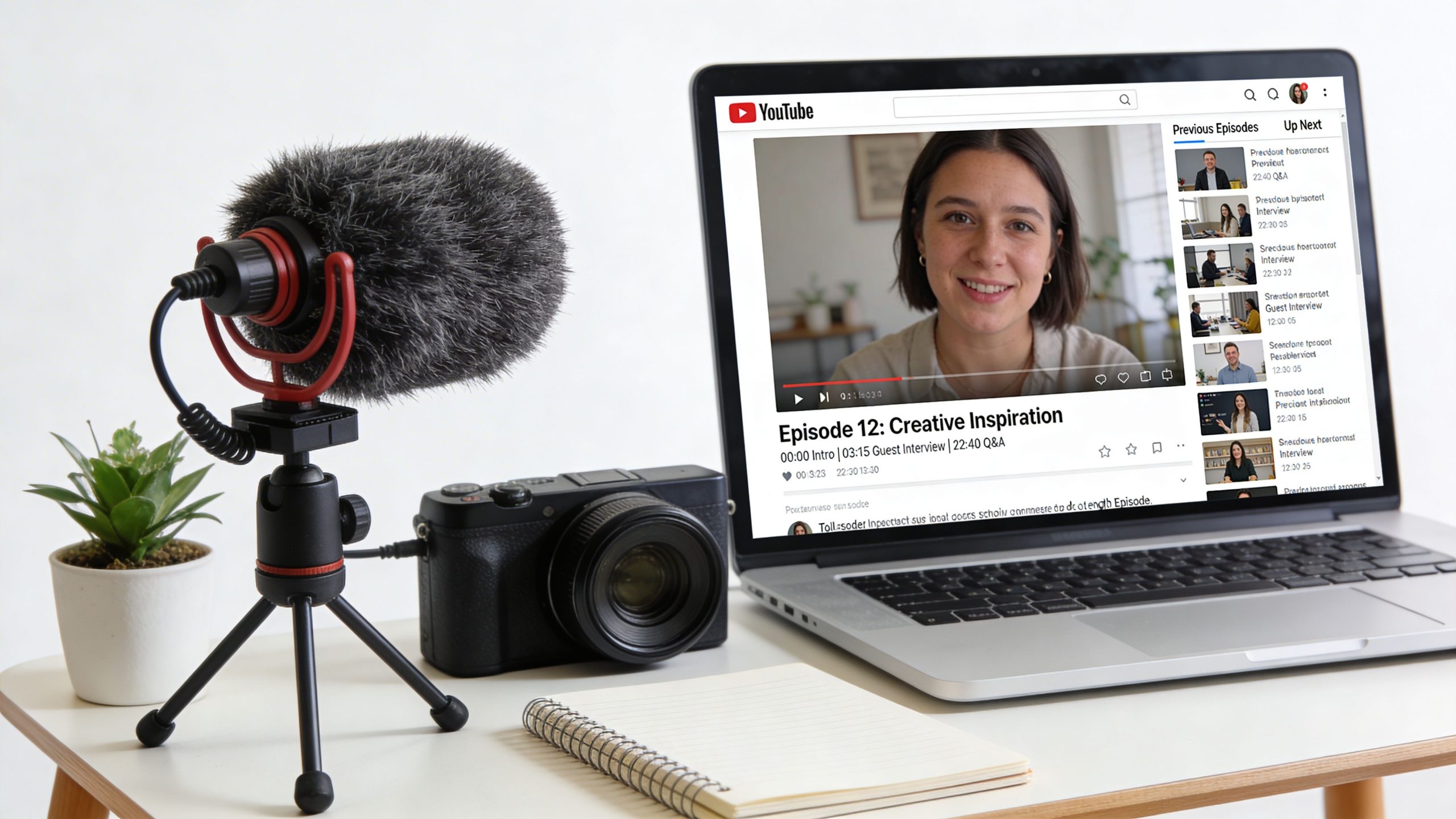
A founder records a strong interview, posts the full video to YouTube, and gets almost no traction. The episode was good. The channel setup was not.
YouTube rewards channels that feel programmed, packaged, and easy to keep watching. A video podcast can fill that role if each episode is produced for long-form viewing instead of treated like an archived recording. This strategy turns a single show into a searchable content library, a credibility asset, and a discovery engine that keeps working between launches.
Build the channel like a viewing product
Viewers decide fast. Before they hear the guest’s best point, they notice lighting, framing, pacing, and whether the title promises a clear payoff.
That is why the production workflow matters upstream. A dedicated video podcast studio gives you cleaner footage, controlled sound, and multi-camera coverage that holds attention over a full episode. Those details raise retention, and retention is what gives long-form YouTube a chance to spread.
Then execute the channel setup with intent:
- Title for the outcome: Lead with the question answered, problem solved, or idea challenged.
- Design thumbnails at series level: Keep a repeatable look so the channel feels connected, not random.
- Open with momentum: Cut long intros. Start with tension, a surprising claim, or the sharpest moment from the conversation.
- Add chapters and timestamps: They improve usability and help busy viewers commit to a longer watch.
- Group episodes into playlists: Organize by audience problem, guest type, or theme.
- Use end screens and pinned comments: Push viewers to the next relevant episode, not just the homepage.
The trade-off is simple
Long-form video builds trust faster than audio-only content because people can see how you think, react, and explain. It also exposes weak production immediately. Flat framing, uneven audio, and slow starts cost attention in the first minute.
I usually advise creators to treat YouTube as a flagship channel only if they can support the full workflow. Recording, editing, packaging, publishing, and comment management all matter. If the team cannot maintain that standard every week, a biweekly release with stronger packaging usually performs better than a rushed weekly upload.
Turn each episode into a repeatable production plan
For ambitious creators, the win is not just publishing full episodes. It is building a system.
Start with one show format. Define your title formula, thumbnail style, intro structure, chapter format, CTA placement, and playlist logic. Then apply it across the next 8 to 10 uploads so the channel starts to signal consistency to viewers and to the platform. If you are also trying to grow audience around those episodes, Flexwork’s guide on how to grow your social media following pairs well with a YouTube-first distribution plan.
For Flexwork clients, this strategy maps directly to studio production and post-production support. The studio handles capture quality. The editing workflow shapes the episode for watch time. The packaging layer, titles, thumbnails, descriptions, chapters, and playlists, turns a recorded conversation into a long-form channel people return to.
Track a short KPI set: click-through rate on thumbnails, average view duration, percentage viewed, returning viewers, and clicks to your site or offer from descriptions and end screens. Those numbers show whether the channel is just storing episodes or building audience momentum.
4. Social Media Clip Series with Narrative Arcs
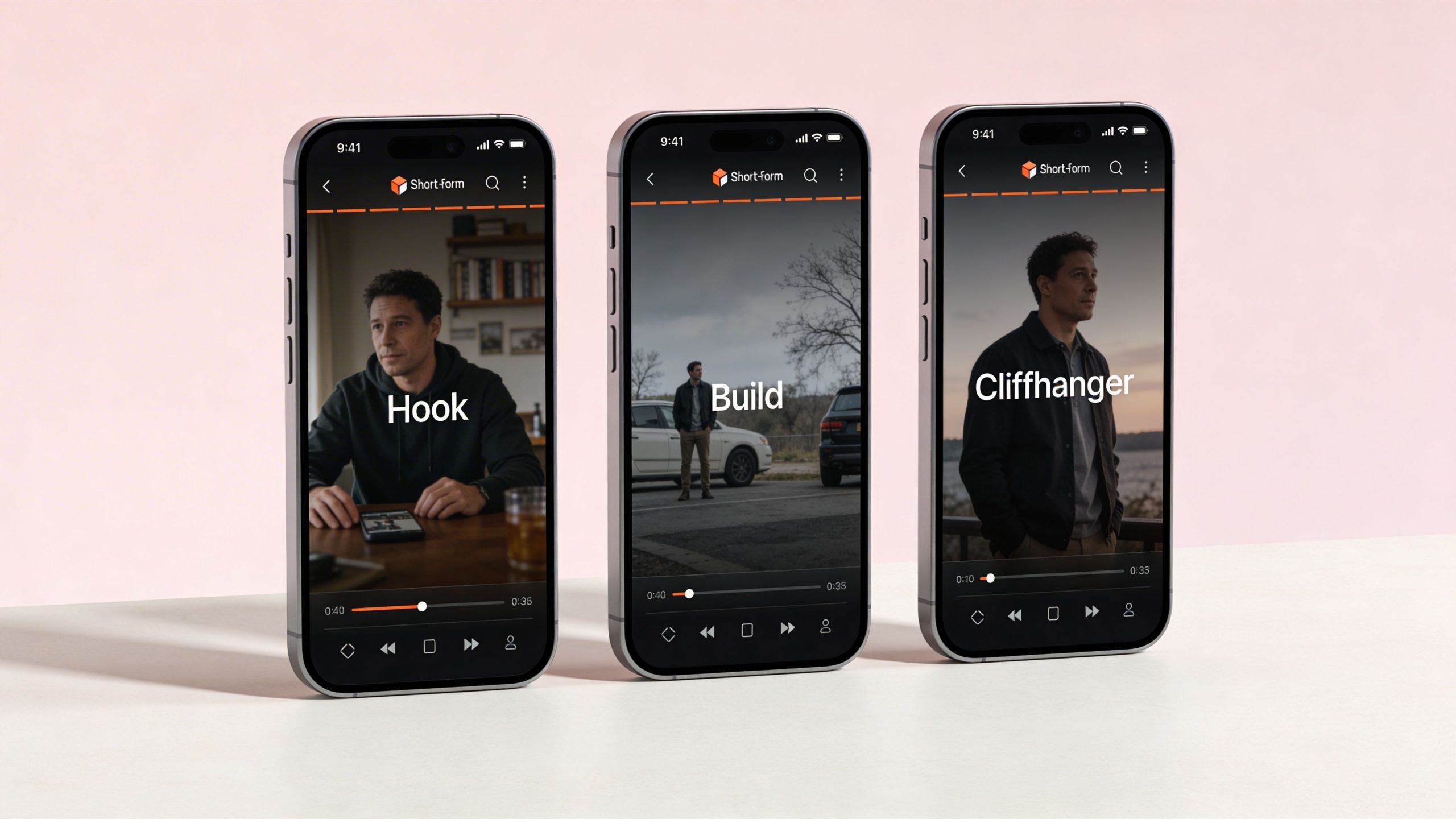
A creator posts a strong clip on Monday. It gets traction. By Wednesday, the next post has a different edit style, a different takeaway, and no reference to the first one. The result is familiar. Good content, weak momentum.
Narrative arcs solve that problem because they turn clips into a series people can recognize, follow, and anticipate. Instead of asking one post to do all the work, you spread attention across a sequence. That usually gives you more room to teach, build curiosity, and repeat your message without sounding repetitive.
The practical use case is straightforward. If an episode includes a founder story, a step-by-step framework, a debate, or a before-and-after transformation, cut it into connected parts with a defined order.
Build the arc before you open the editing timeline
This strategy works best when the series is planned at the scripting and selection stage, not after the team exports random highlights.
Use a four-part structure:
- Clip one: Open with the tension, problem, or claim.
- Clip two: Show what went wrong, what people misunderstand, or what raised the stakes.
- Clip three: Deliver the lesson, method, or turning point.
- Clip four: Add the application, objection, or contrarian takeaway.
That structure gives each post a job. It also makes packaging easier because your editors can use consistent title cards, on-screen labels, captions, and CTAs across the full run.
I have found that the trade-off is speed versus cohesion. A single viral-style clip can go out fast. A sequenced arc takes more planning, tighter story judgment, and a publishing calendar that does not slip. In return, you get a stronger chance of repeat viewing and better audience memory.
How to execute it as a repeatable production system
Treat each episode like source material for one mini-season.
- Identify one strong storyline from the episode, not five loosely related soundbites.
- Write the arc order before editing so each clip leads naturally to the next.
- Create visual continuity with the same framing, text treatment, and naming convention.
- Publish on a tight cadence so the audience still remembers part one when part two lands.
- Reference the previous clip in the opening line or caption.
- Close each post with a forward pull such as “part 3 covers the fix” or “next clip shows what changed.”
Flexwork Studios can make the difference here between a decent clip plan and an actual distribution asset. The service match here is social-first post-production and story packaging. The team can identify the arc inside a longer episode, cut each segment to platform length, standardize the visual system, and package the series so it feels intentional from the first post to the last.
If audience growth is one of your priorities, Flexwork’s guide on growing your social media following with a repeatable content system fits well with this approach.
What to measure
Do not judge this strategy on views alone.
Track completion rate by clip, saves, shares, profile visits, and the drop-off between part one and part two. Also watch whether later clips in the arc pull comments from people referencing earlier posts. That is a strong sign the series is creating continuity instead of functioning as disconnected distribution.
The goal is not just reach. The goal is recognizable storytelling at scale.
5. Email Newsletter Segmentation from Episodes
A listener finishes your episode on a Tuesday commute, means to come back, and never sees it again. The app feed moves on. Your email list gives that episode a second life, with more control over who sees which angle and why it matters to them.
The mistake is treating every subscriber like they signed up for the same reason. They did not.
A single interview can hold three or four strong newsletter angles. An operator might want the process. A consultant might care about positioning. A creator might respond to the guest’s workflow or turning point. Segmentation lets you send the right lesson to the right reader instead of forcing one broad recap across the whole list.
Here is the practical build:
- Review the episode for distinct audience interests. Mark the parts that speak to different buyer types, career stages, or goals.
- Write one primary email for the broadest segment. Keep it tight. One idea, one takeaway, one action.
- Create one or two segment-specific versions. Change the subject line, opening hook, and call to action based on what that group cares about.
- Pull one subscriber-only asset from the episode. This could be an unshared quote, a short framework, or a resource list.
- Route clicks into the next step. Send readers to the full episode, a lead magnet, a product page, or a reply prompt based on the segment.
This strategy works best when segmentation starts before the episode goes live. If guest selection is part of your growth plan, a stronger podcast guest booking strategy makes email segmentation easier because each conversation arrives with a clearer audience fit from the start.
Flexwork Studios fits this strategy at the editorial and production level. The team can identify the best newsletter angles inside each episode, structure the email variants, and package the supporting assets so the episode does more than announce itself. It feeds a real retention channel.
What wins in the inbox
Specific subject lines outperform vague episode alerts. Short emails built around one useful point usually outperform full recaps that try to cover everything at once. The trade-off is volume versus relevance. Sending fewer, sharper emails to defined segments often produces better click quality than blasting the full list every time.
Treat the newsletter as a content product, not a notification tool.
Measure open rate by segment, click-through rate to the episode, replies, unsubscribes, and downstream actions such as bookings, purchases, or event registrations. Those numbers show whether your segmentation is improving fit, not just generating traffic.
6. Guest Expert Content Cross-Promotion Network
Release day arrives, the episode is strong, and your guest posts a quick story link that disappears in 24 hours. That is not a network. It is a missed distribution asset.
Guest cross-promotion works when the sharing plan is built into production, not handled as a polite follow-up after the episode goes live. Founders, consultants, operators, and subject-matter experts will often promote an appearance if the asset package is clean, fast to post, and aligned with their audience. If it creates extra work, it usually stalls.
The playbook is straightforward:
- Choose the share angle during prep. Identify what the guest is known for, what their audience already cares about, and which clip will feel native on their channels.
- Package multiple ready-to-post assets. Prepare two to four clips, co-branded graphics, quote cards, and captions in different lengths.
- Build one destination for traffic. Use a guest-specific landing page with the full episode, key takeaways, and one next action.
- Send the kit before launch. Give the guest time to queue posts with their team.
- Coordinate the posting window. Aim for launch day plus one follow-up share later in the week so the episode gets more than one spike.
That last step matters. A single promotional post creates a short bump. A scheduled sequence gives the episode more surface area across platforms and more chances to reach the right audience.
This strategy is especially useful for B2B and expert-led shows because trust transfers faster through a known voice than through cold distribution. The trade-off is operational. Coordinated promotion takes more prep, more design time, and tighter approvals. The upside is better-fit reach and stronger downstream actions from people who already trust the guest.
Build the guest kit like a service, not a favor
A weak guest kit usually includes one square graphic and a generic caption. That package asks too much of a busy executive and gives them too little to work with.
A strong guest kit includes:
- Clip options by intent: one insight clip, one contrarian take, one personal moment
- Platform-specific copy: LinkedIn, X, and newsletter blurbs should not sound the same
- Co-branded visuals: names, title, show branding, and a clear episode hook
- A guest landing page: simple URL, embedded episode, transcript highlights, and CTA
- Posting notes: suggested publish dates, tags, and approved talking points
Flexwork Studios can handle the editing, design, packaging, and rollout so each guest appearance turns into a repeatable distribution campaign instead of a one-off ask.
Guest quality also affects promotion quality. Experts with a clear audience fit usually share more effectively because the episode supports their existing message. If guest selection still feels inconsistent, this podcast guest booking strategy guide helps tighten the fit before recording even starts.
What to measure
Do not judge this strategy by raw impressions alone. Track guest share rate, referral traffic from guest channels, landing page conversion rate, follower growth from guest audiences, and booked calls or leads tied to guest-specific links.
Those numbers show whether the network is producing reach that matters. The goal is not more noise. The goal is distribution with context, trust, and a clear path to action.
7. Transform Episodes into Webinars and Micro-Learning Courses
A strong teaching episode often signals a bigger asset waiting to be built.
You record a conversation that lands cleanly. The guest explains a framework in plain language, the examples are strong, and listeners start asking the same follow-up questions in DMs or sales calls. That episode should not stay trapped in the podcast feed. It can become a webinar that drives leads or a micro-course that shortens the path from attention to trust.
This strategy works best when the episode already contains a clear transformation. The job is to turn that raw material into a learning experience people can follow, finish, and apply.
Build around the outcome
A webinar needs one promise and one next step. A micro-learning course needs a tighter structure, shorter lessons, and enough support material to help someone act on what they learned.
Start with the audience problem, not the recording file. Then rebuild the episode around four pieces:
- A specific outcome: what the attendee or student will be able to do after finishing
- A clean sequence: modules or sections that move in the right order
- Support assets: slides, worksheets, prompts, templates, or examples
- Conversion path: CTA to a service, product, consultation, or paid offer
I usually make the format choice based on sales intent. Webinars are better for live engagement, objection handling, and offer conversion. Micro-courses are better for evergreen lead generation, onboarding, and client education.
Execution playbook
A simple production workflow keeps this from becoming another half-finished content idea.
- Choose one episode with a teachable core. Look for a framework, process, or repeatable method.
- Write the learner outcome. Use one sentence. Clear outcomes make the whole asset easier to shape.
- Break the episode into lessons. Cut anything that is entertaining but off-topic.
- Fill the gaps. Add slides, examples, exercises, and short explanations where the original conversation assumed too much context.
- Create the CTA. Decide whether the next step is a call, download, membership, or paid product.
- Run it live or pilot it privately. Early delivery shows where people get confused.
- Edit the final version into an evergreen asset. Tight pacing matters more than preserving every minute of the original recording.
Here is a useful example format to study before building your own session:
Where Flexwork Studios fits
One of the clearest service-to-strategy matches in the whole repurposing stack is found here. Flexwork Studios can turn a strong episode into a professional teaching product by handling the recording quality, edit structure, slide-aligned cuts, branded visual packaging, and final exports for webinar platforms or course hosting tools. That matters because audience trust drops fast when educational content feels like recycled podcast audio with a title slide attached.
There is a real trade-off here. A fast repurpose gets you to market quickly, but it usually needs heavier host presence and stronger live delivery. A more polished micro-course takes longer to produce, yet it scales better and gives sales or client success teams something they can use repeatedly.
What to measure
Track the metrics that match the format.
For webinars, watch registration-to-attendance rate, live watch time, Q&A participation, CTA clicks, and post-event conversions.
For micro-learning courses, track opt-ins, completion rate, lesson drop-off points, worksheet downloads, and the percentage of viewers who take the next business action.
Good numbers here mean the content is teaching clearly, not just attracting clicks. That is the core value of this repurposing move. One episode becomes a structured asset with a defined business job.
8. Podcast to Infographic and Data Visualization Series
A listener finishes your episode on a walk, agrees with every point, and still forgets the framework by lunch. A strong visual fixes that. It turns spoken insight into something people can save, share, scan in seconds, and return to later.
This format works best when the episode contains structure. Clear steps, sharp comparisons, original data, and quoted points of tension all translate well. Loose conversation usually does not. The trade-off is simple. Visual repurposing increases reach and recall, but it also forces editorial discipline. If the idea is muddy in audio, the design process will expose it fast.
Start with moments that deserve a visual asset
Choose one core idea per asset type.
Use infographics for multi-step frameworks. Use carousels for comparisons or sequential ideas. Use charts only when the episode includes credible numbers, internal benchmarks, survey findings, or repeated patterns you can label without overstating certainty.
A practical filter I use is this: if someone could apply the takeaway from a single screenshot, it is probably a good candidate for visual repurposing.
Strong source material usually includes:
- Frameworks: ordered steps, operating models, decision trees
- Comparisons: option A versus option B, before versus after, risk versus reward
- Data points: cited findings, internal performance trends, benchmark summaries
- Quote moments: one sharp line that carries the episode's main argument
Build the asset like an editor, not just a designer
Good visuals are edited, not decorated.
Start with the transcript and pull the cleanest section of the episode. Reduce it to one headline, three to five supporting points, and one clear takeaway. Then match the format to the platform. A LinkedIn carousel needs punchy panel-by-panel progression. A long infographic needs hierarchy and pacing. A static chart needs labels people can understand without hearing the episode first.
For teams building a repeatable system, this is often the missing link in how to market your podcast. Distribution gets easier when each episode produces visual assets with a clear job.
Execution playbook
- Review the episode transcript. Highlight frameworks, stats, and quotable sections.
- Pick one asset angle. Do not combine a process explainer, a chart, and five quotes into one visual.
- Write the narrative first. Headline, section titles, captions, CTA.
- Choose the format by platform behavior. Carousel for LinkedIn, tall graphic for Pinterest or blog support, single chart for email or sales enablement.
- Design for skim-reading. One idea per panel, short copy, visible hierarchy.
- Add episode attribution. Include show name, episode title, and a path back to the full content.
- Export variations. Resize for social, blog embeds, newsletter placement, and partner sharing.
Where Flexwork Studios fits
Flexwork Studios can handle the production chain that usually slows this strategy down. That includes transcript review, editorial extraction, branded design systems, motion graphics for animated data visuals, and final exports for each channel.
That service match matters because visual repurposing breaks when the handoff is messy. A founder knows the idea. A designer knows layout. An editor knows what the audience needs. When those roles are disconnected, the result looks polished but says very little. A studio workflow closes that gap and turns one episode into a usable asset set instead of a single social post.
There is also a budget decision here. Static graphics are faster and cheaper. Animated explainers or motion-based data stories take longer, but they usually perform better on feeds where movement earns the first second of attention.
What to measure
Track performance by asset type and by business use case.
For social visuals, watch saves, shares, carousel completion rate, profile visits, and clicks back to the full episode. For blog or newsletter visuals, track time on page, scroll depth, and CTA clicks near the asset. For sales or community use, monitor whether the visual gets reused in decks, onboarding, or member threads.
If your audience later graduates into private discussion spaces, format portability matters too. Teams comparing platform options often review Slack alternatives before deciding where those visual resources will live and keep circulating.
The best signal is simple. People should understand the point without replaying the episode, then feel motivated to hear the full conversation. That is the job of this repurposing move.
9. Podcast-to-Community Building Discord, Circle, or Slack
Repurposed content can do more than attract views. It can start conversations that last longer than the post.
That is the power of a community strategy. Your episode becomes the prompt, but the comments, responses, and member discussions become the engine. If you want deeper loyalty, product feedback, or recurring engagement, a community layer is one of the smartest content repurposing strategies available.
Use each episode as a discussion starter
Do not drop the episode link into a community and disappear. Give people a reason to respond.
Try prompts like these:
- Pull one opinionated quote: Ask members whether they agree.
- Clip a specific moment: Invite reactions from members in the same niche.
- Turn a framework into a challenge: Ask members to apply it during the week.
- Create a follow-up thread: Collect questions you can answer in a future episode.
Verified data highlights a major gap in the market around attribution and format-level ROI tracking for repurposed content, especially for creators trying to determine which formats drive growth and customers (measurement gap in repurposing strategy). A community helps close part of that gap because you can ask directly. Members will tell you which clips brought them in, which takeaways resonated, and which themes they want next.
Pick the platform for the audience, not the trend
Discord tends to suit creator communities and faster chat. Circle feels cleaner for coaches, experts, and premium learning environments. Teams that do not want a traditional Slack setup can also review Slack alternatives before choosing a space.
Flexwork’s guide on how to market your podcast is useful here because community only works when it connects to the broader show growth plan. The weak version is launching a space with no conversation design, no moderation standard, and no reason for members to return.
10. Repurposed Content Marketing for B2B SaaS Partnerships
This is the most commercial version of repurposing, and it's a direction many serious podcast brands eventually want to pursue.
Instead of treating sponsorship as a pre-roll ad and a logo, you turn episode content into partner assets. A founder interview becomes a co-branded webinar. A recurring topic becomes a whitepaper. A niche discussion becomes a case-study-style lead magnet. The show stops acting like media inventory and starts acting like a strategic marketing channel.
Build partner assets around audience problems
The key is relevance. A sponsor does not need more generic impressions. They need your audience to care in a business context.
Strong partnership assets often include:
- Executive recap PDFs
- Co-branded webinars
- Topic-specific landing pages
- Newsletter integrations
- Thought leadership articles based on the episode theme
One verified source notes that 58% of marketers saw revenue growth from content efforts in 2024, up from 42% in 2023, and specifically ties that momentum to repurposing formats like webinars to blogs and guides to infographics (content repurposing statistics and revenue growth). That is why this strategy matters for B2B creators and brand-led shows. Repurposed media can support revenue conversations in a way isolated ad reads rarely do.
What serious buyers respond to
A clear plan. Show the partner how one episode can become a package of assets distributed across your site, feed, email list, social channels, and sales conversations.
The common mistake is pitching sponsorship before proving execution. Build a few strong partner-style assets first, even if they start as self-promotional examples. Once a brand sees what your team can package, the conversation becomes easier.
For creators who want premium positioning, Flexwork’s Market, Manage & Produce My Podcast offer gains particular relevance. The production, editing, graphics, and marketing support make it far easier to sell a polished partnership concept instead of a loose media idea.
Content Repurposing: 10-Point Comparison
| Strategy | Implementation complexity | Resource requirements | Expected outcomes | Ideal use cases | Key advantages |
|---|---|---|---|---|---|
| Podcast Episode Atomization into Short-Form Content | Medium, repeatable editing workflows | Video editor, templates, captioning tools, studio or raw footage | Multiple 15–60s assets; broader social reach; referral traffic | Podcasters wanting rapid social growth and visibility | High shareability; maximizes existing recordings |
| Transcription-to-Blog Article Conversion | Medium, editorial + SEO work | Transcription service, copywriter/SEO, CMS | SEO traffic, long-form authority content, accessibility | Thought leaders and brands targeting organic search | Improves search discoverability; repurposes audio into evergreen assets |
| Video Podcast to YouTube Long-Form Channel | Medium–High, production + channel ops | Multi-camera/video editing, thumbnails, metadata optimization | Subscriber growth, discoverability, monetization potential | Established video-capable podcasters seeking scale/revenue | YouTube search reach and monetization pathways |
| Social Media Clip Series with Narrative Arcs | High, strategic storytelling and scheduling | Strategic editor, content calendar, consistent branding assets | Habit-forming engagement, repeat viewership, higher retention | Creators building daily engagement and serialized audiences | Strong viewer retention and algorithmic engagement |
| Email Newsletter Segmentation from Episodes | Medium, segmentation & personalization | ESP (ConvertKit/Substack), automation, copywriting | Higher opens/CTR, direct audience ownership, conversions | Podcasters focusing on lead gen and customer funnels | Owned channel; personalized messaging and tracking |
| Guest Expert Content Cross-Promotion Network | Medium, coordination and asset delivery | Guest-ready clips, co-branded graphics, outreach processes | Exponential reach via guest networks; reciprocal promotion | Guest-driven interview shows and networked hosts | Amplifies reach through guest audiences; builds partnerships |
| Transform Episodes into Webinars and Micro-Learning Courses | High, instructional design and promotion | Course platform (Teachable/Kajabi), slides, workbooks, marketing | Paid products, qualified leads, premium positioning | Coaches, educators, and creators monetizing expertise | High revenue per learner; evergreen sales funnel |
| Podcast to Infographic and Data Visualization Series | Medium, design and data curation | Designer/tools (Canva/Figma/Illustrator), data sourcing, templates | Shareable visuals, backlinks, traffic from visual platforms | Data-rich shows and brands targeting visual channels | Highly shareable; enhances article and social performance |
| Podcast-to-Community Building (Discord/Circle/Slack) | High, ongoing moderation and activation | Community platform, moderators, exclusive content plan | Loyal, owned audience; feedback loop; membership revenue | Creators building long-term engagement and memberships | Owned audience asset; deeper relationships and retention |
| Repurposed Content Marketing for B2B/SaaS Partnerships | High, strategic positioning and sales alignment | Research, whitepaper/case-study writers, partnership outreach | Enterprise sponsorships, lead generation, partnership revenue | B2B/SaaS podcasts targeting enterprise buyers and sponsors | Attracts high-value partnerships; positions brand as industry authority |
Your Content Deserves a Strategy, Not Just a Schedule
The best podcasters are not only consistent creators. They are disciplined distributors. They understand that the episode is not the finish line. It is the source asset.
That mindset changes everything. Instead of measuring success by how often you can record, you start measuring how much value you can extract from a great recording. One strong interview can become short-form clips, a blog post, a YouTube episode, a newsletter, a webinar outline, a visual summary, community prompts, and even partnership material. The workload feels lighter because you stop reinventing the wheel each week.
This also reduces a common trap for ambitious creators. DIY burnout usually does not come from a lack of ideas. It comes from fragmented execution. You record in one place, edit in another, post inconsistently, and try to market the whole thing between client work, meetings, and real life. The show starts to feel bigger than your systems. Repurposing brings order back. It creates a repeatable rhythm.
There is a bigger business case too. One verified source notes that 41% say content marketing delivers the top ROI among channels, while 92% of social marketers consider performance tracking essential (content repurposing statistics 2026 projection). Those numbers point to the same reality. Publishing more is not enough. You need a system that can be measured, refined, and scaled.
In this context, professional support becomes more than a convenience. It provides a strategic advantage.
Flexwork Podcast Studios is built for creators who want their show to look polished, sound credible, and perform like a real media brand. The studio infrastructure matters. Soundproof rooms, modern sets, cinema-grade cameras, strong audio capture, and reliable workflows all make repurposing easier because the source material starts at a higher standard. The service stack matters just as much. Studio rentals help creators move quickly. Producer support sharpens storytelling. Content Day sessions create batches of market-ready assets. Website builds give your show a proper home. The Market, Manage & Produce My Podcast package supports creators who want ongoing growth, not just edited files.
If you are serious about execution, start with a simple question before your next recording session. What will this episode become after it is published?
Answer that before you hit record and your show gets easier to grow.
A sharp episode in the right studio can become weeks of useful content. A well-produced interview can become the center of your search strategy. A guest conversation can become a campaign. The creators who win with content repurposing strategies are not posting randomly. They are building systems that respect their time and amplify their best ideas.
If you want more ideas beyond the list above, this roundup of 8 Smart Content Repurposing Strategies is a useful complement. Then bring the strategy into a production environment that can support it.
Flexwork is that environment. If you are in the NJ or NY metro area and want to turn one episode into a polished multi-platform brand asset, book a tour of the Springfield studio or explore the production packages. Your content already has more value in it than you are probably extracting. The right system brings it out.
If you want to stop chasing the content treadmill and start building a real show ecosystem, Flexwork Podcast Studios can help you do it with professional recording, editing, content packaging, and growth support. Book a tour, explore the production packages, or plan a Content Day and turn your next episode into weeks of premium assets.