
Professional Podcast Website Design in 2026
 June 15, 202625 Minutes
Meta description: Podcast website design in 2026 is about growth, SEO, and brand authority. Learn what to build and when to invest professionally.
URL slug: /podcast-website-design-2026
Primary keyword: podcast website design
Secondary keywords: podcast website, podcast SEO, podcast website development
You've done the hard part. The show sounds polished, the guests are strong, clips are moving on social, and people are starting to recognize your name. But when someone wants to learn more, binge your archive, join your email list, or send a sponsorship inquiry, they hit a weak link chain. A platform profile. A basic landing page. A bio page that feels disconnected from the quality of the show.
That gap matters more than most podcasters realize. A serious show needs a serious home base, not just a feed living inside someone else's app. Your website is where your brand becomes legible. It's where discovery turns into loyalty, and where audience attention can become revenue, partnerships, and authority.
That's why podcast website design deserves real strategic thinking. If your show is part of a bigger business, media brand, or personal platform, your site can't act like an afterthought. It needs to function like a flagship property. If you're still defining your format or audience, Flexwork's piece on podcasting genres and formats is a useful place to sharpen that foundation before you build.
Introduction
A lot of talented podcasters are operating with a split identity. The content feels premium, but the digital experience feels improvised. You send traffic to Spotify, Apple Podcasts, Instagram, a newsletter signup, maybe a booking form somewhere else. Every piece works on its own, but together they don't feel like a brand with gravity.
That's where many shows stall. Not because the content is weak, but because the infrastructure around it never matured. A great podcast can create attention. A strategic website turns that attention into a durable asset.
In practice, that means thinking beyond colors, fonts, and page templates. Good podcast website design answers business questions. How will a new listener understand the show in seconds? Where should a sponsor go? How do episode pages pull in search traffic over time? What captures audience data that a listening platform won't share with you?
The strongest podcast sites aren't digital brochures. They're operating systems for growth. They help listeners discover, stay, subscribe, inquire, and buy. That's the standard worth designing for.
Why Your Podcast Needs a Strategic Website
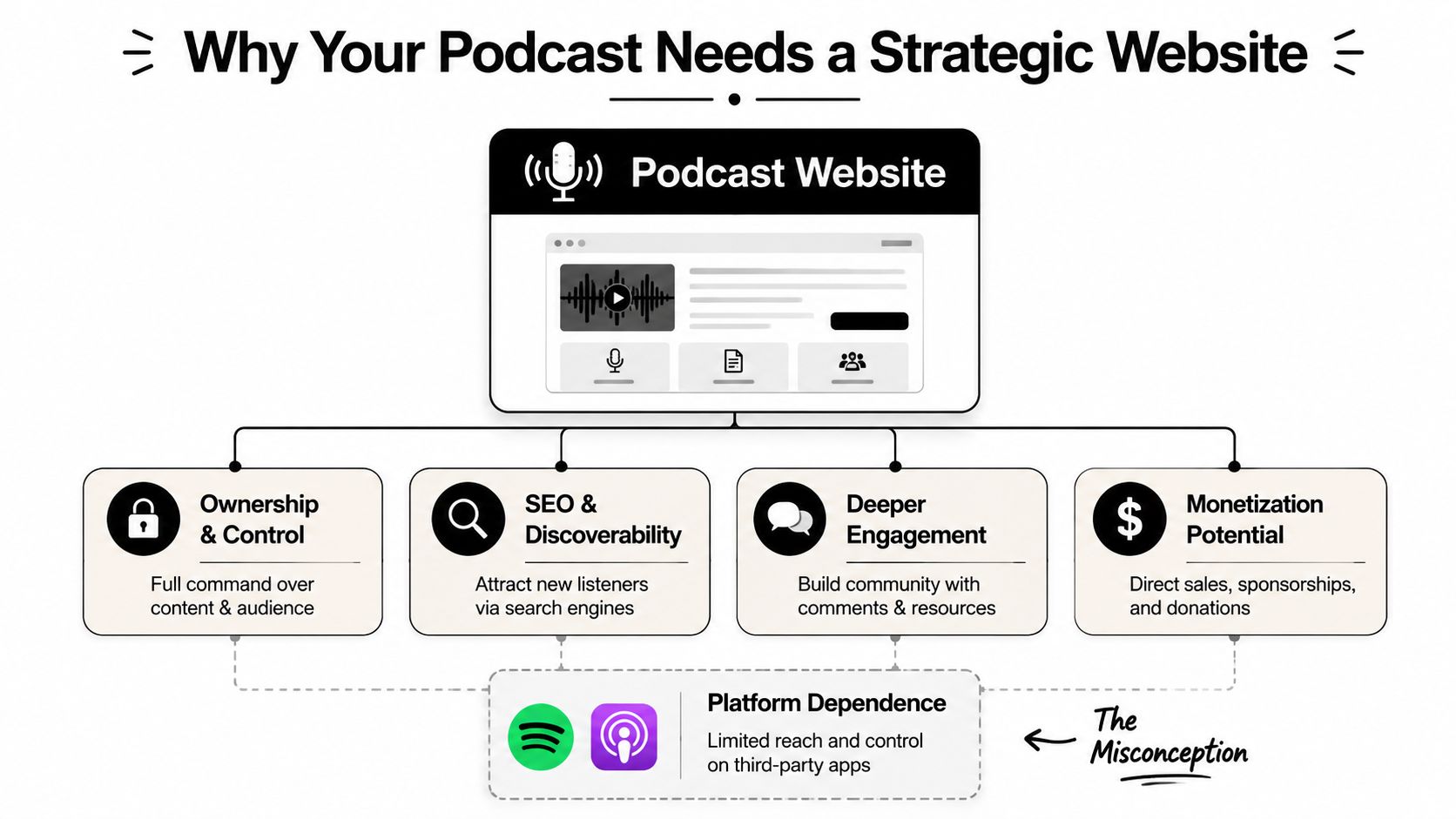
Most podcasters start with the obvious argument for a website: credibility. That's true, but it's not the main reason anymore. The better reason is control.
Podcasting is now mainstream. Global podcast listeners grew from 506 million in 2023 to an estimated 619 million in 2026, and 83% of listening happens on mobile devices, which is why your site has to be fast, responsive, and designed for phones first, not desktops first, according to podcast listener data from DesignRush.
Platforms distribute. Websites compound.
Spotify and Apple Podcasts are distribution channels. They are not your brand headquarters. Their job is to host listening behavior inside their ecosystems. Your job is different. You need a place where the show's identity, library, offers, and audience journey all live under your control.
That distinction changes how you design. A platform page can present an episode. A website can:
- Capture direct relationships through email forms, inquiry forms, and lead magnets
- Organize authority with host bios, guest features, media appearances, and press assets
- Support monetization through sponsorship pages, products, memberships, or service offers
If your podcast is part of your broader business, that control becomes even more valuable. A site lets the show express the same visual and strategic language as the rest of your brand. If your current identity feels fragmented, Flexwork's guide on how to brand your business is a smart companion read.
Practical rule: If a listener loves your episode and wants the next step, your website should make that step obvious within a few seconds.
Owned audience beats borrowed attention
Every creator knows the uneasy feeling of building on rented land. Algorithms change. Platform layouts change. Features disappear. Search behavior shifts. A website gives you an owned destination that doesn't vanish because a third party updated its priorities.
That matters for three reasons:
| Website function | What it supports | Why it matters |
|---|---|---|
| Brand ownership | Voice, visuals, positioning | You control how the show is perceived |
| Audience data | Email capture, form submissions, behavior insights | You learn what content and offers actually move people |
| Discovery | Searchable pages and topic depth | New listeners can find episodes outside podcast apps |
A strategic site also solves a subtle credibility issue. When journalists, guests, sponsors, and collaborators vet your show, they want more than an audio tile and a short description. They want context. Who hosts this? What's the angle? Is there a media kit? Is there an archive worth referencing? Is the show active and professionally run?
Design has to serve business outcomes
Frequently, podcast website design goes awry. The focus stays on aesthetics when the fundamental goal is about movement. The site should move a visitor toward listening, subscribing, contacting, or buying.
That's why the homepage can't be a giant mood board. It should act like a concierge. It should direct first-time visitors, returning listeners, potential sponsors, and potential clients into the right path without friction.
A beautiful site that hides the player, buries the archive, and makes subscription links hard to find is still underperforming. Strategy has to lead. Design should make strategy feel effortless.
The Blueprint for a High-Converting Podcast Site
The easiest way to think about a strong site is as a guided experience. A visitor lands, understands the show, samples the content, and sees a clear next step. Every page should earn its place.

Start with a homepage built for action
The homepage has one job. Reduce hesitation.
Simplecast's guidance is useful here: a conversion-oriented podcast site should include a brief show description, embedded player, artwork, and direct subscription links to major platforms like Spotify and Apple Podcasts, with a prominent trailer for first-time visitors and a homepage that prioritizes immediate listening actions, as outlined in Simplecast's podcast website recommendations.
A strong homepage usually needs:
- A sharp positioning statement that tells visitors who the show is for
- A trailer or featured episode near the top
- Platform buttons that don't force people to hunt for Spotify or Apple Podcasts
- A featured archive section that highlights recent or cornerstone episodes
- One primary conversion path such as newsletter signup, inquiry form, or sponsorship contact
What doesn't work is the common “brand first, utility later” approach. Oversized hero images, vague taglines, and long intro copy often push the actual listening experience too far down the page.
Your homepage should behave like a front desk, not a poster.
Build one page for every episode
This is the architectural decision that gives your site long-term value. A best-practice podcast website should use a one-page-per-episode architecture because searchable episode pages can capture long-tail organic traffic and make it easier to cross-link show notes and guest bios, as Studio Cotton recommends in its guide to podcast website structure.
That means every episode gets its own URL and its own strategic package:
- Episode title
- Embedded player
- Summary or show notes
- Guest bio
- Key links and resources
- Transcript when available
- Internal links to related episodes or topical collections
Podcast website design moves beyond mere decoration to function as a library. Each episode page becomes an indexable asset. Over time, your archive turns into a body of searchable expertise.
Give the About page a real job
Most About pages waste attention. They either read like a résumé or drift into generic founder storytelling. Your About page should build trust and sharpen positioning.
Use it to answer:
- Who hosts the show?
- Why does this show exist?
- Who is it for?
- Why should someone keep listening?
If the show supports a company, consultancy, studio, or media brand, this page should also connect the podcast to the broader business. That doesn't mean turning it into a sales page. It means showing that the show has a point of view and a credible source behind it.
Make conversion pages friction-light
A high-value podcast site usually needs at least one page designed for business intent. That might be sponsorships, speaking, guest submissions, media inquiries, or client bookings.
Form design is crucial. A badly built contact experience can subtly undermine momentum. If you want practical guidance on cleaner fields, better flow, and lower-friction submissions, this breakdown of form optimization strategies for growth teams is worth reviewing before you finalize your site.
A useful rule is simple: ask only for the information you'll use in the next step.
Treat your archive like a content engine
Your episode archive shouldn't feel like storage. It should feel curated.
Organize by season, theme, guest type, or business category if that helps users browse with intent. If your team is producing short clips, quote graphics, blogs, or newsletters from each recording session, connect those assets back to the episode pages. Flexwork's article on how to repurpose a single podcast episode into 10 pieces of content is useful because it reinforces the same idea: one recording should power an ecosystem, not a single upload.
That's the central blueprint. Homepage for clarity. Episode pages for search and depth. About for trust. Conversion pages for action. Archive for compounding value.
The Flexwork Solution for Professional Design
At a certain point, DIY stops being efficient. Not because you aren't capable, but because your attention is better spent on hosting, booking, selling, and shaping the show itself.
A podcast website isn't just another creative task on the list. It affects how your audience experiences the show and how your business captures value from that attention. If the structure is weak, the content has to work harder than it should.
Where professional execution changes the outcome
The difference usually isn't just visual polish. It's strategic alignment.
A professionally designed podcast site can account for questions that DIY builds often miss:
- What should a first-time visitor see above the fold?
- Which pages deserve SEO depth?
- Where should sponsor inquiries land?
- How should the site connect with your production workflow and content calendar?
- Which actions matter most for your business model?
For podcasters who want that handled as part of a broader production ecosystem, Flexwork Podcast Studios offers podcast websites at $5000 plus hosting, and the service sits alongside studio production, editing, content support, and growth-focused packages. That matters if you want the website to connect cleanly to a larger operating model rather than existing as a disconnected side project.
The website works harder when the rest of the system is in place
This is the part many creators miss. A good website doesn't grow in isolation. It performs better when it's fed by strong inputs.
If you're publishing consistently, cutting social assets, improving show packaging, and pushing listeners back to an owned destination, the website becomes a hub instead of a placeholder. That's where broader production support starts to make sense. Flexwork's Market, Manage & Produce My Podcast package starts at $1500 per episode with a 20-episode growth commitment, which is a useful model for shows treating audience growth as an operating priority rather than a side effect.
The site is the asset. The production and marketing system is what gives that asset momentum.
There's also a brand perception advantage. When your visual identity, show packaging, clips, and website all feel aligned, the show reads as established. That affects sponsor confidence, guest confidence, and listener trust.
Technical Essentials for Discoverability
A lot of podcast creators hear “technical SEO” and immediately tune out. Fair enough. Most explanations are written for developers, not creators. But the technical layer matters because it determines whether your content is easy to find, easy to use, and easy to trust.
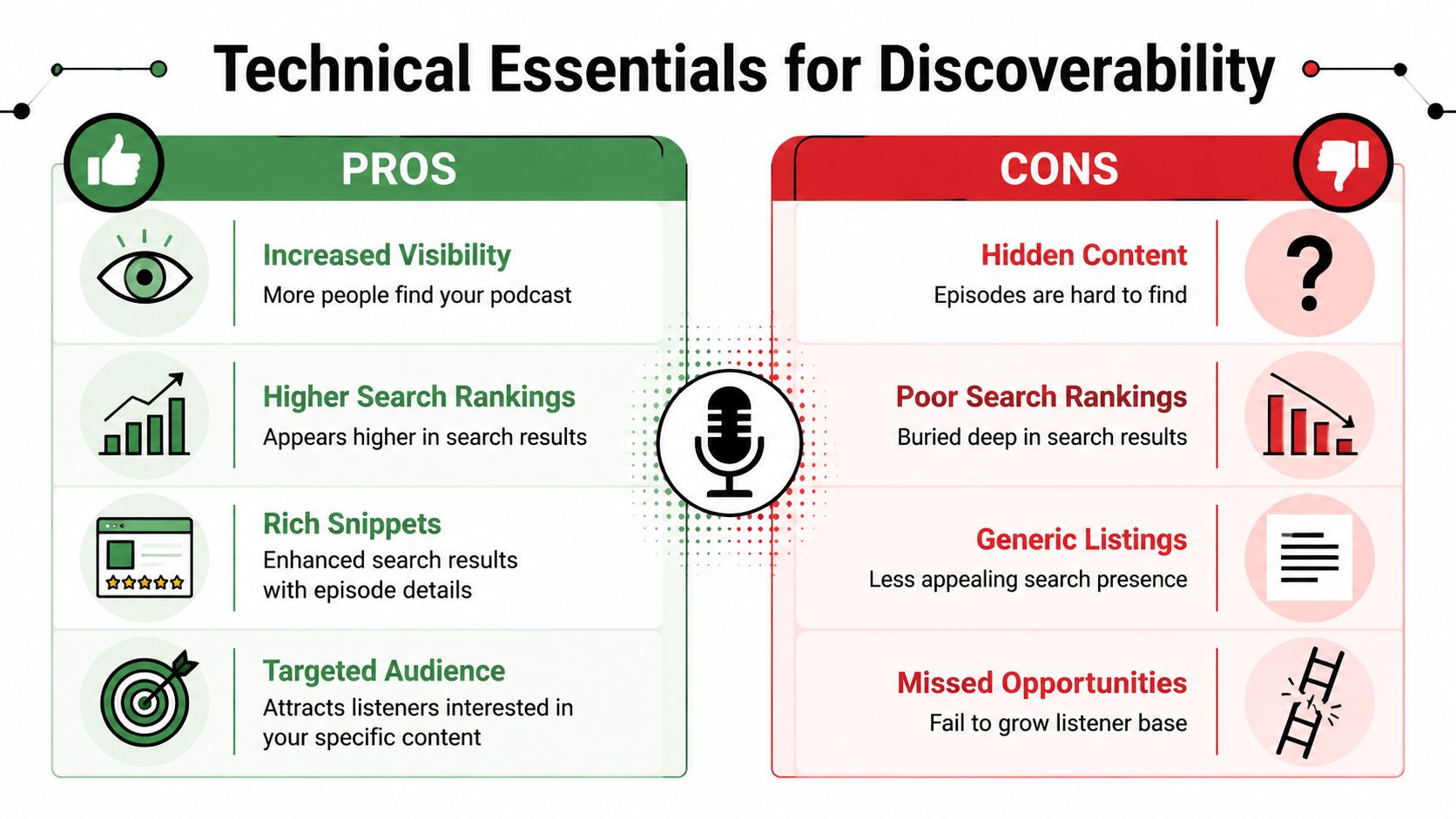
A key shift in podcasting is that discoverability moved from platform-only listening to web-based search. That makes each episode page an indexable asset. It also matters commercially, because U.S. podcast advertising revenue reached $2 billion in 2024, doubled from $1 billion in 2021, and is projected to exceed $3.7 billion by 2029, according to Heartcast Media's analysis of podcast website design and monetization.
Metadata is packaging for search
Your episode page needs more than a title and embedded audio. Search engines need context.
That includes:
- Clear page titles that reflect the episode topic
- Concise descriptions that tell both users and search engines what the page contains
- Logical headings so the page has a readable structure
- Internal links to related episodes, categories, or guest pages
None of this is glamorous. All of it is useful. Good metadata helps your archive function like a discoverable media property instead of a pile of uploads.
Audio player choice affects user behavior
The embedded player is part of the design strategy, not just a widget. It needs to load cleanly, look credible, and make playback obvious on mobile.
The right player also supports a better on-site experience. If a visitor can hit play without friction, continue browsing, and quickly jump to another episode, they stay in your ecosystem longer. If the player is clunky, hidden, or slow, the page loses momentum.
A practical test is simple: open an episode page on your phone and try to listen one-handed while doing something else. If it feels annoying, the design needs work.
RSS, automation, and consistency
Your website should stay in sync with your publishing flow. When new episodes go live, the site should reflect that without creating manual chaos.
That usually means making sure your site architecture works cleanly with your podcast host and episode feed so the archive remains current. You don't want a polished site that becomes outdated because updating it is too cumbersome.
Technical decisions support brand authority. Consistency signals that the show is alive, maintained, and worth following.
Accessibility is part of discoverability
Accessibility often gets framed as a compliance topic. It's more useful to think of it as audience design.
Transcripts, readable contrast, clear navigation, descriptive buttons, and mobile-friendly layouts help more people use your site successfully. They also make the content easier to scan, quote, and reference. In practical terms, accessible pages are often clearer pages.
If you're building your creator stack more broadly, Flexwork's roundup of best tools for content creators can help you think through the surrounding systems that support publishing, promotion, and workflow.
Clean technical structure doesn't make your site feel technical. It makes the experience feel easy.
Launch, Analyze, and Monetize Your Platform
A site going live is a milestone, not the finish line. Once it's public, the primary question becomes whether it's producing useful signals and business outcomes.
A clean launch checklist
Before launch, review the essentials:
- Test every listening link so Spotify, Apple Podcasts, and other destination buttons work
- Check every primary form including newsletter signup, inquiry, and sponsorship contact
- Review the mobile experience page by page, especially homepage and episode pages
- Confirm episode pages are complete with show notes, links, and consistent formatting
- Make the first conversion step obvious whether that's subscribe, inquire, book, or join
That last point is where many sites still wobble. They're live, but they don't direct behavior.
Track signals that help you decide
Don't obsess over vanity metrics. Track behavior that informs decisions.
Useful indicators include which episode pages attract the most visits, which topics hold attention, where people click to subscribe, and which forms get completed. If a sponsorship page gets traffic but no inquiries, the issue might be positioning. If episode pages get visits but little playback, the problem may be page design or weak summaries.
A site should teach you something about your audience every month.
Build monetization paths intentionally
Once the foundation is stable, the site can support different revenue models. That could mean sponsorship inquiries, consulting leads, speaking bookings, premium content access, merchandise, or a service business linked to the show. If sponsorships are part of your plan, Flexwork's guide on how to get podcast sponsors is a practical next read.
There's also a growth angle many podcasters ignore. An often-overlooked strategy is international and multilingual podcast website design. Localizing episode pages, show notes, and key navigation can turn the site into a tool for international growth, as discussed in TBH Creative's look at podcast website opportunities.
As search changes, it's also smart to think beyond classic SEO. If you want a stronger grasp of how discovery is evolving in AI-driven environments, this guide to AI search for brands is a strong strategic companion.
Conclusion
A podcast without a professional website can still publish. It can even build momentum. But it leaves too much value on the table.
The website is where your show becomes a business asset. It holds your archive in a searchable structure, gives your brand a permanent home, supports direct audience relationships, and creates clear paths to monetization. That's why podcast website design matters so much now. It isn't a decorative add-on to the feed. It's part of the business model.
The strongest sites don't try to do everything at once. They make smart decisions in the right order. Clear homepage. Strong episode architecture. Clean conversion paths. Technical discipline that supports discovery. Then consistent analysis and refinement after launch.
If your show has outgrown a patchwork online presence, that's a good sign. It means the brand is ready for infrastructure that matches the ambition behind it. Build the kind of site that can hold the next phase of your growth, not just the one you've already reached.
If you're ready to turn your show into a more durable media asset, explore Flexwork Podcast Studios for podcast websites, production support, studio rentals, and growth-focused services that can help connect your content, brand, and audience journey.