

Best Audio Interfaces for Recording in 2026
 April 13, 202631 Minutes
Meta description: Learn how to choose the best audio interfaces for recording in 2026, with practical advice for podcasters, streamers, and musicians.
URL slug: /best-audio-interfaces-for-recording
Primary keyword: best audio interfaces for recording
Secondary keywords: audio interface for podcasting, USB audio interface, Thunderbolt audio interface
Good content gets skipped every day because the audio sounds like an afterthought. The host is sharp. The idea is strong. The brand looks polished on social. Then the episode starts, and listeners hear hiss, room noise, uneven volume, or that thin laptop-mic sound that instantly lowers confidence.
That gap matters more than most creators want to admit. Audio quality shapes authority before your audience evaluates a single idea. If your show, course, interview series, or branded content is meant to open doors, your signal chain needs to support that ambition. The good news is that choosing from the best audio interfaces for recording doesn't require an engineering degree. It requires a clear understanding of what the box does, which specs matter for your workflow, and where investing in gear helps versus where outsourcing the whole process saves your momentum.
Your Voice Deserves Professional Sound Quality
A lot of creators hit the same wall. They’ve outgrown “good enough,” but they’re still recording through a setup that makes every sentence harder to trust.
You hear it in the playback. A strong point lands, but the vocal sounds flat. A guest laughs, and the level jumps. You clean up the file in editing, but the result still feels homemade. That’s frustrating because the problem often isn’t your mic, your message, or your confidence. It’s the part of the chain that decides how cleanly your voice reaches the computer.
An audio interface is easy to ignore because it sits on the desk. Yet it’s one of the first places your brand either gains polish or loses it. It affects noise, clarity, monitoring, and how stable the whole session feels.
Your audience won’t describe your setup in technical terms. They’ll simply decide whether your content feels trustworthy, premium, and worth staying with.
When people search for the best audio interfaces for recording, they’re usually asking a bigger question. How do I make my content sound like it belongs in the room with serious creators?
From DIY Burnout to Broadcast-Ready Audio
Recording at home can start as freedom and slowly turn into admin. One day you’re excited to launch. A few months later, you’re troubleshooting drivers, chasing hum, re-recording sections, and wondering why your sessions always seem to begin with twenty minutes of setup friction.
That’s the hidden cost of DIY audio. It’s not just the gear purchase. It’s the mental switching between creator, engineer, editor, producer, and support desk.
What burnout sounds like
Most creators don’t quit because they run out of ideas. They stall because the workflow becomes heavier than the creative payoff.
Common signs include:
- Too many test recordings: You keep recording intros multiple times because something always sounds off.
- Monitoring confusion: You hear delay in the headphones and start speaking unnaturally.
- Inconsistent episodes: One release sounds clean. The next sounds distant or noisy even though you used the same mic.
- Editing fatigue: You spend more time repairing audio than shaping the actual story.
- Launch hesitation: You delay publishing because the final mix never feels fully finished.
The irony is brutal. The more seriously you take your content, the more damaging weak production becomes.
Why managed production changes the equation
There’s a point where buying another piece of gear isn’t the best move. The better move is removing technical drag from the process entirely.
That’s where a fully managed workflow makes sense. Flexwork’s Market, Manage & Produce My Podcast package starts at $1500 per episode with a 20-episode growth commitment, and it’s built for creators who don’t want to spend their best energy fighting the mechanics of production. That kind of arrangement handles the recording environment, production support, and release pipeline so the host can stay focused on message, delivery, and growth.
If you’re still deciding whether to build a home setup or shift into a more reliable production model, this guide on boosting your brand with a home podcasting studio is a useful companion read.
Practical rule: If the tech is causing missed publishing dates, it’s no longer a gear problem. It’s a workflow problem.
When the premium option is actually the efficient option
Creators often assume doing everything themselves is the disciplined path. Sometimes it is. But if your podcast supports a business, client acquisition strategy, or public profile, inconsistency costs more than convenience.
A managed setup helps when:
- You record with guests regularly and can’t afford unstable sessions.
- You publish on a schedule and need repeatable quality.
- You’re building a personal or company brand where rough audio signals low standards.
- You want short-form clips, polished edits, and distribution support without stitching together five freelancers.
DIY can absolutely work. It just stops being “lean” once it starts slowing down the work that grows your show.
What an Audio Interface Actually Does for Your Content
Many creators first see an audio interface and think, “small box, lots of knobs, probably important.” That instinct is right. The box is doing a lot of invisible work.
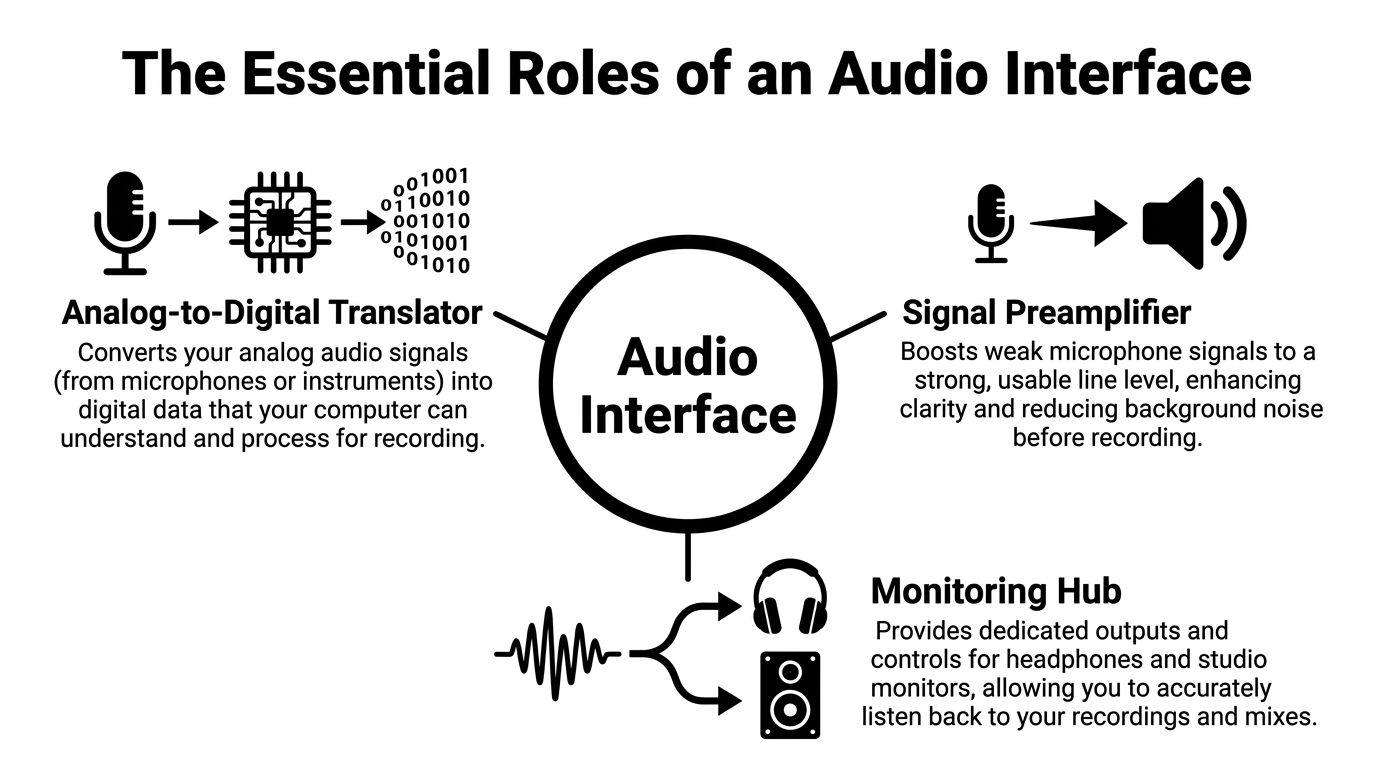
At its simplest, an audio interface is the bridge between your microphone and your computer. Your mic hears your real-world voice. Your computer only understands digital information. The interface handles that translation cleanly, powers certain microphones, and gives you a stable way to hear yourself while recording.
It translates your voice into something usable
Your microphone captures an analog signal. Your recording software needs digital data. The interface converts one into the other.
That sounds dry until you hear the difference. A weak conversion stage can leave a voice sounding smaller, harsher, or less detailed. A better one preserves the shape of the performance. Breath, tone, and texture come through with more realism, which matters a lot in podcasts where the human voice carries the whole experience.
It resembles a translator at a high-stakes interview. If the translation is sloppy, your meaning gets flattened. If it’s precise, your intent survives.
It boosts the signal before it falls apart
Microphones don’t send a strong signal on their own. The interface includes preamps, which raise that level to something your system can work with.
Many creators struggle with this point. More gain isn’t automatically better. Clean gain is the point. A quality preamp lets you turn up a microphone without dragging up hiss and ugly background noise with it.
According to the referenced explanation of interface preamp performance, professional audio interfaces often use low-noise preamps that achieve -128 dB EIN or better, preserving roughly 12-15 dB of signal-to-noise ratio headroom for podcast recording. That extra headroom matters when you process vocals later because you can shape the sound without pulling up hum or hiss at the same time (supporting reference).
A good preamp doesn’t make your voice fake. It lets your actual voice survive the recording chain with less damage.
For podcasters, that means cleaner spoken word. For interview shows, it means easier level matching between host and guest. For branded content, it means the final product feels composed instead of improvised.
It powers and monitors the session
If you use a condenser microphone, the interface often supplies the power it needs. That’s one of those features beginners don’t think about until nothing records properly.
It also handles monitoring. That matters because recording gets awkward fast when your headphones feed your own voice back with a noticeable delay. A proper interface gives you direct or low-latency monitoring so you can hear naturally while speaking.
A quick visual can make this click:
Why your audience feels the difference
Listeners rarely say, “Great preamp design.” They say the show sounds polished. They stay longer because the audio feels easier on the ear.
Here’s what an interface improves in practical terms:
- Clarity: Spoken words sound more intelligible.
- Consistency: Voices sit at a more stable level from episode to episode.
- Comfort: Monitoring feels natural, which helps hosts perform better.
- Editability: Cleaner files respond better to EQ, compression, and noise reduction.
- Perception: Better sound raises the perceived quality of the brand behind the content.
That’s why the best audio interfaces for recording aren’t just technical purchases. They shape how your content is experienced.
Decoding the Specs That Define Pro Audio
You are comparing two interfaces late at night. One page says 24-bit/192kHz. Another highlights low-latency drivers, bus power, loopback, and ARM support. The language sounds technical, but the question is simpler: which box helps you create with less friction and sound like a pro every time you hit record?
That is why specs matter. They are not trivia for engineers. They predict how your sessions will feel, how polished your brand will sound, and whether this purchase will still fit your setup a year from now.
Start with inputs and outputs
Inputs and outputs, or I/O, tell you how many sources you can record and monitor at once.
A solo host can work comfortably with one or two inputs. A creator who plans to add a co-host, guest mic, instrument, or outboard gear needs more headroom. An interface with too few connections creates the kind of bottleneck that shows up at the worst time, right when your content format starts growing.
A good way to frame it is this. Your interface is not only a recording tool. It is part of your production identity. If your brand depends on interviews, live performances, or multi-person sessions, your I/O count should reflect that from the start.
Preamps shape the raw material
The preamp is the first gain stage your microphone hits. If that stage is clean and quiet, your voice arrives in the computer with more detail and less hiss. That gives you more freedom later.
This matters even more with dynamic microphones, which often ask for more gain than beginners expect. Pair a gain-hungry mic with a weak preamp and your recording can sound flat or noisy before you even start editing. If you are still choosing the front end of your chain, this guide to the best microphone for podcast recording helps clarify how the mic and interface work together.
The result is practical. Cleaner capture means EQ and audio compression for better mixes respond more naturally, because you are shaping a strong recording instead of trying to repair a weak one.
Buy for the format you are growing into, not only the one episode on your calendar this week.
Sample rate and bit depth matter, but context matters more
These numbers describe how your analog voice becomes a digital file. They do affect quality, but they are often used as marketing shorthand for "pro" without explaining the benefit.
For most creators, 24-bit recording is the more meaningful part of the spec because it gives you more room to work with levels during recording and editing. High sample rate options can be useful, but they are rarely the deciding factor for spoken-word production. The bigger takeaway is whether the interface captures clean audio reliably and gives you files that hold up under processing.
So if two models both offer professional recording resolution, do not stop there. Look at driver stability, monitoring options, and how well the unit behaves with your computer.
Latency changes performance
Latency is the time it takes for your voice to go in, travel through the system, and come back to your headphones.
On paper, small delays can look harmless. In practice, delayed monitoring throws off timing fast. A host starts second-guessing pacing. A singer pushes against the beat. A streamer hears their own voice in a way that feels disconnected from the moment.
Connection type plays a role, but driver quality and software support matter just as much. USB is the standard choice for many creators because it is widely supported and easy to integrate into everyday setups. Thunderbolt can make sense for heavier music sessions with stricter real-time monitoring demands. The right choice depends less on hype and more on how demanding your sessions really are.
Compatibility is a buying decision, not a footnote
This is one of the most overlooked parts of shopping for an interface. A model can look perfect on paper and still become a headache if its drivers, control software, or mixer app lag behind current computers.
That matters a lot if you use an Apple Silicon system such as an M1, M2, or M3 Mac, or any newer ARM-based machine. Before you buy, confirm native support for your operating system, the manufacturer’s current driver policy, and whether the control software is actively maintained. An interface that works smoothly with modern chips protects your workflow. An interface with spotty support can cost you hours in setup work, firmware troubleshooting, or routing glitches that break momentum.
For creators building a professional brand, reliability is part of the sound.
Build quality and layout affect every session
The physical design tells you a lot about day-to-day use. Clear meters help you catch clipping before a take is ruined. A dedicated headphone knob saves time during sessions. Well-spaced controls reduce mistakes when you are adjusting gain quickly.
Look for a few signs of good design:
- A control layout you can understand at a glance
- Headphone level control that is easy to reach
- Metering that makes overload obvious
- Stable software support for your current computer
- Enough I/O for the next version of your workflow
A good interface does more than pass audio. It supports a recording process that feels calm, repeatable, and professional. That is what turns a spec sheet into a smart brand decision.
Your Decision Guide Podcasters vs Musicians vs Streamers
Not every creator needs the same interface, and a lot of bad buying decisions come from reading recommendations meant for someone else. A musician producing layered sessions, a podcaster tracking interviews, and a livestreamer routing game or browser audio are solving different problems.
The podcaster’s checklist
Podcasters need simplicity, clean vocal capture, and dependable monitoring. You don’t need a mountain of routing options if your format is one host and one guest. You do need an interface that gets out of the way.
The best match usually includes:
- One or two strong mic preamps for host and guest setups
- A clear headphone path so monitoring doesn’t distract performance
- Simple controls that make gain staging easy
- Stable computer compatibility for long-form sessions
If your show also includes short-form clips and visual production, renting instead of buying can make sense. This page on podcast equipment rental is useful if you need access to gear for a project, a content sprint, or a temporary production setup.
The musician or producer’s priorities
Musicians care more about latency, routing, and expansion. You may track vocals, guitar, keys, or multiple sources in the same session, and you may need the interface to behave well under heavier software loads.
That’s where lower-latency systems and more advanced connectivity become more attractive. If you’re recording music as well as voice, it’s also worth understanding how dynamics processing shapes a finished track. This primer on audio compression for better mixes gives useful context on one of the most common tools you’ll use after the recording stage.
The livestreamer’s must-haves
Livestreamers often need something different from both podcasters and musicians. The key issue is routing. You may need to bring computer audio into the stream while still controlling what you hear in headphones.
Look for:
- Loopback or flexible routing if you need to include app or desktop audio
- Reliable monitoring to avoid disorienting delay on live shows
- Simple switching because livestream environments are time-sensitive
- Driver stability if you move between creative apps frequently
Some interfaces sound good on paper and still create frustrating live workflows because the routing software slows everything down.
Modern computer compatibility is no longer a side note
A lot of generic buying guides still treat compatibility as a footnote. It isn’t one anymore.
A critical consideration is support for M-series Apple Silicon Macs. According to MusicRadar’s discussion of current interface choices, many USB interfaces work, but native drivers and Thunderbolt connectivity on models from Universal Audio or RME often provide lower latency and better stability in demanding applications like Logic Pro compared with some class-compliant USB options.
That doesn’t mean USB is bad. It means “works” and “works elegantly on your machine” are not the same thing. If you’re buying an interface to last, check how well it behaves on the exact computer platform you use now.
Interface feature checklist by creator type
| Feature | Podcaster | Musician / Producer | Livestreamer |
|---|---|---|---|
| Clean preamps | Essential | Essential | Essential |
| Low latency monitoring | Important | Critical | Critical |
| Multiple inputs | Useful for guests | Often necessary | Sometimes useful |
| Loopback routing | Nice to have | Sometimes useful | Essential |
| Simple controls | Very important | Helpful | Very important |
| Thunderbolt option | Usually optional | Often valuable | Can be valuable |
| Strong driver support on modern Macs | Important | Critical | Important |
The right choice gets easier once you stop asking which interface is “best overall” and start asking which one supports your actual workflow with the least resistance.
Top Audio Interface Picks for Every Creator
Your interface choice often shows up first on an ordinary recording day. You plug in a mic, open your session, and either everything feels clear and controlled, or you lose twenty minutes to monitoring confusion, noisy gain, or software friction. That is why this decision is bigger than a spec sheet. The right interface helps your work sound more polished, keeps your workflow calm, and supports the kind of brand you are building.
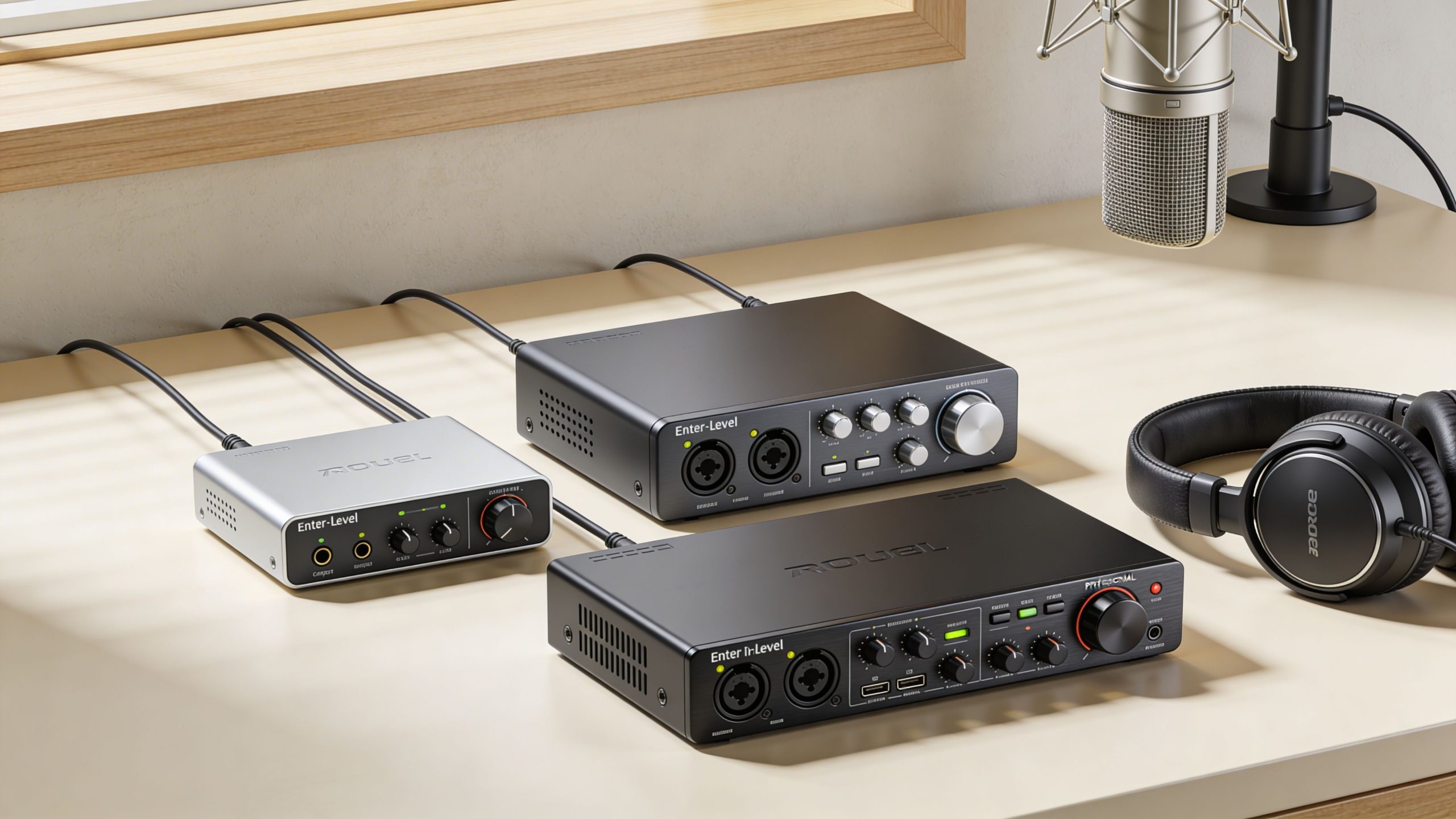
Focusrite Scarlett 2i2 4th Gen
The Scarlett 2i2 4th Gen is a strong first serious interface for solo podcasters, voiceover artists, singer-songwriters, and creators who want professional results without building a complicated rig.
Its appeal is simple. You get two solid mic preamps, direct monitoring, and a control layout that makes sense the first week you own it. For a creator still learning gain staging, that matters more than a long list of features you may never touch. It works like a reliable entry point into studio habits. You can focus on mic technique, performance, and consistency instead of wrestling with the box on your desk.
It also makes sense as a brand decision. If your content depends on interviews, coaching, lessons, demos, or clean solo narration, the 2i2 gives you a credible front end that sounds serious to clients, listeners, and collaborators. If you are pairing this with your first mic, headphones, and boom arm, this guide to the best podcast equipment for beginners can help you build the rest of the chain intelligently.
Audient iD14 MkII
The Audient iD14 MkII fits the creator who has outgrown beginner gear and wants a desk setup that feels more refined every time they record.
Audient interfaces are often chosen by people who care about the character of the preamps, the monitor control experience, and having room to grow. That growth angle matters. A coach can start with a single XLR mic today, then add external preamps or more inputs later. A producer can sketch ideas now and still have a compact interface that belongs in a more serious studio next year.
It is a thoughtful middle-ground pick for creators building a premium identity. The unit stays compact, but the workflow feels more like a professional control point than a basic adapter for your microphone.
Universal Audio Apollo Twin X
The Apollo Twin X is for the creator who already knows recording is central to the business, not just a supporting task.
This interface earns its place when session speed, dependable monitoring, and polished tracking matter every week. Producers, high-end podcasters, composers, and spoken-word teams often choose Apollo because the experience feels more like working from a finished studio than a home setup. You hear what you are doing clearly, make decisions faster, and spend less time second-guessing the chain after the take.
It is also one of the more strategic choices for Apple users who expect to stay on M-series systems for years. Hardware in this tier is not just about today’s sound. It is about buying into a recording environment that can keep pace with more demanding projects, client work, and tighter turnaround expectations.
Creators who also stream should compare their needs carefully. Live routing, loopback, and audience-facing reliability can matter as much as preamp quality, so this roundup of the best audio interface for streaming is a useful companion if your setup has to handle both recorded and live content.
Rent the front end if ownership isn’t the smartest move
Buying an interface is not always the best business decision.
If you record in batches for launches, campaigns, or guest days, studio time can give you better sound with less setup responsibility. You show up, perform, and leave with cleaner raw material. That can be a smarter use of money than owning gear that sits idle between projects or creates new technical chores.
Flexwork Podcast Studios offers recorded sessions in acoustically treated rooms with production support for creators who want professional audio without managing every engineering detail themselves.
The right pick supports your format, your computer, and your publishing rhythm. It should remove friction from the work, not add another layer of setup to solve.
Elevate Your Content Beyond the Gear
The interface matters. It shapes clarity, workflow, monitoring, and how professional your content feels before editing even begins. But gear is only the useful part of the story when it helps you publish better work with less friction.
That's the key decision. Not just which box to buy, but where your time should go.
If you love building your own setup, choose an interface that matches your format, your computer, and your growth path. Don’t overbuy for imaginary needs. Don’t underbuy if your show already depends on polished sound.
If you’d rather spend your time hosting, interviewing, teaching, or selling, the smarter move may be using a production environment that already solves the technical side. A treated room, experienced engineering, and a reliable recording chain remove a lot of variables that sabotage otherwise strong content.
For creators trying to improve what they already have, this guide on how to improve audio quality is a practical next step.
The best audio interfaces for recording can absolutely raise your level. The bigger upgrade is building a workflow that keeps your content consistent, credible, and easy to produce.
If you’re ready to record with fewer technical compromises, explore Flexwork Podcast Studios for studio sessions, production support, Content Days at $3000/day with 20 edited reels or 60 pro photos, podcast websites at $5000 plus hosting, or managed growth support designed for creators who want polished output and a repeatable publishing system.