

You have a powerful idea for a podcast—a unique perspective, an expert insight, or a story that needs to be told. That’s the spark. But the path from a brilliant concept to a polished, professional show can feel overwhelming, filled with technical hurdles and DIY burnout that stop many creators before they even start. The modern podcasting landscape is competitive, and quality is non-negotiable. To stand out, you need more than just a good idea; you need a strategic approach and a professional sound from day one. This guide is your roadmap to sidestepping the amateur mistakes and launching a podcast that not only captures attention but builds a loyal audience. At Flexwork Studios, we transform ambitious creators into influential voices by making professional production seamless and accessible. Let's build your platform, together.
The Problem: From Passion Project to DIY Burnout
Let's be honest. The podcast idea you can't shake is giving you a mix of excitement and a serious case of "where do I even begin?" The initial thrill of a great concept quickly gives way to the reality of execution: the intimidating gear, the confusing software, and the nagging self-doubt. Many entrepreneurs and creatives find themselves trapped in a cycle of research and procrastination, ultimately losing momentum.
The real cost of the DIY approach isn’t just the money spent on a microphone that ends up collecting dust; it's the hours lost to troubleshooting, the frustration of subpar audio quality, and the creative energy drained by a steep technical learning curve. Your podcast is meant to be a powerful tool for building your brand and connecting with your audience, not a source of stress and inconsistent output. When your brand's reputation is on the line, inconsistent audio quality and a scattered production workflow aren't just minor issues—they're significant roadblocks to growth.
If you're still weighing your options, take a look at our breakdown of podcasting vs other forms of content creation to see how it fits into your larger brand strategy.
Crafting Your Podcast's Core Identity
Before you think about microphones or studio time, let's define the soul of your podcast. This foundational work happens in a notebook or a strategy document, where you build the entire world your listeners will step into. A successful podcast isn’t just a series of conversations; it’s a distinct brand with a clear promise. This identity is your North Star, guiding every decision you make. Get this right, and you're not just creating content—you're building a community.
Find Your Niche and Define Your Listener
The podcasting universe is crowded, which means there’s a dedicated audience for everything. The secret to cutting through the noise is to be incredibly specific.
Don't launch a generic "business" podcast. Instead, consider a show focused on "navigating co-founder dynamics in the New Jersey tech scene." That laser focus is magnetic; it attracts exactly the right people who feel like you're speaking directly to them.
To achieve this, develop a crystal-clear picture of your ideal listener.
- Who are they, really? Go beyond demographics. A 32-year-old marketing manager is a start, but what are their career aspirations, their daily frustrations, and their passions?
- What are their motivations? What problems are they trying to solve? What kind of content are they actively seeking out?
- Why should they listen to you? What value are they hoping to gain? Actionable advice? A sense of community? Or the inspiration to take the next step in their own journey?
When you know this person intimately, creating content becomes a conversation, not a broadcast.
Choose a Format That Fits Your Vision
Your show's format provides structure and sets listener expectations. More importantly, it must align with your personality and workflow. Choosing a format that leads to burnout is the fastest path to "podfade."
Consider the primary formats:
- The Solo Show: You are the expert and the guide. This format is excellent for building authority but requires you to carry the energy of the entire show.
- The Co-Hosted Show: Two or more hosts create a dynamic conversation. The magic is in the chemistry; when it works, listeners feel like part of the group.
- The Interview: This format brings in fresh perspectives and allows you to leverage your guests' audiences. It requires strong research and conversational skills.
- Narrative Storytelling: Think highly produced, scripted content with sound design. This is a significant undertaking but can create a deeply immersive experience.
There's no wrong answer, but be realistic. Choose a format you can consistently and sustainably produce.
Develop Your Show's Angle and Name
With your niche, listener, and format defined, it’s time to sharpen your angle. What is your unique promise? What is your perspective on the topic that no one else offers?
Your unique angle isn't just about what you discuss; it's how you discuss it. It's the synthesis of your personality, experience, and the specific value you provide that makes your show impossible to replicate.
Once that’s locked in, choose a name. A great podcast name is memorable, easy to spell, and clearly hints at the show's content. Always search Apple Podcasts, Spotify, and social media to ensure the name is available.
The potential audience is massive and growing, with an estimated 584.1 million global listeners. In the U.S. alone, 55% of the population listens monthly. This is a significant opportunity for a well-defined show to find its tribe. You can dive deeper into the numbers with these podcast listenership statistics on Backlinko.
A strong identity is more than a name; it’s the feeling you create. To master that, explore our guide on The Art of Storytelling to Captivate Your Audience.
Choosing Your Production Path: DIY vs. Pro Studio
You have a powerful concept. Now, where will you bring it to life? This decision will define your sound, your workflow, and ultimately, your sanity. You have two main paths: the scrappy, at-home DIY setup or the streamlined, professional studio experience. Let's explore what each route truly entails.
The Allure and The Grind of a DIY Setup
The DIY path is tempting. The idea of controlling every detail—buying the gear, soundproofing a corner of your office, and mastering the software—feels empowering.
Financially, it seems accessible. A good USB mic costs $50–$200. Editing software can be free or cost $10–$30/month. Hosting is around $5–$20/month. You could be operational for under $300–$500 for the first year. This low barrier to entry is fueling the global podcast market, which is projected to exceed $30–$40 billion. You can get a better sense of the podcast industry economics over at PodcastIndustry.org.
However, the hidden cost of DIY is paid in time and frustration.
- The Troubleshooting Tax: You will lose hours diagnosing mic buzz, recovering from software crashes, and fixing echoey audio.
- The Quality Gamble: Poor audio is the primary reason listeners abandon a show. Background noise and reverb immediately signal an amateur production.
- The Steep Learning Curve: You’re no longer just a host. You're also a sound engineer, video editor, and IT support specialist.
DIY is a valid starting point, but be honest about the time and energy you're willing to invest. We break this down further in our guide to the pros and cons of studio vs. DIY podcasting.
This quick flowchart can help you decide which format makes the most sense for your goals right now.
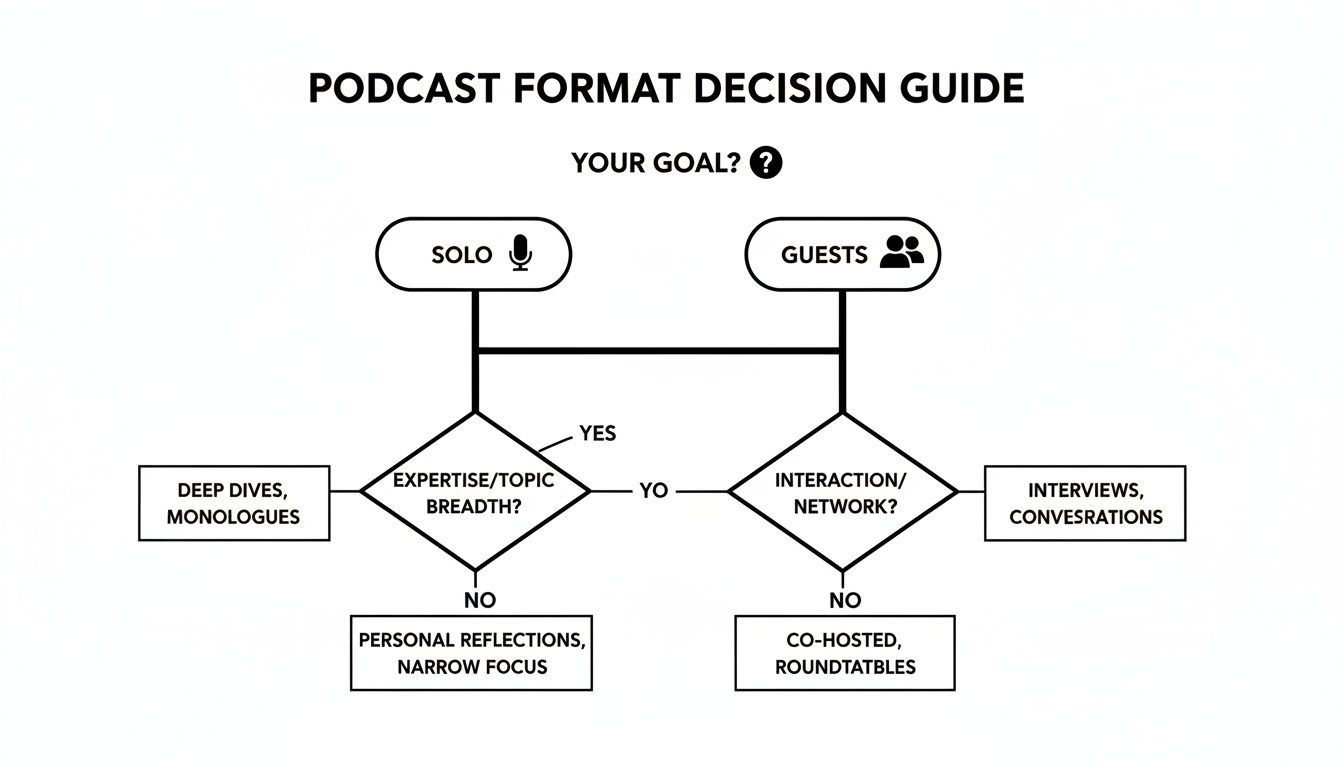
Sometimes just seeing it laid out like this makes the choice between going solo or bringing on guests a whole lot clearer.
The Professional Path: The Flexwork Advantage
Now, picture a different scenario. You walk into a room acoustically tuned for perfect sound. The industry's best microphones, cameras, and lighting are already set up and dialed in by an expert. Your only job is to sit down and deliver your message. You record several episodes with flawless audio and video, and then you leave.
This is the Flexwork Studios experience. We built our New Jersey facility to eliminate the friction that holds back so many brilliant creators.
Your energy should be invested in creating compelling content, not battling with technology. A professional studio environment frees you to perform at your best, ensuring your brand is represented with the polish it deserves from day one.
This isn’t about cutting corners; it’s about strategic focus. Our services are designed for entrepreneurs and creatives who understand their time is better spent on their message, not on microphone placement.
Podcast Production Path Comparison
| Factor | DIY Home Setup | Flexwork Studios Professional Path |
|---|---|---|
| Upfront Cost | Low ($300–$500 initial gear). | Zero gear cost; pay per session/package. |
| Audio/Video Quality | Variable; dependent on gear and skill. | Consistently broadcast-quality, guaranteed. |
| Time Investment | High; includes setup, troubleshooting, editing. | Minimal; show up, record, and leave. |
| Learning Curve | Steep; you are the engineer, editor, and host. | None; expert team handles all technical aspects. |
| Workflow | Often inconsistent; solo problem-solving. | Streamlined and efficient; focus only on content. |
| Brand Perception | Can risk sounding amateurish if not done well. | Polished and professional from the very first episode. |
| Best For | Hobbyists, those on a very tight budget, or creators who genuinely love the technical side. | Serious creators, entrepreneurs, and brands who value their time and professional image. |
Seeing it side-by-side really clarifies the trade-offs. The right choice depends entirely on where you want to invest your resources: your money or your time.
Maximize Your Time with a Content Day
For the creator serious about building a brand, our Content Day package is a strategic game-changer. For $3000/day, you get exclusive access to our studio to batch-record an entire season of your podcast in one focused, highly productive session.
But the value extends far beyond the recording. We transform that single day into a comprehensive content library. You leave with:
- Professionally recorded and mixed episodes with pristine audio and video.
- A robust library of social media assets, including 20 edited reels or 60 pro photos.
Imagine creating months' worth of high-quality content in one day. You bypass all technical headaches and emerge as a professional creator with a full content pipeline, ready to build your brand faster and more effectively.
The Secret Sauce: Polishing Your Podcast & Building Your Brand
Hitting "stop record" is a milestone, but the raw audio file is just the starting point. The real alchemy—transforming a good conversation into a compelling listening experience—happens in post-production. This is the critical stage that separates hobbyists from professionals.
This is also where many podcasters get bogged down. You didn't start this journey to spend hours staring at audio waveforms, meticulously removing every "um" and "uh." This phase is a technical craft, a distinct skillset from being a dynamic host.
From Raw Takes to a Seamless Episode
"Post-production" encompasses a few key steps, each adding a layer of professionalism that listeners will feel, even if they can’t name it.
First is editing. This is where the narrative is shaped. You cut mistakes, tighten rambling tangents, and remove awkward pauses to maintain momentum and keep your audience engaged.
Next comes mixing. This is the art of balancing all audio elements—your voice, your guest's voice, the intro music, and any sound effects—so they blend seamlessly. Nothing should be jarringly loud or frustratingly quiet.
The final touch is mastering. This process brings the overall volume of your episode up to the industry standard for platforms like Spotify and Apple Podcasts, ensuring a full, rich, and consistent sound across all listening devices.
The DIY Burnout is Real
The learning curve for audio engineering is steep and a notorious source of creator burnout. You didn’t launch a podcast to spend eight hours editing a 40-minute episode. This is a critical moment to ask: is my time better spent wrestling with software or creating exceptional content?
Your unique value lies in your ideas, your questions, and your voice. Outsourcing the technical production isn't a shortcut—it's a strategic decision to protect your creative energy for the work only you can do.
For creators ready to reclaim their time and guarantee a broadcast-quality sound, our "Be My Podcast Producer" package is the solution. You record, and we handle the rest. We take your raw audio and apply our professional workflow, delivering a flawless episode complete with expert mixing, mastering, and integration of your intro/outro music for a polished, signature feel. To get a sense of the detail we obsess over, check out our guide on post-production best practices.
Branding: More Than Just Good Audio
A polished show is crucial, but a truly successful podcast is also a visual brand. Your show's identity must be compelling in more places than just your listeners' earbuds.
Consider the visual assets that build your show's identity:
- Cover Art: This is your show's billboard in a crowded podcast app. It must be bold and clear enough to make someone stop scrolling.
- Episode Graphics: On-brand graphics for social media and your website signal new content and create a cohesive, professional look.
- Audiograms & Video Clips: These promotional tools are your secret weapon, turning the best audio moments into short, shareable videos that attract new listeners.
Your Website: The Home Base for Your Brand
Ultimately, you need a central hub for your show—a digital property you own. Relying solely on social media means building your brand on rented land. A dedicated website is your most powerful asset.
Your podcast website is where you:
- Build Your Email List: This is your direct line to your most loyal fans.
- Showcase Your Entire Brand: It's the home for your back catalog, blog posts, and behind-the-scenes content.
- Monetize Your Work: Whether you're selling products or services, your website is the engine that converts listeners into customers.
Your website needs to be as professional as your podcast. Our Podcast Website service ($5000 + hosting) is a turnkey solution for creating a beautiful, functional home for your show. We handle the design and build, delivering a custom site engineered to grow your audience and achieve your business goals.
Launching Your Podcast to The World
You’ve done the work. Your episodes are polished, your brand is defined, and you’re ready to share your creation. The launch is the moment you've been working toward—getting your podcast out of the studio and into the ears of listeners everywhere. A great launch is more than just publishing; it’s about making a strategic impact.
First, Your Podcast Needs a Home
Before your show can appear on Apple Podcasts or Spotify, your media files need a place to live online. This is the role of a podcast hosting service.
Platforms like Libsyn, Buzzsprout, or Transistor are specialized cloud storage for podcasters. You upload your finished episodes, and they handle the delivery.
Crucially, your host generates your RSS feed. This unique link is the backbone of your podcast, telling all podcast apps when a new episode is available, what it's about, and where to find the file. Without a reliable host and a functional RSS feed, your podcast doesn't exist to the outside world.
Getting Your Show on the "Shelves"
With your hosting established and at least one episode uploaded, it's time for distribution. You will submit your RSS feed link—one time only—to all major podcast directories to get your show listed.
Your show must be on these platforms from day one:
- Apple Podcasts: A dominant player, accounting for over 32% of all podcast downloads.
- Spotify: The current market leader, commanding over 34% of downloads and offering a powerful discovery engine.
- YouTube: A critical platform for audience growth. Posting full video episodes or audio with a static image is non-negotiable.
A successful launch strategy is built on presence. Being available on every major platform from the very first day removes friction for potential listeners and signals that your show is a serious, professional production.
The submission process is straightforward, and your hosting service will provide step-by-step guides. Complete this process before announcing your launch date, as some directories, like Apple Podcasts, have a review period that can take a few days.
Don't Just Launch—Strategize
Releasing a single episode and hoping for the best is not a strategy. You need to build momentum and give new listeners a reason to subscribe.
Here’s how to ensure your debut makes an impact:
-
Launch With a Binge-Worthy Batch: This is the most critical advice for a new show. Launch with 3-5 episodes simultaneously. This allows new listeners to immerse themselves in your content and get hooked, converting them from casual listeners to loyal subscribers.
-
Nail Your Show Notes and Titles: Think like your ideal listener. How would they search for your content? Optimize your episode titles and show notes with clear, intriguing language and relevant keywords to improve discoverability.
-
Pick Your Categories Wisely: When submitting your show, choose specific subcategories. It's better to be a prominent show in a niche category like "Business > Entrepreneurship" than to be lost in a broad, overcrowded one.
By strategizing your launch, you’re not just releasing content—you’re engineering an event that captures attention and builds a foundation for long-term growth.
So You Launched. Now What? Growing Your Audience
Celebrating your launch is just the beginning. The real work is the marathon of building a dedicated audience, which starts the moment your first episode is live. This is the shift from making a podcast to building a media platform, and it requires consistency, smart content promotion, and strategic outreach.
Get More Mileage Out of Every Episode
You invested hours creating a great episode; now, maximize its reach. The smartest strategy is to repurpose your long-form content into snackable, shareable assets for social media.
This is a non-negotiable for growth in today's market. Create compelling audiograms and short video clips that highlight your "aha!" moments to stop the scroll. These micro-assets serve as trailers, giving potential listeners a taste of your show's value. For a complete playbook, see our guide on how to repurpose a single podcast episode into 10 pieces of content.
Another powerful tactic is to appear as a guest on other podcasts in your niche. This provides a direct line to thousands of potential fans who are already engaged with similar content. Be a phenomenal guest—show up prepared, deliver immense value, and listeners will seek out your show for more.
Finally, leverage social proof. Actively encourage your listeners to leave reviews on platforms like Apple Podcasts. Positive reviews not only build credibility but also signal to the platform algorithms that your show is worth recommending to new audiences.
Ready to Go Pro? The Ultimate Growth Engine
Organic marketing is your foundation, but when you're ready to build a truly influential platform, you need a dedicated team. If you're tired of being the host, editor, social media manager, and booking agent, it’s time to engage a professional production partner.
Your time is your most valuable asset. Investing in a team that handles the entire production and marketing lifecycle isn't an expense—it's a strategic decision to accelerate your growth and build a sustainable media brand.
This is why we created our premier package: "Market, Manage & Produce My Podcast." It’s the ultimate growth engine for creators who are serious about building an influential show. This is a partnership where we handle everything but the hosting, freeing you to focus on creating brilliant content.
This comprehensive service starts at $1500 per episode (with a 20-episode growth commitment) and is designed to take everything off your plate.
- Full-Service Production: We manage recording, editing, mixing, and mastering to ensure every episode meets broadcast standards.
- Strategic Marketing: We don’t just publish; we promote. Our team creates and executes a custom marketing plan, producing social media assets, audiograms, and video clips.
- Audience Growth Initiatives: We manage distribution to all major platforms and handle outreach to secure guest appearances on other relevant shows.
This package is for the visionary—the podcaster who is ready to transition from a passion project to a professional media asset.
Answering Those Last-Minute Podcasting Questions
Let's address the final questions that might be holding you back. Consider this your final confirmation that you are ready to hit record.
So, How Long Should My Episodes Actually Be?
While there's no single magic number, most successful podcasts fall within the 20 to 45-minute range. This length aligns perfectly with the average commute, workout, or household task.
However, content should dictate length. A daily news brief should be concise (under 15 minutes), while a deep-dive interview can easily justify an hour or more. The goal is not to hit a specific time but to pack every minute with value. When you've said what needs to be said, stop recording.
How Many Episodes Do I Need Before I Launch?
This is critical: launch with at least 3 to 5 episodes ready on day one. A single-episode launch is a missed opportunity.
A batch launch gives new listeners a substantial body of work to engage with. If they enjoy the first episode, they can immediately binge the next, creating a loyal subscriber. It also provides you with a content buffer, reducing the pressure of a weekly production schedule from the start.
Pro Tip: This is exactly what a "Content Day" at Flexwork is built for. You can knock out your first batch of episodes in one professional session and launch with a rock-solid, binge-worthy library.
Do I Have to Interview Guests?
Absolutely not. The best format is the one that genuinely excites you and best serves your content. Forcing guests into a show that isn't designed for them is a common mistake.
- Solo Shows: Perfect for establishing your authority and sharing your unique perspective.
- Co-hosted Shows: Excellent for creating a dynamic, conversational energy.
- Interview Shows: A fantastic way to introduce fresh voices and leverage cross-promotion.
Don't feel pressured to chase big-name guests immediately. If a solo commentary show is your vision, own it. Authenticity will always outperform a format that doesn't align with your strengths.
Ready to stop planning and start creating? The team at Flexwork Studios is here to eliminate the technical hurdles so you can focus on what you do best: creating a show that matters. Explore our production packages and let's bring your voice to the world. Book your studio session today.