Pearl Studios NJ vs Flexwork: A Guide for NJ Podcasters
 May 5, 202623 Minutes
Meta description: Comparing pearl studios nj with a modern production partner. Learn which setup fits podcasters, creators, and brands in New Jersey.
URL slug: /pearl-studios-nj-vs-flexwork-guide
You’re probably doing what most serious creators in New Jersey do. You open five tabs, compare studios, squint at photos, and try to figure out whether you’re booking a room or buying a real shot at a stronger show. That confusion is normal. The NJ and NYC market has plenty of spaces that look polished online, but polished walls don’t automatically produce polished content.
For podcasters, coaches, founders, and video-first brands, the core question isn’t whether a studio has gear. It’s whether the studio helps you turn one recording day into a repeatable content engine. If you’re also planning discoverability and repurposing, this guide to podcast transcription is worth a read because transcripts shape clips, captions, show notes, and search visibility long after the session ends.
That’s why your evaluation has to go beyond aesthetics. If you’re comparing pearl studios nj with other options and also looking at a more podcast-focused studio rental setup in New Jersey, the smart move is to judge the whole workflow, not just the room.
Finding Your Creative Space in New Jersey
A lot of creators start in the same place. They want a clean room, decent sound, maybe some lighting, and a location that won’t turn every recording day into a full logistics problem. Then reality hits. Recording is only one part of the job. Editing, clipping, packaging, posting, and building authority all come after.
That’s where many studio searches go sideways. A photographer, a band, a rehearsal client, and a business podcaster might all search for the same thing, but they don’t need the same service. A band may need isolation and engineering support. A founder launching a branded show needs a machine that keeps content moving every week.
The best studio decision usually comes down to one question. Are you renting space, or are you buying momentum?
In New Jersey, that distinction matters because the market includes traditional studios and newer creator-focused spaces. Both can be useful. Only one is usually right for the kind of content business you’re trying to build.
An Overview of Pearl Studios NJ
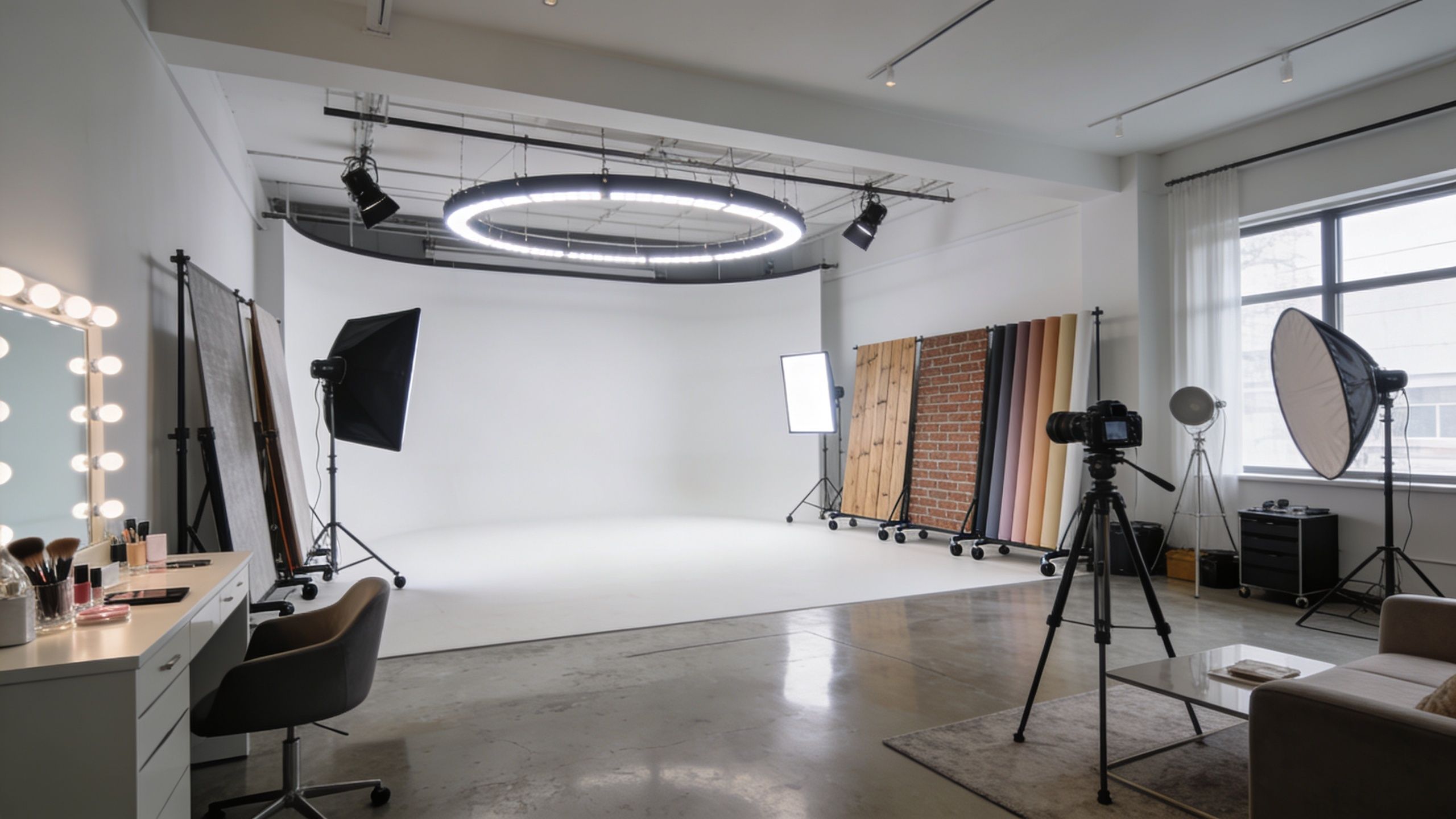
Publicly available information on pearl studios nj presents it as a capable creative facility in Jersey City. The listing highlights multi-track recording and video production, plus in-house engineers for mixing, recording, mastering and audio production on its venue profile. That makes it easy to understand the appeal. If you want a professional environment with technical support and production capability, it checks some important boxes.
What Pearl Studios NJ appears built for
Based on the public description, Pearl looks strongest as a facility-first studio. That matters. Some studios are organized around rooms, engineering, and session support. They’re useful when the client already knows what they need and already has a plan for everything after capture.
That model fits several project types well:
- Music sessions: Artists who need recording space, engineering, and a technically solid room.
- Rehearsal and practice use: Creatives who prioritize access to space over full-scale post-production support.
- Simple video capture: Teams that already have an editor, strategist, and publishing workflow in place.
There’s nothing wrong with that. In fact, for the right client, it’s efficient.
Where podcasters may hit friction
The issue for podcast and video creators isn’t capability. It’s clarity.
Public information doesn’t appear to show transparent pricing tiers, package breakdowns, or creator-specific bundles for podcast production, editing, or ongoing support. If you’re a podcaster trying to compare options, that’s a practical problem, not a cosmetic one. You’re not just asking, “Can I record here?” You’re asking, “What will the full process cost me, and what exactly do I get?”
That gap becomes more important when you’re evaluating ROI across a full season, launch cycle, or content sprint.
| Criteria | Pearl Studios NJ |
|---|---|
| Core identity | Traditional studio facility |
| Publicly listed strengths | Multi-track recording, video production, in-house engineers |
| Best fit | Music, rehearsal, creator-led production |
| Public package clarity for podcasters | Limited |
| Marketing and growth support | Not publicly detailed |
If you already have your own editor, distribution plan, and content strategist, a traditional studio can work. If you don't, the room alone won't solve your bottleneck.
That’s the key read on pearl studios nj. It looks like a legitimate space. But for podcasters, especially business-minded ones, the bigger question is what happens after the files leave the studio.
The Problem with Just Renting a Room
A lot of first-time podcasters underestimate where the work resides. It doesn’t live in the hour you spend on mic. It lives in the pile of decisions waiting after the recording ends.
You wrap the session feeling productive. Then you go home and realize you still need to clean audio, cut video, pull clips, write titles, draft descriptions, create thumbnails, publish the episode, and promote it in a way that doesn’t look rushed. That’s where DIY podcasting starts eating your week.
Recording is the easy part
Most creators can survive one decent recording day. The trouble starts when that single day has to become a repeatable system.
A room rental usually leaves you holding the rest of the process:
- Audio cleanup: Removing distractions, balancing voices, tightening pacing.
- Video editing: Choosing angles, trimming pauses, exporting platform-ready cuts.
- Short-form repurposing: Pulling reels and clips that gain attention.
- Packaging: Titles, episode descriptions, show notes, thumbnails, and posting assets.
- Distribution: Getting the content published correctly across channels.
- Promotion: Turning the episode into something people see, save, and share.
If you want the fuller breakdown of where professionals gain an advantage, this piece on studio vs DIY podcasting lays out the tradeoffs well.
DIY burnout is usually a systems problem
Creators often blame themselves when consistency slips. They think they need more discipline. Usually they need less fragmentation.
When your workflow depends on five freelancers, late-night revisions, scattered file transfers, and a vague publishing plan, the show starts feeling heavier than it should. The problem isn’t ambition. The problem is that you built a production line out of loose parts.
Practical rule: If your podcast only exists when you personally push every step forward, you don't have a production system. You have a recurring burden.
That burden shows up fast for entrepreneurs and personal brands. The show starts as a visibility tool, then evolves into a part-time operations job. Quality gets uneven. Posting cadence slips. Clips stop shipping. The brand feels less premium than it should.
Why room-first thinking limits growth
A room solves acoustics. It doesn’t solve momentum.
That distinction matters more for podcasters than for many other studio clients because podcasting is a compounding media play. Your authority comes from consistency, polish, discoverability, and distribution. If the studio only helps with capture, you still need another structure to make the content useful.
Here’s the blunt version. If your goal is to record, renting a room is fine. If your goal is to build a show that supports your business, expands your audience, and makes your brand look serious, “just fine” usually isn’t enough.
Flexwork The End-to-End Content Production Partner
The strongest alternative to a traditional studio model is a production-partner model. That means the creator doesn’t have to assemble the workflow from scratch. The studio, team, post-production, and content support already live in one ecosystem.

That’s the key distinction with a modern content hub. It isn’t selling isolation booths and backdrops as the end product. It treats those as the foundation. The end product is a finished content pipeline.
If you want an example of that model in practice, this look at a podcast studio that handles editing shows why podcasters increasingly prefer integrated support over piecing together vendors.
What end-to-end support actually changes
A podcast producer doesn’t just make the room work. A good producer protects your time, catches mistakes before they become expensive, and helps shape the episode into something publishable.
That’s why packages like Be My Podcast Producer matter. They answer a question most studios ignore. Who owns the quality after the record button stops? For a serious host, that’s the difference between hobby energy and professional output.
A stronger system also extends beyond the episode itself. For creators who want a real audience-building operation, Market, Manage & Produce My Podcast is the kind of offer that makes sense because it connects production with promotion instead of pretending those are separate worlds.
Transparent pricing changes the decision
One of the biggest advantages in a modern content studio is simple. You can evaluate the investment upfront.
Known package examples make that easier:
- Content Days are $3000/day and include 20 edited reels or 60 pro photos.
- Podcast websites are $5000 plus hosting.
- Market & Manage starts at $1500 per episode with a 20-episode growth commitment.
That level of clarity matters because creators can map deliverables to goals before they commit. You can decide whether you need an intensive content capture day, a full publishing machine, or a branded site that makes the show look credible.
The shift becomes even clearer when you see the workflow in motion.
Why this model tends to produce better ROI
The ROI isn’t just in file delivery. It’s in removing friction from the entire content cycle.
An integrated production setup gives you advantages a room-first model often doesn’t:
- Creative continuity: The same team understands your show format, voice, and visual standard.
- Faster repurposing: Clips, reels, and social assets are planned around the episode, not treated as an afterthought.
- Cleaner brand presentation: Your show, website, and distribution materials match each other.
- Operational sanity: You spend less time coordinating vendors and more time preparing strong episodes.
A premium show rarely fails because the host lacked ideas. It fails because the production workflow couldn't support the ambition.
For podcasters who care about authority, audience perception, and long-term consistency, that’s a better investment than chasing the cheapest room and paying for the chaos later.
Comparing Pearl Studios NJ and Flexwork Studios
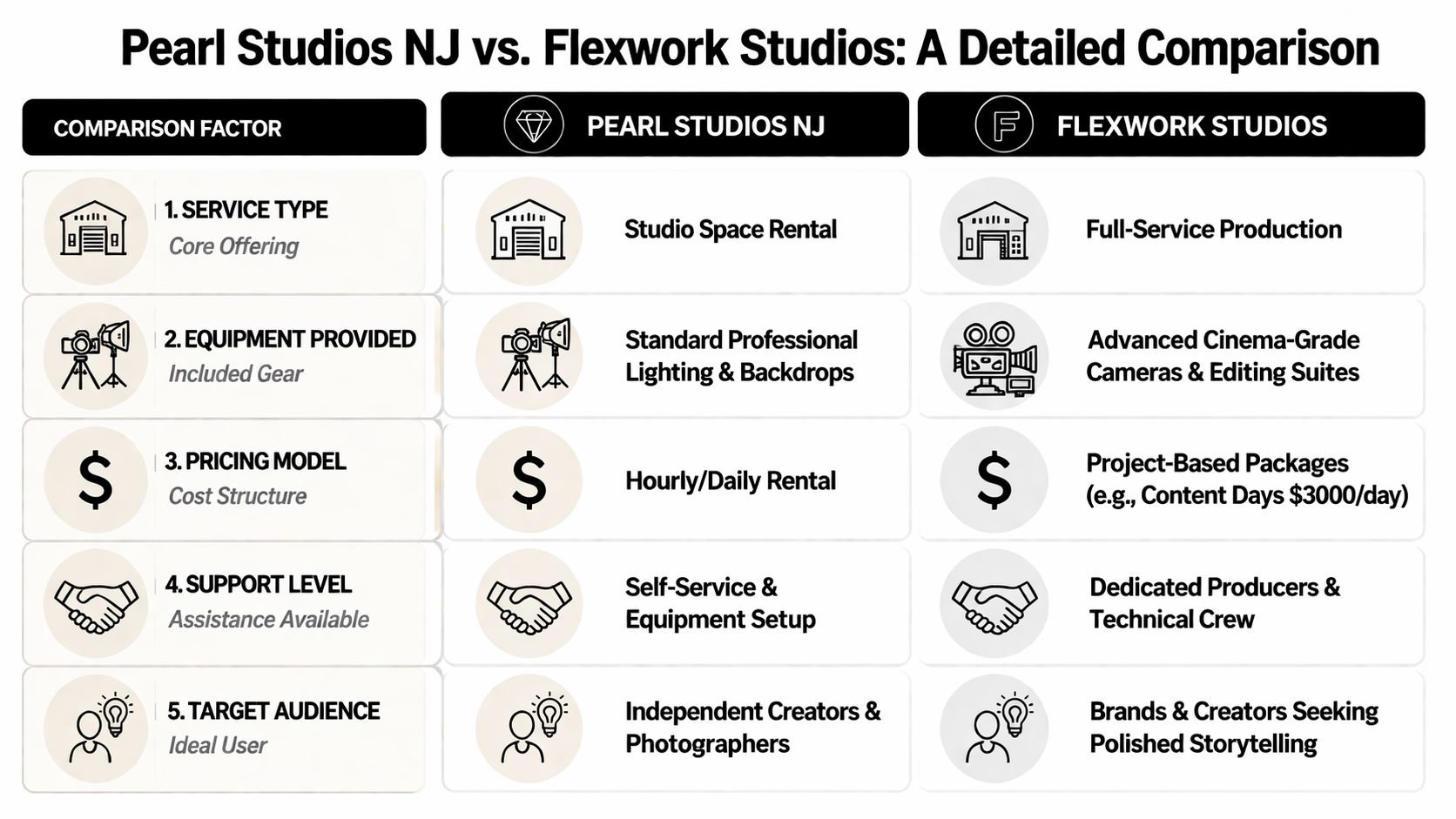
If you strip away marketing language, pearl studios nj and a full-service content studio are built around different assumptions. Pearl appears designed for clients who need a professional facility and can manage the rest. A modern podcast production hub is designed for clients who want the room, the team, and the downstream execution tied together.
That doesn’t make one universally better. It makes them suited to different kinds of creators.
Side-by-side comparison
| Category | Pearl Studios NJ | Flexwork Studios |
|---|---|---|
| Studio philosophy | Room and recording environment first | End-to-end content system |
| Publicly highlighted strengths | Multi-track recording, video production, in-house engineers | Recording, editing, packaging, marketing support |
| Ideal client | Musicians, rehearsals, self-managed creators | Podcasters, brands, entrepreneurs, growth-focused creators |
| Pricing visibility | Public package clarity appears limited | Transparent package examples are publicly stated |
| Post-production model | Engineering support is noted publicly | Editing and broader production support are central to the offer |
| Strategic value | Good if you already have your own team | Better if you want one partner managing the workflow |
A more detailed local comparison is also covered in this breakdown of what you really get for the price at NJ podcast studios.
The biggest divider is pricing transparency
The gap gets hard to ignore for podcasters.
Industry data on creator spending shows 62% of podcasters cite "unclear pricing structures" as a barrier to professional studio selection, according to the public reference tied to Pearl Studios NJ on Tagvenue. That’s not a minor inconvenience. It affects how creators budget, plan seasons, and decide whether professional support is realistic.
If a studio doesn’t publicly explain package logic, creators are forced to guess:
- What’s included
- What costs extra
- Whether editing is separate
- Whether the studio is built for podcasts at all
- How to compare one option against another
Pricing opacity doesn't just slow decisions. It makes creators postpone better production choices because they can't see the path clearly enough to commit.
For music clients, that may be less of an issue because they already know how they buy studio time. For podcasters, especially newer business podcasters, it creates friction right where confidence should exist.
Traditional studio versus content business infrastructure
A traditional studio asks, “What do you need to record?”
A modern production partner asks, “What are you trying to achieve with this show?”
That second question is far more useful for professionals. It changes the conversation from equipment to outcomes. A coach might need a weekly interview show, short-form clips, and a website that books discovery calls. A founder may need a branded video podcast that positions the company as credible in sales conversations. A media personality may need batch recording, polished social outputs, and a producer who keeps the set moving.
Those goals require infrastructure, not just access.
My candid take
If you’re a self-sufficient creator with your own editor, strategist, and publishing team, Pearl may be enough. You can use the room, direct the session, and keep your existing system intact.
If you’re building a podcast as part of your brand or business, the integrated model is the smarter move. You’ll derive more value from clear deliverables, fewer handoffs, and a setup that treats your show like a media asset instead of a one-off recording.
That’s the comparison. Pearl Studios NJ looks like a functional studio. Flexwork is built more like a content engine.
Which Studio Is Right for Your Creative Project
The best choice depends on what you’re producing. Not what sounds impressive. Not what photographs well. What the project needs.

Choose Pearl Studios NJ if
Pearl makes more sense when your project is space-led.
- You’re a musician or rehearsal client: The room and engineering environment matter more than content repurposing.
- You already have your own production stack: Editor, social team, publishing workflow, and brand strategy are already handled elsewhere.
- You want a facility, not a partner: You know exactly how to run your session and don’t need broader support.
That’s a valid use case. Not every creator needs the same level of infrastructure.
Choose a full-service production partner if
A modern production hub is the better move when your project is outcome-led.
Maybe you’re a coach building authority. Maybe you’re a founder who wants a clean branded show for clients and investors. Maybe you’re a creator who’s tired of recording strong episodes and then watching them disappear because nobody has time to package them properly.
Those creators need three things:
- A polished recording environment
- Reliable post-production
- A distribution-minded workflow
If your content is part of your business, treat it like business infrastructure. That’s also why more creators are paying attention to how podcasters are redefining global influence. The reach of a show now extends beyond audio. A single session can feed thought leadership, social content, search visibility, and relationship building.
You don't need the most famous room. You need the setup that makes it easiest to publish your best work consistently.
A quick decision filter
Ask yourself these questions before you book anything:
| Question | If your answer is yes |
|---|---|
| Do I already have editing covered? | A traditional studio may be enough |
| Do I need reels, clips, and content packaging? | Use a production partner |
| Is this podcast tied to business growth or personal brand authority? | Use a production partner |
| Am I mainly recording music or rehearsal material? | A traditional studio may fit better |
My recommendation is simple. If your show needs to perform, not just exist, choose the environment built for repeatable output.
Book Your Tour and Elevate Your Content
Serious podcasters in New Jersey don’t just need a room anymore. They need a workflow that protects quality, saves time, and turns recording days into real brand assets.
Pearl Studios NJ may fit creators who only need a capable space. But if you want a podcast that looks sharp, sounds finished, and keeps moving after the session, a full production partner is the stronger choice. That’s especially true when transparent packages and strategic support matter as much as the room itself.
The smartest next step is to see the difference in person. Book a free studio tour if you want to compare setup, process, and production philosophy before committing. A good studio should make your next season feel clearer, not more complicated.
If you’re ready to build a podcast that looks premium and runs like a real media operation, explore Flexwork Podcast Studios. Book a tour, review the production options, and choose a setup that supports your growth instead of adding more work to your plate.