
Headline: Lighting Equipment Rental for Smarter Content
Meta description: Lighting equipment rental can sharpen your video, but hidden costs add up fast. Learn when to rent and when a studio makes more sense.
URL slug: /lighting-equipment-rental-guide-2026
Primary keyword: lighting equipment rental
Secondary keywords: podcast studio lighting, video lighting rental, three-point lighting setup
You're probably in a familiar spot right now. Your mic sounds clean. Your message is strong. Your clips are thoughtful, sharp, maybe even funny. Then you hit play on the video and something feels off. The frame looks flat, your skin tone looks strange, the background disappears, and suddenly your content feels cheaper than it is.
That disconnect hurts more than most new creators realize. People will forgive a simple set. They won't forgive video that looks accidental. Lighting is usually the missing piece.
A lot of creators start searching for lighting equipment rental because it feels like the next smart move. Sometimes it is. Sometimes it's the first step into a more expensive and more complicated production workflow than expected. If you're trying to grow your brand without wasting time, this is the decision to get right.
The Missing Piece in Your Content Puzzle
A creator records a great interview at home. The guest is strong. The audio is solid. The conversation has real clip potential. But the final video looks like it was filmed in a hurry with a desk lamp and overhead kitchen light. The content isn't the problem. The visual trust is.
That's the trap. A weak lighting setup makes polished ideas look amateur. It drains authority from coaches, founders, podcasters, and personal brands that are trying to look credible enough for bigger rooms and better opportunities.
One doesn't hit this wall because they lack ambition. They hit it because lighting looks simple from the outside. Buy a panel, add a stand, point it at your face, done. In practice, good lighting is part technical skill, part taste, part environment control. That's why so many creators end up researching gear lists, tutorials, and best tools for content creators long before they realize the room and setup matter as much as the fixture itself.
Why Professional Lighting Elevates Your Brand
Professional lighting changes how people read you before they hear a word. It shapes your face, separates you from the background, and gives your content the kind of visual confidence that says you know what you're doing.
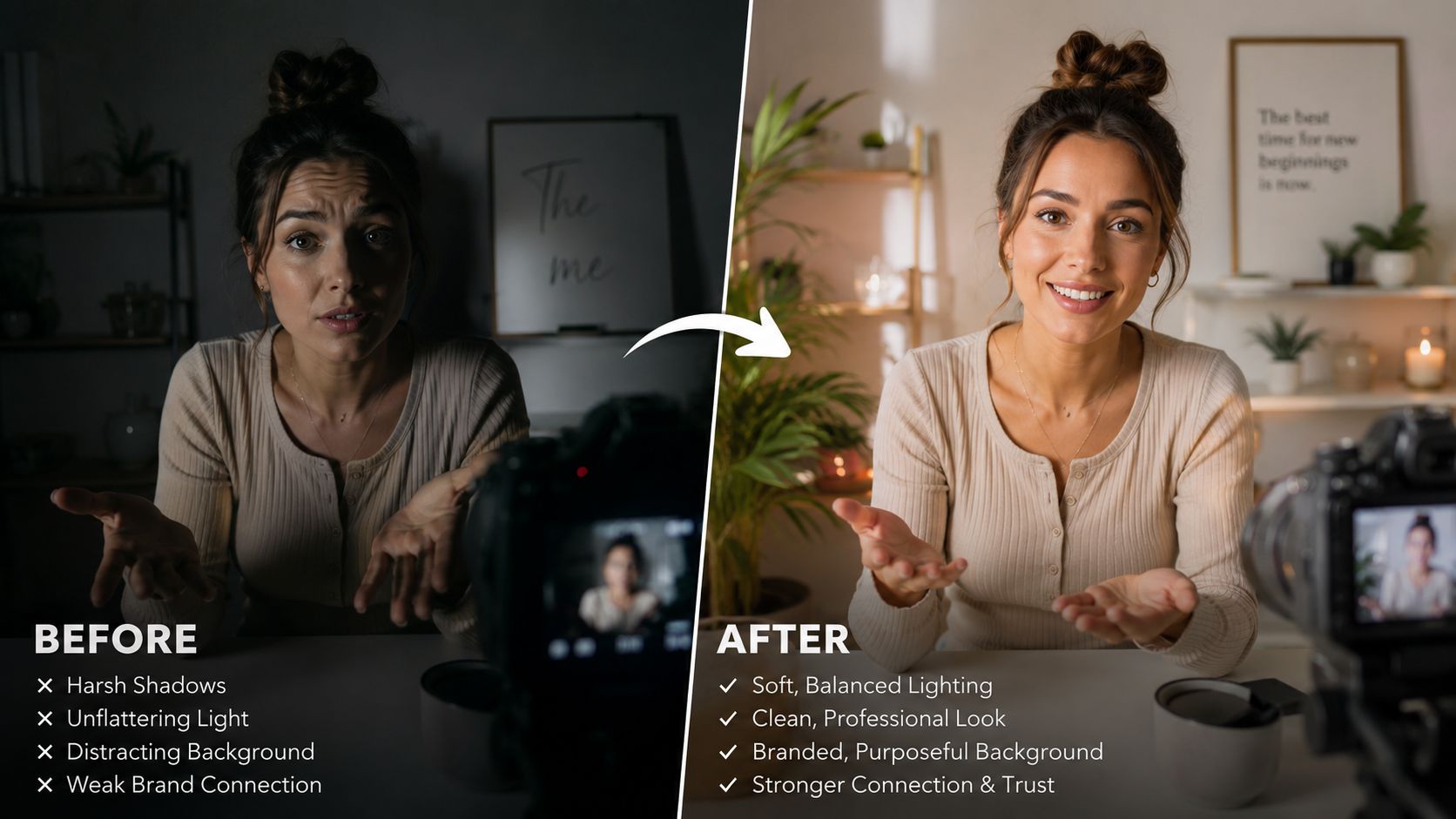
A lot of creators obsess over cameras first. That's backwards. Great lighting can make a modest camera look expensive. Bad lighting can make expensive camera footage look lifeless. If you care about trust, premium positioning, or brand consistency, lighting isn't decoration. It's presentation strategy.
Good lighting protects your credibility
The technical term worth knowing is CRI, or Color Rendering Index. For broadcast-quality video, fixtures must maintain a CRI of at least 90, and low CRI or uneven spectrum causes color shift that makes skin tones look unnatural and lowers production value no matter how good the camera is, according to this breakdown of video lighting quality and CRI requirements.
That matters more than most rental catalogs admit. A cheap light can be bright and still be wrong. Brightness alone doesn't make someone look healthy, polished, or premium on camera.
Practical rule: If your face looks gray, shiny, overly red, or oddly green on camera, don't blame the lens first. Blame the light.
There's also a style question. Professional lighting helps you control mood. Soft, flattering light works for interviews, expert-led content, and polished podcast clips. More directional light can create drama for brand films or creative campaigns. The point isn't making everything look cinematic. The point is making your look intentional.
For creators building a recognizable visual identity, that consistency matters. The same host should look like the same brand from episode to episode. The same founder should look equally credible in a solo clip, a guest interview, or a launch announcement. If your lighting changes wildly every time you shoot, your brand starts to feel unstable.
Lighting does more than flatter faces
It also handles practical problems:
- Background separation: A strong setup keeps you from blending into dark walls, furniture, or set pieces.
- Color accuracy: Brand colors, clothing, and product packaging look more believable on screen.
- Viewer retention support: People may not name the lighting issue, but they notice when a frame feels harsh, dim, or chaotic.
- Set polish: The room feels designed instead of improvised.
If you want a useful visual primer before comparing gear, this guide to best lighting for video recording is a smart reference point.
Here's a simple demonstration worth watching before you spend money on fixtures.
The brand lesson most creators learn late
Your audience may not understand lighting terminology. They do understand polish. They know when a frame looks trustworthy and when it looks like an afterthought.
That's why professional lighting enhances your brand so quickly. It doesn't just make you look better. It makes your content feel more expensive, more deliberate, and more ready for growth.
A Podcaster's Guide to Lighting Equipment
If you're looking at lighting equipment rental for podcast video, don't start with product names. Start with the job each light needs to do.
The easiest framework is three-point lighting. Imagine it as dressing a person for camera. One element leads, one balances, one adds separation.

The three lights that matter most
Key light
This is the main light on your face. It does the heavy lifting. It creates shape, defines your features, and sets the tone for the entire image.
For most podcast setups, the key light should be soft, flattering, and controlled. That's why creators often rent or use an LED panel with diffusion, a softbox, or a COB light pushing through a modifier.
Fill light
The fill light softens the shadows created by the key light. Without it, your frame can look too contrast-heavy for business content, interviews, or conversational video.
Sometimes the fill is a second light. Sometimes it's just bounce from a reflector or nearby wall. You don't always need a powerful fixture here. You need balance.
Backlight
The backlight sits behind or slightly above the subject and helps separate them from the background. This is the light that gives the image depth.
Without backlight, a frame can look flat. With it, the subject pops.
A polished podcast frame usually doesn't look complicated. It looks clean because every light has one job and does it well.
The gear you'll actually see in rental inventories
The lighting equipment rental market is being shaped by LED lighting technology, which offers energy efficiency and reduced heat output, along with wireless control systems, according to this overview of global lighting equipment rental trends. For creators, that means the most practical rental options are often the easiest to work with.
Here's the plain-English version of common gear:
- LED panels work well for interviews, desks, and podcast sets. They're quick to place and easy to adjust.
- Softboxes tame harshness and make faces look better. If your content centers on people, softness usually wins.
- COB LED lights give you more output and more modifier options. They're popular when you need flexibility.
- Light stands seem boring until one fails or doesn't fit your space. They matter.
- Grids and flags control spill. They stop light from washing out the background or bouncing everywhere.
- Wireless controls save time when you need to tweak brightness or color without walking into frame repeatedly.
What podcasters should prioritize
A podcast host doesn't need the same lighting package as a live event crew. You need the setup that supports faces, set design, and repeatability.
Use this filter when evaluating a rental list:
| Priority | Why it matters for podcasts |
|---|---|
| Soft key light | Helps skin look natural and flattering |
| Fast setup | Saves energy before the conversation starts |
| Low heat | Keeps talent comfortable during longer recordings |
| Simple control | Reduces fiddling between takes |
| Compact footprint | Important in tighter studio or office setups |
If you're shooting guest interviews or solo episodes regularly, it helps to understand how a professional room is assembled. This look inside a video podcast studio gives useful context for how lighting fits with camera placement, background design, and workflow.
The Real Cost of DIY Lighting Rental
You book a light kit for what looks like a reasonable day rate. By the time the cases are in your car, the stands are built, the room is fighting you, and your first test shot looks flat, you are no longer making content. You are managing a small production problem.
That is the trap with DIY lighting rental. The fixture price looks clear. The working cost is not.

The advertised rate only covers part of the job
Rental quotes often start with the attention-grabbing item. Then the practical gear shows up. A checklist from Axion Stage Light on hidden stage lighting rental costs explains how items such as safety cables, trussing, power distribution, and consumables can push the final bill far beyond the fixture rate.
That matters because creators do not shoot with a lamp. They shoot with a system. The light needs support, control, power, transport, and enough setup time to make it useful.
Daily rental numbers can still look manageable on paper. The problem is that paper ignores the room, the labor, and the margin for error. If the light is technically rented but the environment is still uncontrolled, you have not solved the production problem. You have rented part of a solution.
The expensive part is often your time
DIY rental rarely fails because a light does not turn on. It fails because the day gets eaten by tasks that were never on the creative brief.
Here is where the time goes:
- Pickup and return: loading cases, checking inventory, protecting gear in transit, and getting everything back on schedule
- Assembly: stands, modifiers, sandbags, cabling, and power routing
- Room correction: fighting window spill, ceiling height limits, reflective walls, and bad outlet placement
- Testing: adjusting exposure, color temperature, shadow shape, and background separation
- Troubleshooting: fixing the setup when skin tones look off or a two-person frame needs a different approach
A creator can lose hours before recording a usable first take.
If your shoot day includes learning lighting from scratch, you are spending production time on training, not output.
Bad lighting is a brand cost
This is the part gear lists miss. Lighting mistakes do not just slow down the session. They show up in the final asset.
Flat faces make a set look cheap. Mixed color temperatures make skin look unhealthy. Spill on the background kills depth. Inconsistent exposure across episodes weakens recall, because your content stops looking like a deliberate series and starts looking improvised.
That is why repeatable content demands more than access to fixtures. It demands control. If you need that control without building it yourself each time, a look at professionally managed in-house studio options is more useful than comparing fixture specs line by line.
Ask these questions before you rent anything
A quick self-audit will tell you whether DIY is a smart production choice or a false economy.
Do you understand the room?
Window light, wall color, ceiling height, and power access shape the result as much as the fixture does.Can you judge light through the camera, not just with your eyes?
A setup that feels bright in person can still look muddy or uneven on screen.Do you have time for resets?
Recording days already include scripting, guest management, styling, audio checks, and pickups.Do you need consistency across episodes or campaigns?
If the answer is yes, improvising each setup is the wrong workflow.
Rental pricing reflects more than the object
Equipment rental companies price for wear, maintenance, downtime, prep, and replacement risk. Hapn's equipment rental utilization benchmarks show how operators track utilization and daily rates to keep inventory profitable and serviceable.
You should care because that pricing logic explains why DIY rarely stays cheap for long. You are paying for the gear ecosystem, then adding your own labor on top of it. For a one-off experiment, that can be fine. For recurring podcast production, founder content, or branded video, it usually means spending more effort to get a less consistent result.
DIY still has a place
DIY rental makes sense when you have a specific creative concept, a crew that knows how to light it, and a location already under control.
For routine content, it usually turns a straightforward recording day into a technical operation. That is a poor trade if your goal is polished, repeatable work.
The Turnkey Advantage of Flexwork Studios
You arrive ready to record at 9:00. By 9:40, you are still adjusting stands, chasing glare off the table, and asking whether the key light should sit higher or softer. That is the fork in the road. A rented light kit gives you equipment. A turnkey studio gives you a working production system.

That difference matters more than many creators expect. Good lighting depends on the room, the set, the camera angle, skin tones, wardrobe, reflective surfaces, and how fast you need to move through a shoot. If those pieces are handled separately, you become the person responsible for making them work together.
A turnkey studio removes that burden.
What turnkey actually buys you
The biggest gain is predictability. You walk into a room built for recording, with lighting that already makes sense for the set and camera positions. Audio treatment, framing, and background control are part of the environment, not extra problems waiting to appear on set.
Time is the next advantage. A self-managed setup can burn through the best part of your session before you record a usable take. In a studio built for podcasts and branded video, that energy goes into performance, guest chemistry, and getting enough strong material to publish.
Then there is taste. Gear does not create a polished look by itself. Placement, shaping, contrast, and consistency do. Professional help closes the gap between having lights and producing something that looks credible to clients, sponsors, and future guests.
Repeatability is what turns a one-off shoot into a business asset. If your show, founder content, or branded series needs to look consistent week after week, the environment has to cooperate.
Smart creators stop paying for the chance to figure it out and start paying for a setup that works on demand.
Where Flexwork fits for serious creators
Flexwork Podcast Studios makes sense for creators who want strong output without building a mini production department around every session. The value is not a pile of gear. The value is alignment. The room, lighting, camera setup, and support are built around podcast and video production, so you are walking into a process instead of assembling one.
That is why podcast equipment rental and studio support is a better starting point than another round of gear research for many NJ and NY creators. You can choose the level of help that matches the job, from straightforward studio time to a more guided production day.
The package decision many creators should make earlier
Here is the producer's advice. If you publish occasionally and just need a clean space, keep it simple. Book the room, record efficiently, and leave with usable footage.
If you are building a serious content engine, batch production wins. A focused content day is easier to schedule, easier to brand, and easier to turn into clips, promos, and episode assets without starting from zero every week. That is where Flexwork's higher-touch packages become practical. They are built for creators who need output, not just access.
The same logic applies if your goals include audience growth, distribution, and a stronger brand presence around the show. Production is one part of the machine. Strategy is the other. If you are still deciding your content strategy, settle that first. Once video is clearly part of your growth plan, a controlled studio workflow becomes an operational decision, not a luxury.
A simple comparison
| Option | What you manage | What you get |
|---|---|---|
| DIY lighting rental | Gear selection, pickup, setup, testing, troubleshooting, return | Flexibility with more room for inconsistency |
| Production space plus add-on lights | Space booking and partial technical coordination | Better environment, but support can stay fragmented |
| Turnkey studio session | Your preparation and on-camera performance | Controlled production and consistent output |
| Producer-backed package | Creative direction and approval | Polished capture plus a clearer path to publishing |
Lighting rental sounds like a gear choice. For a growing creator, it is a workflow choice. If you want to spend your best energy hosting, selling, teaching, interviewing, or leading the room, choose the setup that keeps you out of technical cleanup.
Elevate Your Content Beyond the DIY Ceiling
At a certain point, DIY stops being resourceful and starts becoming expensive in all the wrong ways. You spend time solving lighting, fixing inconsistencies, managing gear, and trying to make a temporary setup look permanent. That effort rarely shows up as brand value.
Professional content needs control. Not flashy gear for its own sake. Control over light, sound, framing, pace, and output.
If you're still deciding where video fits in your brand, this guide on deciding your content strategy is worth reading because it helps clarify what format deserves your energy. Once you know video belongs in your growth plan, the next move is simple. Stop building around friction. Build around quality you can repeat.
The creators who rise fastest usually don't do everything themselves. They choose better systems sooner.
If you're ready to create in a space built for polished podcast and video production, book a session with Flexwork Podcast Studios. Tour the Springfield, NJ studio, explore the production packages, and choose the setup that lets you focus on performing instead of troubleshooting.