

How to Soundproof a Room for Flawless Audio
 February 10, 202616 Minutes
Exceptional audio isn’t a luxury—it's the price of entry. For discerning podcasters, creators, and entrepreneurs, the difference between professional polish and amateur quality is often decided before you even hit record. The subtle hum of traffic, the echo from a bare wall, or the muffled sound from the next room can instantly undermine your credibility. To truly command your audience's attention, you need a pristine sonic environment. This guide explores how to soundproof a room effectively, but more importantly, it will show you the most efficient path to achieving broadcast-quality sound. At Flexwork Studios, we've engineered the perfect solution for New Jersey's most ambitious creators, eliminating the guesswork so you can focus on your craft.
The High Cost of DIY Burnout
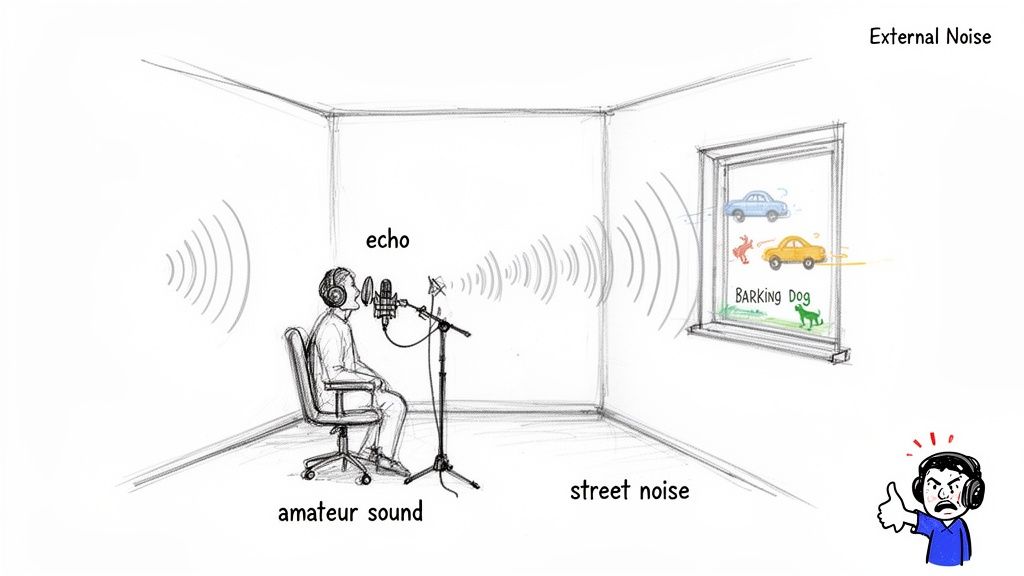
You’ve invested in a quality microphone and sharpened your content, yet something is still off. That faint buzz from the air conditioner, the reverb bouncing off your home office walls, or the distracting city sounds bleeding through the window—these aren't minor flaws. They are brand assassins. In today’s competitive content landscape, listeners have zero tolerance for subpar audio. It signals a lack of professionalism and silently erodes your authority.
This frustration sends countless creators down a rabbit hole of expensive gear upgrades and complex editing software, only to find the root problem remains: the room itself. The time, money, and creative energy spent battling your environment is a drain on your most valuable resource. This is the definition of DIY burnout—a common pain point for ambitious podcasters trying to produce high-end content in a less-than-ideal space. Every hour spent troubleshooting audio is an hour not spent creating, connecting, and growing your brand.
The Flexwork Solution: Professional Sound, On Demand
This is precisely where a professional studio environment becomes a strategic advantage. Instead of sinking thousands of dollars and countless hours into a home setup that may never meet professional standards, you can access a perfectly engineered space on demand.
At Flexwork Studios, we offer the definitive solution to DIY burnout. Our Market, Manage & Produce My Podcast package is designed for creators who are serious about growth and quality. Starting at $1500 per episode (with a 20-episode growth commitment), this comprehensive service provides access to our state-of-the-art, acoustically perfect studios and lifts the entire production burden from your shoulders. We handle the recording, editing, distribution, and marketing, transforming your podcast into a polished, professional media asset. For creators who need flexibility, our Hourly Studio Rentals provide the same pristine environment without the long-term commitment. Stop fighting your room and start creating your best work.
Soundproofing vs. Acoustic Treatment: A Critical Distinction
Before you invest in any sound solutions, it’s essential to understand the fundamental difference between two commonly confused terms: soundproofing and acoustic treatment. Misunderstanding this is the most common and costly mistake aspiring creators make. One isolates your room from the outside world, while the other refines the sound within it.
Soundproofing is about isolation. Its sole purpose is to block sound from entering or leaving a space. This is a structural endeavor, involving dense, heavy materials to create a barrier against external noise like traffic, neighbors, or construction. True soundproofing requires adding mass and decoupling structures to stop sound vibrations in their tracks.
Acoustic treatment is about absorption and diffusion. It controls how sound behaves inside the room. This is what eliminates echo, tames harsh frequencies, and prevents reverb, resulting in clear, articulate audio. Acoustic panels, bass traps, and diffusers are tools of acoustic treatment, not soundproofing.
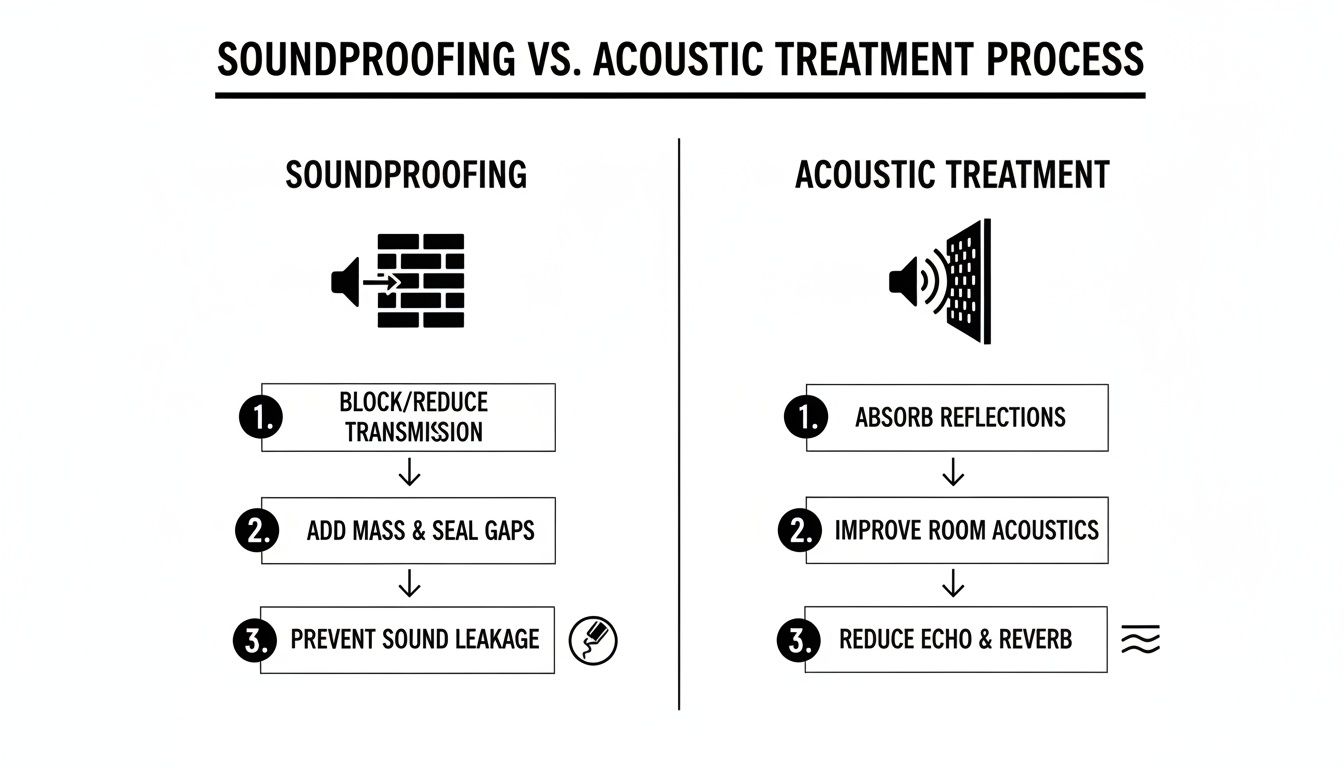
A room can be perfectly acoustically treated but still be useless for recording if you can hear sirens outside. Conversely, a fully soundproofed room might sound like a cavernous echo chamber without proper acoustic treatment. A professional studio, like those at Flexwork, is meticulously engineered to master both. If you want to see how these principles come together in a pro setup, our guide on podcast studio design ideas is packed with inspiration.
Your Practical DIY Soundproofing Playbook
If a professional studio isn't in the budget just yet, targeted DIY efforts can make a noticeable improvement. The key is to focus on high-impact, low-effort solutions that address the most common sources of noise pollution. Forget ineffective myths like egg cartons—these are the actionable steps that yield real results.
1. Seal Every Air Gap
Sound travels like water: it exploits the path of least resistance. The most significant audio leaks in any room are air gaps. Sealing them is the single most effective DIY soundproofing tactic.
- Acoustic Sealant: Apply this flexible caulk around window frames, door trim, and electrical outlets to plug invisible leaks.
- Weatherstripping: Install high-quality foam or rubber weatherstripping around the perimeter of doors and windows to create an airtight seal when closed. Remember the golden rule: if air can get through, sound can get through.
2. Add Mass to Doors and Windows
Standard interior doors are often hollow, offering almost no sound resistance. Windows are another weak point. The solution is to add density.
- Mass-Loaded Vinyl (MLV): This heavy, flexible material can be attached directly to a door to significantly increase its mass and sound-blocking capability.
- Heavy Curtains: Use dense, multi-layered "blackout" or "thermal" drapes over windows to absorb sound and reduce transmission.
3. Leverage Furniture Strategically
Your existing furniture can be a powerful acoustic tool. Soft, porous surfaces absorb sound, while hard, flat surfaces reflect it.
- A large, stocked bookshelf against a shared wall acts as an excellent sound diffuser and absorber.
- A plush sofa, upholstered chairs, or a thick area rug will dramatically reduce echo and absorb stray sound frequencies.
Thinking strategically about room layout can improve your audio quality at no extra cost. For more tips on setting up your space, check out our deep dive on building an effective home podcasting studio.
While these methods help, professional acoustic insulation is a massive industry for a reason. Materials used in studios can achieve a sound reduction of 40-50 dB, blocking up to 90% more sound than a DIY setup. To understand the technology, explore the latest market trends for building acoustic insulation.
Advanced Soundproofing: The Professional Standard
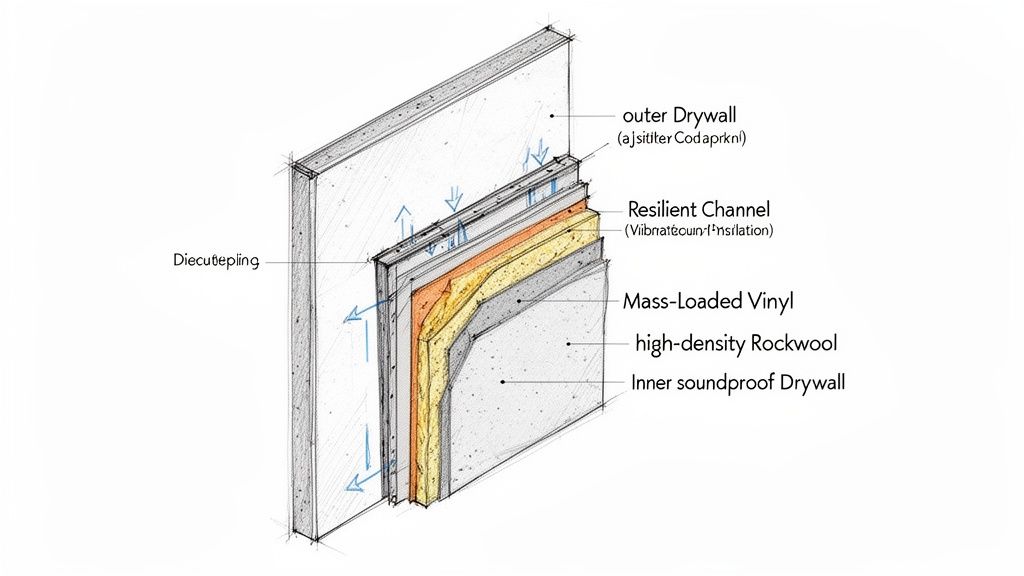
When basic fixes aren't enough, it's time to adopt the principles of professional studio construction. This moves beyond surface-level treatments to fundamentally altering a room's structure to achieve true sonic isolation. This is the science that separates acceptable audio from exceptional audio.
The Power of Decoupling
The most critical concept in professional soundproofing is decoupling. This means creating a physical separation between structures to stop sound vibrations from traveling through them. It’s the principle behind the "room-within-a-room" design used in world-class recording studios.
- Resilient Channels & Isolation Clips: These specialized hardware components are used to "float" drywall off the wall studs. This creates an air gap that breaks the path of vibration, dramatically reducing sound transmission.
High-Density Insulation
Standard home insulation is designed for thermal efficiency, not acoustic performance. Professional studios use high-density materials designed specifically to absorb sound energy.
- Rockwool: This insulation, made from spun volcanic rock, is incredibly dense and highly effective at trapping sound waves within wall cavities, converting their energy into heat.
Adding Critical Mass
Finally, increasing the mass of your walls is key to blocking low-frequency sound like traffic rumble.
- Mass-Loaded Vinyl (MLV): Sandwiching this thin, heavy material between layers of drywall adds significant sound-blocking power without adding excessive thickness.
- Soundproof Drywall: This engineered product features a constrained layer of viscoelastic polymer that converts sound energy into heat, effectively deadening vibrations.
Combining these techniques is how you achieve true silence—the foundation of professional content. You can see how we put these principles into practice by taking an insider look at what makes a great podcast studio.
When to Stop DIYing and Go Pro
There comes a point where the returns on your DIY efforts diminish. You’ve sealed every gap and hung every blanket, but the neighbor’s lawnmower still ruins a perfect take. This is the moment to stop thinking like a hobbyist and start making strategic decisions as the CEO of your brand. Your time, energy, and creative focus are too valuable to be spent constantly battling your recording environment.
The compromises of a "good enough" setup accumulate. Each workaround, each edit to remove background noise, and each moment of frustration chips away at your final product and your passion for the craft. Your content deserves a setting that matches its quality. Professional growth happens when you decide your creative energy is a finite resource that must be protected. Investing in a perfect recording environment isn’t an expense; it’s an investment in your brand’s future.
If you feel you're at this crossroads, explore our article on the top five signs you’re ready to upgrade to a professional podcast studio.
The Flexwork Studios Advantage
This is the problem Flexwork Studios was built to solve. We've mastered the science of sound so you don't have to. Our studios are not just quiet rooms; they are precisely engineered acoustic environments designed for one purpose: to capture flawless audio and video for New Jersey and New York’s top creators.
- Total Sound Isolation: Our broadcast-standard soundproofing provides a silent canvas, free from the distractions of the outside world.
- Flawless Acoustics: Our rooms are treated to eliminate echo and reverb, ensuring your voice is captured with pristine clarity.
- Premium Equipment: Walk in and access industry-standard microphones, cameras, and lighting to produce content that looks and sounds exceptional from the start.
Solutions like Framery interior pods offer a glimpse into professional-grade isolation. At Flexwork, we provide that same elite quality, wrapped in a full-service ecosystem designed to accelerate your growth.
Burning Questions About Soundproofing
Navigating the world of soundproofing can be confusing. Here are clear, straightforward answers to the most common questions from creators seeking perfect audio.
What is the cheapest way to make a room quieter?
The highest-impact, lowest-cost action is sealing air gaps. Use acoustic sealant to fill any cracks around windows, doors, and outlets. This simple step can yield a dramatic improvement for a minimal investment, making it the most efficient first move for any DIY project.
Will foam panels soundproof my room?
No. This is the single most common misconception. Acoustic foam panels are for acoustic treatment—they absorb sound inside the room to reduce echo and reverb. They do nothing to block sound from entering or leaving. True soundproofing requires heavy, dense materials to create a physical barrier.
What is the realistic cost of professional soundproofing?
Hiring professionals for a full soundproofing renovation is a significant construction project. A "room-within-a-room" build, which involves decoupled walls and specialized materials, can easily cost between $10,000 and $50,000 or more. This is why renting a professionally built studio is a more financially strategic option for most creators.
What is the absolute first step I should take?
Before you buy anything, diagnose your core noise problem. Record yourself speaking and listen back carefully. Is the issue echo and reverb from within the room (an acoustic treatment problem)? Or is it external noise like traffic bleeding in (a soundproofing problem)? Identifying the true culprit will ensure you invest your time and money in the right solution.
When your ambition outgrows your environment, it's time to leverage a space designed for excellence. At Flexwork Podcast Studios, we've eliminated the technical barriers to professional content creation. Our fully soundproofed and acoustically tuned studios provide the silent, pristine canvas your work deserves.
Stop wrestling with your room and start creating with confidence. Explore our studio rental and production packages to discover the difference professional sound can make.