

The Best Podcast Microphone for Creatives Who Mean Business
 November 22, 202536 Minutes
You've got a powerful message, but is your microphone doing it justice? Choosing the best microphone for podcasting feels like a critical decision because it is—your audio quality is the first impression you make. While a solid starter choice like the Rode NT-USB+ ($169) offers plug-and-play simplicity for solo creators, the true industry standard for professional, broadcast-quality sound is the legendary Shure SM7B ($399). The right microphone doesn't just capture your voice; it communicates your authority. At Flexwork Studios, we've built our entire recording experience around helping you sound as professional as your ambitions, eliminating the guesswork so you can focus on your craft. This guide will help you understand the essential choices that separate amateur audio from a polished, premium sound.
Your Voice Is Your Brand. Stop Settling for Bad Audio.
In the competitive world of podcasting, your audio is your digital handshake. It’s the first—and often only—chance you get to establish credibility with a new listener. Presenting your brilliant ideas with subpar audio is like showing up to a keynote presentation in a wrinkled shirt. It signals a lack of professionalism and undermines your authority before you’ve even made your point. Your voice isn't just delivering content; it is your brand, and every hiss, echo, or distortion chip away at the premium experience you want to create. This guide cuts through the technical jargon to help you make a smart, confident investment in your sound.
The True Cost of Poor Audio
Think about the last podcast you abandoned mid-episode. Chances are, it wasn't due to a boring topic but because the sound was distracting—the host's voice was thin, background noise was overwhelming, or the volume was inconsistent. Listeners have endless options, and their tolerance for poor audio quality is razor-thin. Bad sound doesn't just cost you listeners; it costs you authority. Mastering fundamental techniques, like learning how to reduce background noise from your microphone, is the first step toward sounding like a professional who deserves to be heard.
Your gear should empower your creativity, not complicate it. When you spend more time fighting hums and buzzes than connecting with your audience, your process is broken.
From DIY Dilemmas to Professional Polish
Many aspiring podcasters fall into the same trap: they invest in a high-quality microphone but neglect their recording environment. A $400 microphone in an empty, echo-filled room will still sound amateurish. This is the content creator's plateau—the frustrating gap between the gear you own and the polished, "NPR-level" sound you're striving for. Achieving that clean, professional audio is a sophisticated blend of the right equipment, an acoustically treated space, and expert technique.
This is precisely the problem Flexwork Studios was designed to solve for creatives in the New Jersey area. Our acoustically engineered studios and industry-standard equipment provide the perfect environment to capture your voice with the clarity and power it commands. Instead of getting lost in technical details, you can focus on delivering your best performance. To learn how we perfect every recording, explore our guide on post-production best practices.
Dynamic vs. Condenser: The Two Main Flavors of Mics
So, you’re ready to buy a microphone. The first big decision you'll face is choosing between a dynamic and a condenser mic. Think of it like a chef selecting a knife. One isn't inherently "better," but a sushi chef and a butcher require different tools to achieve professional results.
A dynamic mic is your rugged, all-purpose chef's knife. It's tough, reliable, and fantastic at focusing on the task at hand—capturing your voice while ignoring a lot of the clatter around it. This makes it a hero in less-than-perfect recording spaces, like your home office with the whirring computer fan or a lively interview with multiple guests talking over each other.
On the other hand, a condenser mic is like a razor-sharp, specialty sashimi knife. It’s incredibly sensitive and designed to capture every tiny detail, every subtle texture, and every delicate nuance of your voice. This is what gives professional podcasts that crisp, shimmering, "radio-ready" sound. But that precision comes with a catch: it needs a quiet, controlled environment to do its best work. Otherwise, it'll pick up that sashimi and the sound of the air conditioner kicking on down the hall.
To make it even clearer, let's break down the core differences.
Dynamic vs Condenser Mics at a Glance
| Feature | Dynamic Microphone | Condenser Microphone |
|---|---|---|
| Best For | Untreated rooms, multiple guests, loud speakers | Acoustically treated studios, solo hosts |
| Sensitivity | Lower (rejects background noise) | Higher (captures fine detail) |
| Durability | Very durable, built like a tank | More fragile, requires careful handling |
| Power Needs | None (typically) | Requires Phantom Power (+48V) |
| Sound Profile | Rich, warm, broadcast-style | Crisp, detailed, and airy |
| Typical Price | Generally more affordable | Often more expensive |
Ultimately, your choice boils down to your recording reality. Let’s dig into which one is right for you.
When to Grab a Dynamic Microphone
Dynamic mics are the undisputed workhorses of the podcasting world, and for good reason. Their focused pickup pattern is incredibly forgiving, making them the go-to for creators who value reliability over capturing every last whisper.
You should go with a dynamic microphone if:
- Your recording space echoes: Got hardwood floors, big windows, or bare walls? A dynamic mic is your best friend for taming that nasty room reverb that a condenser would gobble up.
- You host a roundtable show: When multiple people are in the same room, a dynamic mic's ability to reject sound from the sides is a lifesaver. It keeps everyone’s audio clean and separate.
- You get LOUD: If you're an energetic host who laughs, shouts, or gets passionate, a dynamic can handle those high-volume moments without distorting.
The industry has certainly voted with its wallet. Dynamic mics have become the default for podcasting, with their market share hitting an estimated USD 1.20 billion and making up a whopping 66.59% of the total podcast mic market. You can read more about why podcasters love this tech at consainsights.com.
Struggling with bad audio? This little flowchart can help you figure out if your mic or your room is the real villain.
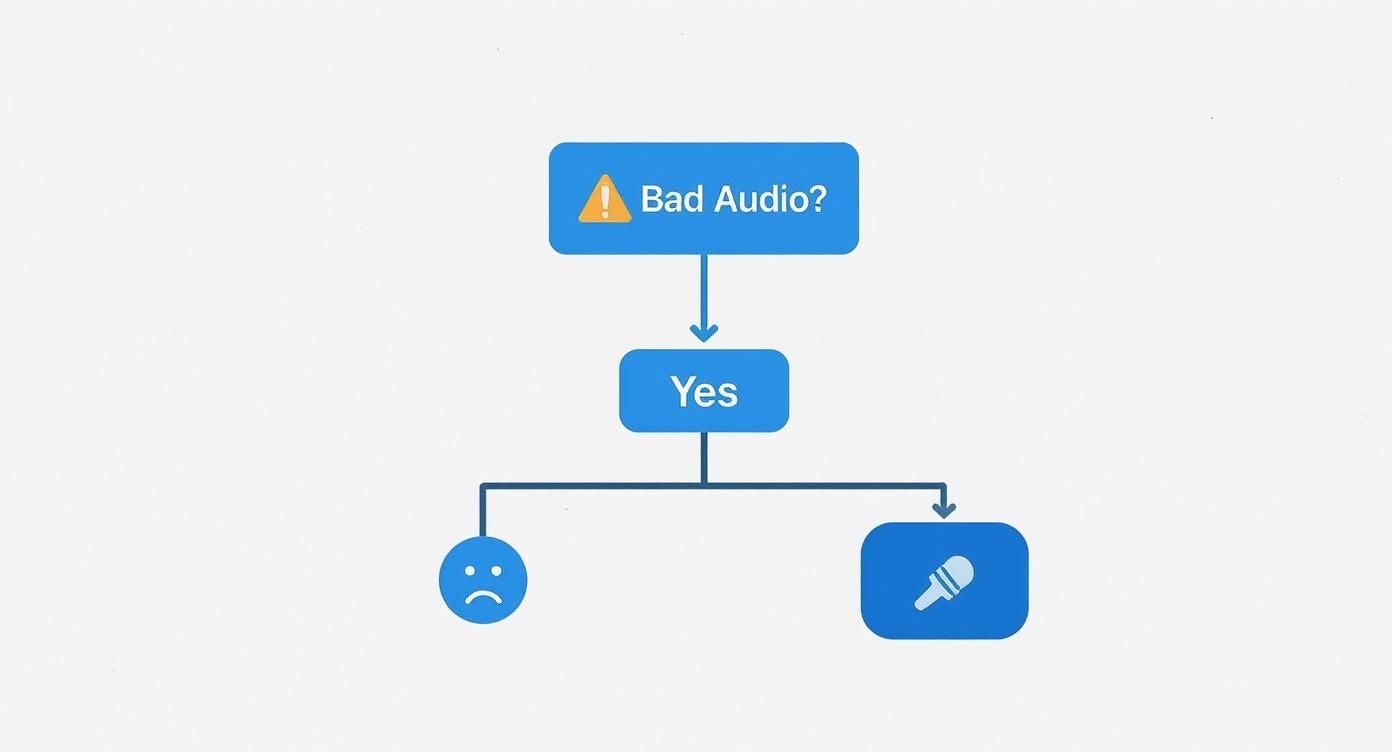
That chart drives home a point that so many new podcasters miss: your room is just as much a part of your sound as your microphone is.
When a Condenser Microphone Makes Sense
A condenser mic is your golden ticket to that ultra-clear, deeply detailed sound you hear on top-rated shows. It captures a much wider range of frequencies, which gives your voice a richer, more "in-the-room" presence. But remember, with great sensitivity comes great responsibility.
Choose a condenser microphone only when:
- You record in a treated, silent space: A room with acoustic panels, bass traps, or even a walk-in closet packed with clothes is where a condenser truly gets to shine without picking up unwanted noise.
- You're a solo host obsessed with audio perfection: For audiobooks, solo narrative shows, or anyone who wants to capture every subtle inflection, a condenser will elevate your sound to a whole new level.
The big dilemma for most podcasters is wanting that premium condenser sound without having the pro-level room to match. This is precisely the problem a professional studio solves in an instant.
At Flexwork Studios, our soundproof recording booths were built from the ground up to be the perfect home for high-end condenser mics. We’ve handled the acoustics so you can get that polished, signature sound without worrying about the neighbor's dog barking or your fridge humming. To learn more about creating that professional edge, check out our guide on advanced recording techniques for elevating your podcast. Once you understand this crucial difference, you can finally align your gear with your goals.
USB vs. XLR: Choosing Your Connection
https://www.youtube.com/embed/KP1h_ooipDk
Alright, so you’ve picked your side in the great dynamic vs. condenser debate. The next big question is all about the plug: how does this thing actually connect to your computer? This isn't just about a cable. It's about choosing your path—simplicity or scalability.
Think of it like this: a USB mic is like a fantastic point-and-shoot camera. It’s simple, powerful, and gets you a great shot with minimal fuss. An XLR mic is like a pro-grade DSLR with interchangeable lenses. It offers unparalleled control and quality, but it requires a bit more gear and know-how.
Your two main options here are USB and XLR. Let's break down what that really means for you and your podcast.
The "Plug and Play" Hero: USB Microphones
A USB microphone is the very definition of convenience. You take it out of the box, plug the USB cable directly into your computer, and you’re ready to roll. It pulls power and sends your voice down the same wire. No extra boxes, no complicated setup.
This simplicity is its greatest strength. If you're a solo host, an entrepreneur who needs to record quickly, or anyone who just wants to hit "record" without a technical headache, the USB mic is your best friend. You can literally be recording five minutes after the delivery driver drops off the package.
- Best for: Solo podcasters, beginners, and anyone who wants a minimal, no-fuss setup.
- Key Advantage: Incredible ease of use and affordability. You don't need any other hardware to get started.
- Heads-Up: Most computers can only handle one USB mic at a time, which makes them a tough choice for shows with in-person co-hosts or guests.
The Professional Powerhouse: XLR Microphones
Step into any professional recording studio on the planet, and you'll see XLR cables snaking across the floor. This is the undisputed industry standard, and for good reason. An XLR mic doesn't plug directly into your computer. Instead, it connects to an audio interface (or a mixer), which is a separate box that then connects to your computer via USB.
That little box is where the magic happens. An audio interface is packed with high-quality components designed to do one job perfectly: translate your voice into pristine digital audio. It gives you physical knobs to control volume, a dedicated headphone jack to hear yourself without any lag, and—most importantly—multiple inputs. You can finally record with a co-host!
An XLR setup is an investment in your future. It’s the foundation that lets your show grow from a solo project into a multi-host production without ever hitting a technical wall.
This is exactly why all our podcast suites at Flexwork Studios are built around a high-end XLR workflow. We handle the pro-level interfaces and mics so you can get that broadcast-quality sound without the upfront cost and learning curve. This kind of professional flexibility is a game-changer, especially for more advanced setups, as we explain in our guide on how to host remote guests from our NJ podcast studio.
- Best for: Ambitious podcasters, multi-host shows, and anyone who refuses to compromise on audio quality.
- Key Advantage: Top-tier sound, hands-on control, and the ability to expand your setup for guests and co-hosts.
- Heads-Up: This route requires buying an audio interface, so the initial investment is a bit higher.
So, what’s the final verdict? A USB mic is the perfect way to get your voice out there with fantastic quality and zero friction. An XLR setup is the choice for creators who are building for the long haul, ready to create a podcasting empire.
The Only Mic Specs You Actually Need to Care About
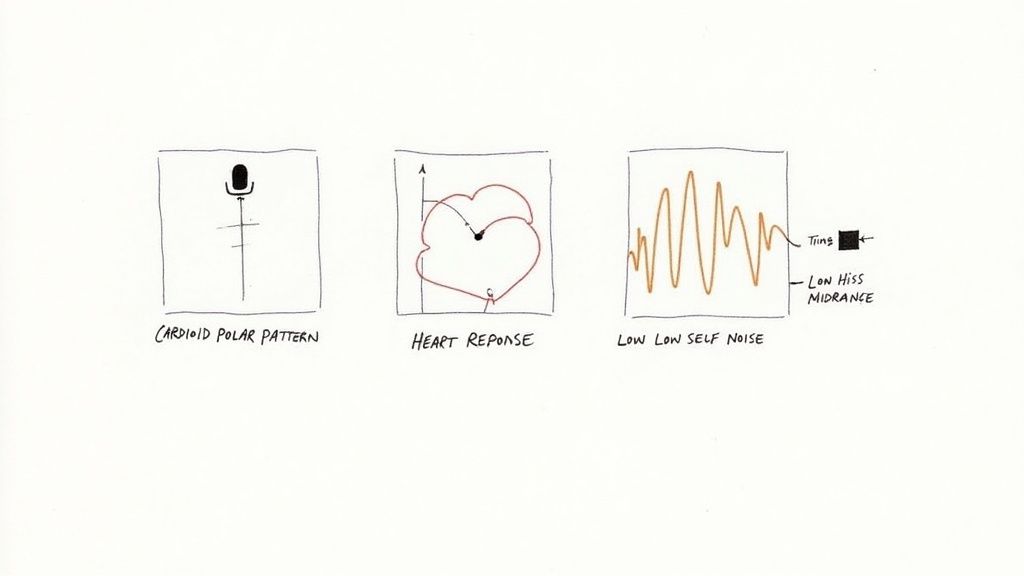
Let’s be honest: staring at a microphone’s spec sheet can feel like trying to read ancient hieroglyphics. You’ll see terms like "max SPL" and "transient response" thrown around, but for podcasting, most of that is just technical noise.
You don’t need an engineering degree to pick a great mic. We're going to cut through the clutter and focus on the three pillars that truly separate a pro-sounding podcast from an amateur one. Think of these as your cheat codes to amazing audio.
Polar Patterns: Where Your Mic Is Listening
A microphone’s polar pattern is its superpower. It’s a map of where the mic is paying attention and, just as importantly, where it’s not. For a podcaster, there’s one pattern to rule them all.
That champion is cardioid. Picture a heart-shaped bubble of sensitivity extending from the front of the mic—that’s its sweet spot. Anything you say into that zone sounds fantastic. But the real magic is what it rejects. Sounds from the sides get muffled, and noises from behind are almost completely ignored.
This is your built-in defense against the echo bouncing off your walls, the clacking of your keyboard, and the annoying whir of your computer fan. While some mics are chameleons with multiple patterns (like omnidirectional or bidirectional), the focused nature of cardioid is what keeps your voice the star of the show.
Frequency Response: How Your Mic Hears Your Voice
If the polar pattern is where the mic listens, frequency response is how it listens. It’s all about the range of tones the mic can pick up, from the deep rumbles in your voice to the crisp, high-end details.
You might hear audio nerds praise a "flat" response, which means the mic captures all tones equally. But for podcasting, a little bit of personality is a good thing. The best mics are often tailored specifically for the human voice. They might have a slight, gentle bump in the upper-mid frequencies, which is the secret sauce for making speech sound clear, present, and articulate.
What you're trying to dodge is a mic that makes you sound unnaturally boomy or, worse, thin and tinny. The goal is to find a mic that captures a warm, natural, and rich version of you—think of it as the audio equivalent of a perfectly tailored suit.
Key Takeaway: A great frequency response doesn't just record you; it flatters you. It makes your voice sound full and authoritative, giving your words the impact they deserve.
Self-Noise: The Sound of Silence
Here’s the spec that separates the toys from the tools: self-noise. It’s the incredibly faint electronic hiss a microphone produces just by being on. In professional audio, the entire game is getting this number as low as possible.
Why does it matter? A mic with low self-noise gives you a clean, black canvas to record on. When you pause for dramatic effect, your listeners hear pure, delicious silence—not a distracting, fuzzy hiss. This is a massive differentiator between cheap gear and professional-grade equipment.
Starting with a quiet signal makes your life in post-production a thousand times easier. If you try to compress or EQ a noisy recording, you’re just turning up the volume on that hiss. A quiet mic means your final product will sound polished, clean, and effortlessly pro. To learn more about building that perfect sound, check out our other guides on achieving top-tier audio quality.
Building Your Essential Podcasting Audio Kit
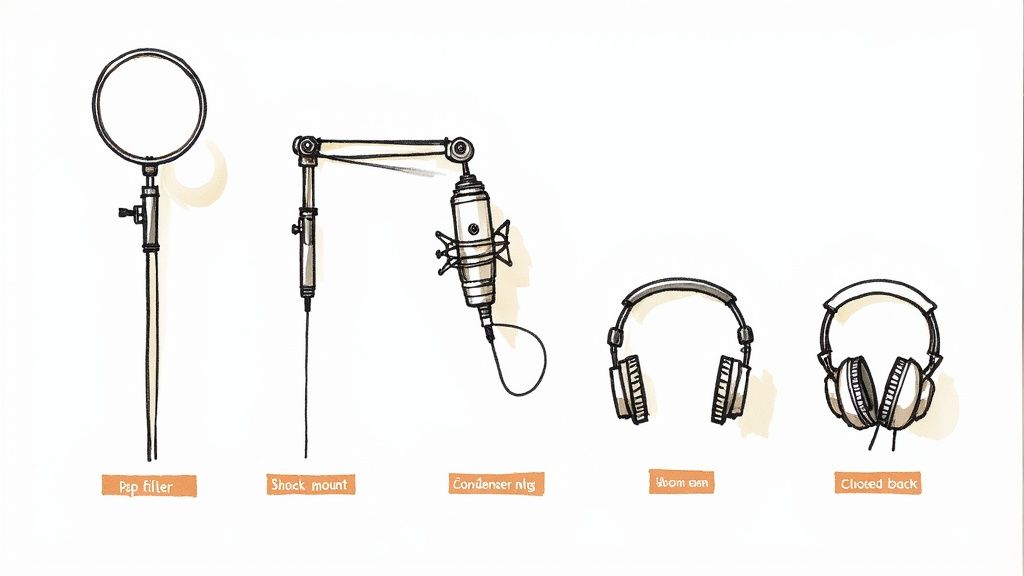
So, you’ve picked out the perfect microphone. Fantastic! But that’s just step one. To get that rich, polished sound you hear on your favorite shows, you need to build a complete audio system around it. The right accessories are what turn good audio into truly great, broadcast-ready content.
Think of your microphone as a world-class race car engine. It’s got a ton of power, but it’s not going anywhere without a solid chassis, killer tires, and a tuned suspension. This is your audio toolkit—the gear that makes sure your voice is captured cleanly and consistently, free of any weird technical hiccups.
The Must-Have Podcasting Accessories
Let's be real: pulling together a proper setup takes time and money. While the mic gets all the glory, these supporting actors are what make the show possible. Don't even think about hitting record without them.
Here’s your essential checklist for a pro-level audio kit:
-
Pop Filter or Windscreen: This little lifesaver is your first line of defense against plosives. You know, those harsh, thumping air blasts you get from words with hard 'p' and 'b' sounds? A pop filter smooths them out. It’s a cheap tool that makes a massive difference.
-
Shock Mount: Ever accidentally bump your desk while recording? That low-frequency rumble you hear is a recording-killer. A shock mount uses elastic bands to cradle your mic, absorbing those vibrations before they ever reach the recording and ruin a perfect take.
-
Boom Arm: A good boom arm does more than just hold your mic up. It lets you position it perfectly and comfortably, so you can speak naturally while keeping a consistent distance. That consistency is the secret to steady, professional-sounding audio levels.
-
Professional Headphones: Recording without headphones is like flying a plane blind. A pair of closed-back studio headphones lets you monitor your audio as it’s happening. You'll catch problems like an air conditioner kicking on or your levels being too hot during the recording, not when you’re listening back later.
The Value of a Ready-Made Pro Setup
The right gear isn't just a "nice-to-have" anymore; it's the standard. Microphones have become the top dog in the podcasting hardware world, making up 24.2% of a market valued at a whopping USD 3.6 billion recently. As you map out your shopping list, checking out a complete guide to starting a podcast can give you the bigger picture. In fact, the demand is so high that the market is projected to skyrocket to USD 28.07 billion.
Investing in a full audio kit is a serious commitment. It means research, setup, and troubleshooting—all time you could be spending on creating amazing content. For a busy professional, time is everything.
This is exactly why we've done the hard work for you. Every single session at Flexwork Studios, whether it’s one of our Hourly Rentals or a full-service “Be My Podcast Producer” package, comes with a complete, professionally dialed-in audio kit. We provide industry-standard Shure microphones, shock mounts, boom arms, and studio headphones—all set up and ready to go. You can dig deeper into our gear choices in our articles on podcasting equipment.
When you book with us, you get to skip the entire gear-buying-and-fiddling-with-it phase and step right into a broadcast-ready environment. You can put all your energy into your performance, knowing the tech behind you is top-tier.
Beyond the Mic: Escaping DIY Burnout for Good
There comes a point in every serious creator’s journey when the endless gear hunt becomes a distraction. You’ve spent hours on YouTube reviews, invested in the "best" microphone, and meticulously placed a pop filter. Yet, your audio still has that unmistakable homemade quality. The polished, professional sound you're chasing feels perpetually out of reach. This is DIY burnout—the sinking feeling that you’re spending more time as a frustrated audio engineer than as the visionary creator you set out to be. If this sounds familiar, it’s a clear sign: it’s time to upgrade your process, not just your equipment.
Trading Your Gear Obsession for a CEO Mindset
It's easy to get caught in the gear acquisition trap. The podcasting microphone market, valued at USD 1.1 billion and projected to hit USD 2.5 billion, is built on selling the dream of a quick fix. You can dive into the market trends and see why North America leads the charge over at dataintelo.com.
But the most successful creators—those who transform their podcasts into thriving brands—understand a fundamental truth: their most valuable asset isn't a piece of equipment. It's their time. Adopting a CEO mindset means focusing on high-impact activities like scripting compelling content, securing high-profile guests, or building a community. It means delegating the technical complexities to experts so you can operate in your zone of genius.
The big leagues aren't about what gear you own. They're about getting the best possible results in the most efficient way possible.
That's the shift. Booking a professional studio isn't an expense; it's a strategic investment in quality, efficiency, and your own creative energy.
Your Shortcut to Professional Sound
This is precisely why we created Flexwork Studios. We have obsessively managed every technical variable so you don’t have to. Our studios are not merely quiet rooms; they are acoustically engineered environments designed to make our industry-standard microphones perform flawlessly, ensuring you leave with impeccable audio every single time. Stop worrying about background noise or room echo. Walk into a space built for perfection and focus on what you do best: creating impactful content.
We offer a clear path forward for creators at every level:
- Producer Packages: For those who demand a polished, multi-camera video podcast and flawless audio without the technical burden. Our team handles every detail, from recording to final edits.
- Market, Manage & Produce My Podcast: This is our all-inclusive solution for creators committed to serious growth. Starting at $1500 per episode (with a 20-episode commitment), we become your strategic production partner.
- Content Day Sessions: Maximize your efficiency by batch-recording an entire season's worth of content. For $3000, you get a full day in our studio and leave with a wealth of assets, including 20 edited reels or 60 professional photos.
The cycle of buying, testing, and returning gear is a treadmill that keeps you from your best work. It’s time to trade frustration for confidence. Stop the gear hunt and book a tour of Flexwork Studios—and hear what truly professional sounds like.
Your Podcast Mic Questions, Answered
Alright, let's tackle some of the most common questions that pop up when you're wading through the sea of podcast microphones. Think of this as your personal cheat sheet for making smart choices.
What's the best microphone to start with if I'm a total beginner?
If you're just starting out and want something that just works right out of the box, you can't go wrong with a solid USB condenser mic like the Rode NT-USB+. It gives you that crisp, clean sound for solo recording and is as simple as plugging it into your computer.
But here's a little pro-tip: think about where you want your show to go. If you ever plan on bringing in a co-host, interviewing guests in person, or adding video, you'll eventually need to jump to a more professional XLR setup. So, the "best" first mic is one that fits where you are now, but with an eye on the future.
Realistically, how much cash should I set aside for a good mic?
For a really solid entry-level USB mic, you're looking at a budget between $100 and $200. If you're ready to step up to the big leagues with a pro-level dynamic XLR mic—like the legendary Shure SM7B you see everywhere—plan for around $400 for the mic itself. Don't forget, you'll also need a decent audio interface, which will add another $150 to $300 to the bill.
Toss in a boom arm, a pop filter, and a shock mount, and a complete home studio setup can easily top $700. This is exactly why so many smart creators just book time at Flexwork Studios. You get to play with thousands of dollars worth of top-tier gear without having to shell out all that cash upfront.
Can my co-host and I just share one microphone?
Technically, you could… but please, for the love of your listeners, don't. Sharing a single mic is a recipe for disaster. You'll end up with one person sounding way too loud, the other sounding like they're in a different room, and an overall hollow, unprofessional echo. It's a nightmare to fix later.
The golden rule of podcasting is simple: one person, one mic. This gives you clean, separate audio tracks for each speaker, which is the only way to get that polished, professional sound. It's non-negotiable, and it's how every multi-person setup at Flexwork Studios is wired.
If I spend a ton of money on a mic, will my podcast automatically sound amazing?
Nope. Not a chance. A super expensive microphone is like a high-definition camera—it captures everything with stunning clarity. That includes the good (your voice) and the bad (the echo in your spare bedroom, the hum of your air conditioner, your neighbor's dog barking).
An expensive mic in a bad room will always sound worse than a decent mic in a great room. Your recording space is just as important as your gear. That's the secret sauce of a place like Flexwork Studios. Our rooms are acoustically treated and built from the ground up to make sure our world-class mics capture nothing but pristine, perfect audio.
Stop chasing gear and start creating your best content. The professional sound you're looking for is waiting for you at Flexwork Podcast Studios. Book a free tour today and experience the difference for yourself.
Article created using Outrank

Related Posts
How to Preserve Your Creative Vision Without Handling Tech
Your creativity is the asset. The tech should follow. Discover how top creators…
Turnkey Podcast Solutions for Consultants Who Want to Scale Their Brand
Consultants don’t need another job—they need a system. Learn how turnkey…
Podcasting for B2B Brands: A Tactical Playbook
Forget vanity metrics. This is how B2B brands are using podcasts to drive real…