
How to Start a Podcast from Scratch in 2025
 December 10, 202527 Minutes
So, you want to start a podcast. It's a powerful impulse for any entrepreneur or creative with a message to share. But before you get lost in visions of high-end microphones and viral soundbites, let’s establish one critical truth: the magic isn't in the gear. The real work lies in strategy, quality, and execution.
Launching a successful podcast comes down to four key milestones: defining a magnetic concept, choosing the right production path, recording and editing pristine episodes, and executing a launch that commands attention. Get these fundamentals right, and you're not just creating content—you're building a brand. At Flexwork Studios, we specialize in helping ambitious creators navigate this journey, turning great ideas into polished, professional shows that captivate and convert.
Your Podcast Begins With a Powerful Idea, Not a Microphone
It’s easy to fall down the rabbit hole of tech specs and gear reviews. You can spend weeks comparing XLR mics to USB mics, agonizing over audio interfaces, and watching endless tutorials. But the secret sauce of a truly great podcast isn't a thousand-dollar microphone.
It's the idea. The vision. The why.
Before you even think about hitting "record," the most important work happens with a clear strategic plan. A crystal-clear concept is the bedrock of any show that manages to build a loyal, engaged audience. Think of it as the strategic blueprint for your brand, whether that's personal or professional. Inconsistent or unfocused content is a common pain point for creators, leading to audience churn and stagnant growth. A strong concept solves this before it starts.
Foundational Questions for Your Podcast
Every podcast that makes a real impact started with solid answers to a few core questions. Nailing these down is what separates a hobby from a professional production that drives results.
- What is the core premise of my show? Distill your podcast's purpose into a single, powerful sentence. This is your north star.
- Who is my ideal listener? Get specific. Picture them clearly—their ambitions, their challenges, what they seek from your content.
- What is my unique angle? The podcasting landscape is crowded. Your unique perspective, voice, and experience are your competitive advantage.
- How will I structure my content? Are you a solo expert, an insightful interviewer, or a masterful storyteller? The format defines the experience.
This isn't just busywork; it's non-negotiable strategy. Getting clear on this foundation makes every subsequent decision—from episode topics to marketing tactics—infinitely easier. It's the deep preparatory work that ensures success, whether you’re building a DIY setup or walking into a professional space like Flexwork Studios.
A podcast without a clear concept is just noise. Your idea is the signal that cuts through, creating a direct line to the listeners who need to hear exactly what you have to say.
Ultimately, a killer concept is the first step in mastering the art of storytelling that captivates your audience. It's what makes your show resonate long after the episode ends.
Find Your Niche and Define Your Podcast's Identity
Let's be direct: in a world saturated with audio content, another generic show is destined to be ignored. Before you daydream about theme music or cover art, your critical mission is to carve out a sharp, specific identity for your podcast.
This isn't an optional step. This is the strategic foundation that separates a fleeting hobby from a brand that builds a fiercely loyal community. Your podcast’s identity is the combination of your unique viewpoint, the specific person you’re speaking to, and the value you promise to deliver, every single time they hit play. This clarity prevents the inconsistent content quality and limited reach that plague so many DIY podcasters.
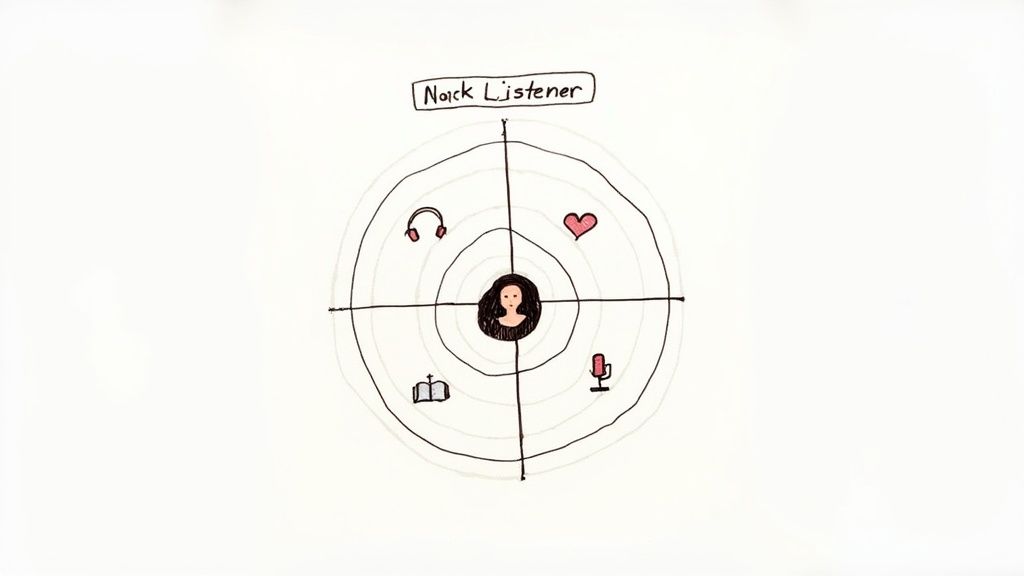
Who Are You Actually Talking To?
The first rule of compelling content is to know your audience. And we mean truly know them. Vague descriptions like "millennial entrepreneurs" or "health-conscious women" are insufficient. You need to dig deeper.
It's time to build a listener persona—a detailed, vivid profile of your ideal fan.
Get inside their head and understand their world:
- What are their primary challenges and aspirations? Your content must be the solution they are actively seeking.
- What other media do they consume? Knowing the podcasts, blogs, or creators they admire provides a roadmap to their tastes and expectations.
- What is their ultimate goal? Whether scaling a business or mastering a skill, your show should be their trusted guide on that journey.
When you truly understand this one person, every episode feels like a direct conversation. That's how you make someone feel seen and understood—the bedrock of listener loyalty.
Carve Out Your Space in a Crowded Market
Jumping into podcasting in 2025 means stepping into one of the most exciting—and packed—arenas in media. With millions of shows available, the competition is immense.
The only way to win is to get specific. You need to find a niche where you can become the undisputed, go-to authority.
A niche isn't about thinking small; it's about being laser-focused. Don't start a generic "business podcast." Instead, launch a show about "scaling a SaaS startup from $1M to $10M ARR." Forget a broad "wellness" show. How about "mindfulness for ER nurses"?
A narrow focus is your superpower. It attracts a highly engaged audience that is far more likely to subscribe, share, and champion your show. It's always better to be a major voice to a passionate tribe than a faint whisper in a crowded stadium.
Choosing a Format That Fits Your Vision
Think of your show's format as the vehicle for your big idea. It shapes the listening experience and dictates your entire production workflow. There's no "best" format—only the one that best serves your content and plays to your strengths.
Here are a few proven models:
- The Solo Show: Positions you as the expert. Ideal for thought leadership, deep dives, or coaching-style content. You have total creative control but must command the listener's attention alone.
- The Interview: Leverages the expertise and audience of your guests. An excellent way to network and bring fresh perspectives, but it demands strong research and conversational skills.
- The Co-Hosted Dynamic: The right chemistry between two hosts can be electric, creating a relatable energy that makes listeners feel part of the conversation.
- Narrative Storytelling: The heavyweight champion of podcasting. Weaves together interviews, narration, and rich sound design. It's production-intensive, but the result can be pure, immersive magic.
The format you choose defines your show's personality. To explore your options, see our guide on the vibrant world of podcasting genres and formats. It will help you match your concept to the perfect structure.
Choosing Your Gear: The DIY vs. Professional Studio Path
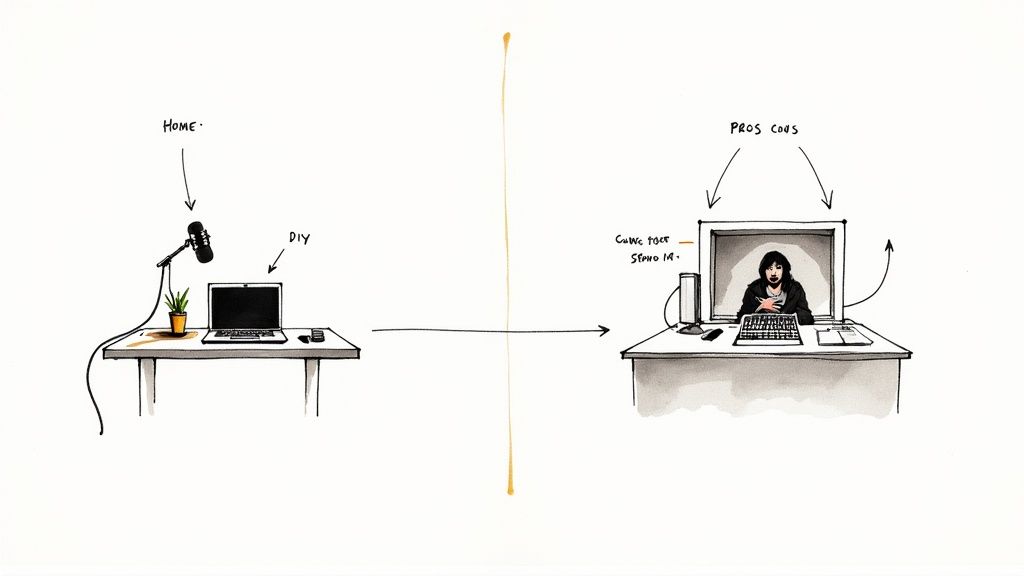
You have your concept. Now comes the part that trips up many aspiring creators: the gear. It's easy to get lost in technical reviews, but the goal isn’t to become an audio engineer. It’s to capture clean, professional sound that honors your content.
Your listeners' attention is precious. The quickest way to lose it is with crackly, echoey, or amateur audio. This is your first major strategic decision: Do you build a home studio or leverage a professional one? This choice impacts your time, budget, and the quality you present to the world from day one. Many creators face DIY burnout from wrestling with tech issues instead of focusing on their message.
The DIY Home Studio Route
Going the DIY route is tempting. It offers the convenience of recording on your own schedule. But it also appoints you Head of IT, sound engineer, and troubleshooter.
The costs can be deceptive. A simple USB mic can quickly escalate into a full shopping list: audio interface, boom arm, pop filter, quality headphones, and acoustic treatment. Your "side project" suddenly has a significant price tag and a steep learning curve.
Here's a realistic look at the investment:
- The Starter Kit ($150 – $300): A solid USB mic like a Blue Yeti or Rode NT-USB+. It’s a start, but you’ll be at the mercy of every ambient noise in your room.
- The "Getting Serious" Setup ($400 – $800): An upgrade to an XLR microphone and an audio interface like the Focusrite Scarlett 2i2. The quality improves, but so does the complexity.
- The "Pro" Home Studio ($1,000+): High-end mics, a mixer like the RODECaster Pro, and dedicated acoustic treatment. This can yield incredible sound… if you master it.
And that's before considering software. You'll need to learn editing, which means comparing podcast editing software like Descript and Tubentum to find the right fit for your workflow.
The true cost of a DIY setup isn’t just financial. It’s the countless hours spent on research, troubleshooting, and learning technical skills that detract from content creation. For a busy professional, that time is your most valuable asset.
The Professional Studio Advantage
What if you could bypass the technical hurdles entirely? Imagine walking into a space engineered for perfect sound, sitting down at a world-class microphone, and focusing solely on your message. That's the professional studio path.
This is the ultimate accelerator for creators who value their time and demand exceptional quality from episode one. Booking a session at Flexwork Studios provides access to an acoustically perfect, soundproof environment equipped with industry-leading gear. Instead of wrestling with software, you can channel 100% of your energy into your performance.
Podcast Setup Comparison: DIY Home Studio vs. Flexwork Studios
Which path is smarter for an ambitious podcaster? This table lays out the tradeoffs.
| Factor | DIY Home Studio | Flexwork Studios Hourly Rental |
|---|---|---|
| Upfront Cost | Moderate to very high ($150 – $1,000+) | Zero |
| Audio Quality | Variable, dependent on gear & your skill | Consistently professional & broadcast-ready |
| Technical Setup | Your responsibility; a potential time sink | Handled entirely by our expert team |
| Time Investment | Significant hours in research & setup | Minimal; walk in and start recording |
| Acoustics | A constant battle against echo & room noise | Perfectly treated, soundproof environment |
| Professionalism | Requires serious effort to sound high-end | Instant premium look and sound |
For the modern entrepreneur, using a professional studio isn't an indulgence—it's a strategic move. You eliminate technical headaches, guarantee pristine quality, and launch your brand with the polish it deserves. Our hourly rentals provide an accessible entry point to premium production, emphasizing affordability and speed for creators on the move.
Mastering the Art of Recording and Production
Your concept is locked in, and your production path is chosen. Now, it's time to create. This is where you step up to the mic and bring your vision to life.
Capturing clean, crisp audio isn’t just a best practice; it's the price of admission. Poor audio quality is the number one reason listeners abandon a show. Whether you’re in a professional studio or a home setup, the core principles of a great recording remain the same.
Getting That Broadcast-Ready Sound
Your microphone is an instrument. How you use it dramatically impacts the warmth and clarity of your voice.
- Find Your Sweet Spot: Position yourself about 2-4 inches from the mic for that rich, intimate "radio voice." Too close creates a muddy, bass-heavy sound; too far sounds thin and distant.
- Talk Across, Not Into: A pro technique to minimize plosives (harsh "p" and "b" sounds). Angle your mouth slightly to the side of the mic’s diaphragm instead of directly into it.
- Control Your Environment: Ambient noise is the enemy of clean audio. Before recording, silence your phone, close the window, and turn off any fans or air conditioners. A sensitive microphone will pick up everything.
For a deeper dive, explore our guide on advanced recording techniques to elevate your podcast sound quality for more tips on achieving pristine audio.
The Overlooked Art of Post-Production
A great recording is only half the battle. Raw audio files require post-production—the meticulous process of editing, mixing, and mastering that transforms a good recording into a polished listening experience. This is where DIY burnout becomes a serious threat.
Staring at a complex audio timeline, trying to eliminate every "um," balance levels, and add music without it sounding amateurish is a technical, time-consuming skill. It pulls you away from what you do best: creating exceptional content.
The hours you sink into learning software and fixing audio are hours you're not spending booking guests, planning content, or growing your audience.
This workflow illustrates the journey from raw recording to a polished, publish-ready episode.
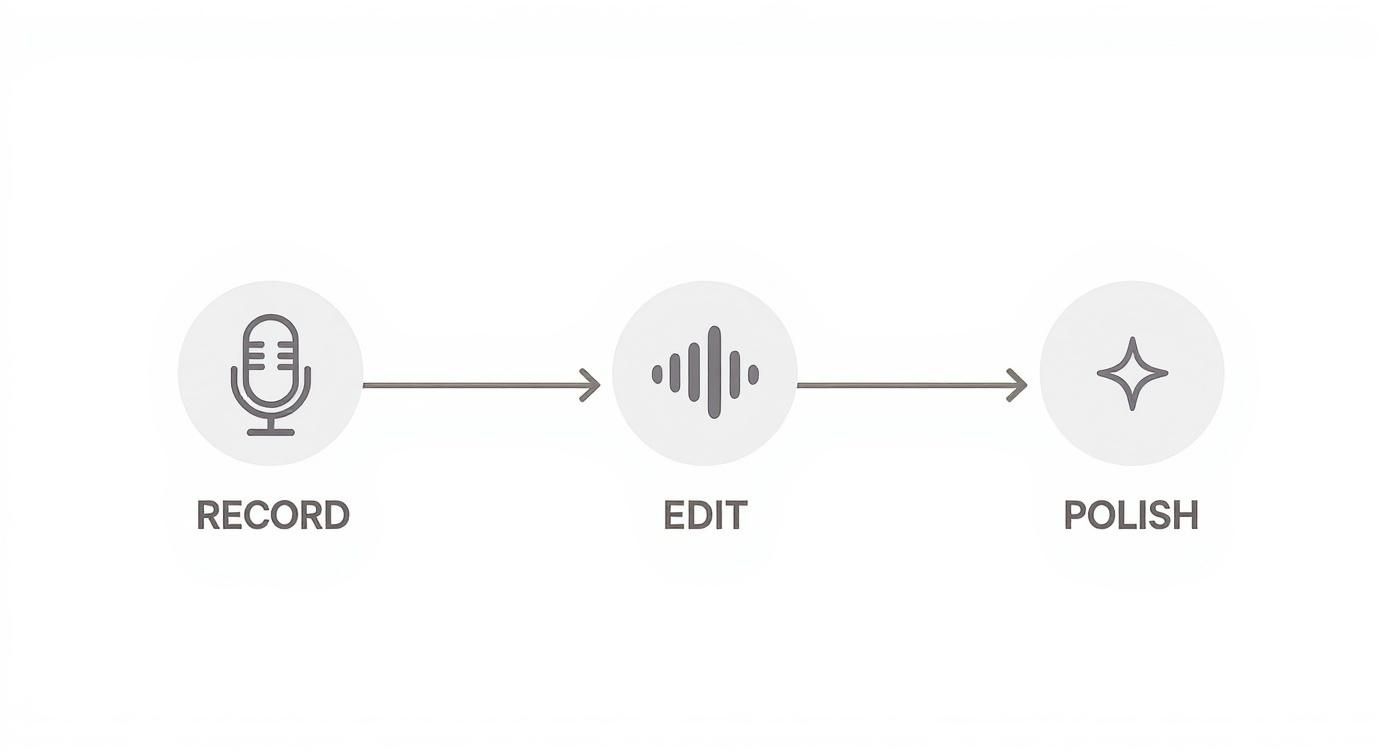
Each step is a craft in itself, which is why outsourcing to a professional is a game-changing decision for serious creators.
Your Professional Production Partner: The Flexwork Solution
This is precisely why we created the “Be My Podcast Producer” package at Flexwork Studios. It’s the definitive solution for ambitious creators who value their time and refuse to compromise on quality. You focus on recording—either at home or in our New Jersey studio—and our team handles the rest.
Our audio engineers meticulously edit your raw files, removing mistakes and awkward pauses while preserving the natural flow of conversation. We then mix in your intro/outro music, add any sound effects, and master the final track to meet industry loudness standards, ensuring it sounds incredible on every platform. For video podcasts, this includes editing footage, adding custom graphics, and creating compelling short-form clips perfect for social media promotion.
It’s Time to Launch: A Winning Game Plan for Your Podcast
Recording a great episode is a major accomplishment, but a brilliant podcast is useless if no one hears it. Now, you shift from creator to promoter. A strategic launch plan ensures your podcast doesn't just get published—it gets discovered.
This is where your investment in quality pays off. A well-executed launch finds your target audience and builds the kind of momentum every creator dreams of.
From Your Hard Drive to the World
Before anyone can listen, your podcast needs a home online. This involves a podcast hosting platform like Buzzsprout, Libsyn, or Transistor. These services store your audio files and generate your RSS feed—the critical link that syndicates your show to listening apps.
Once you have your RSS feed, you’ll submit it one time to the major directories:
- Apple Podcasts
- Spotify for Podcasters
- Amazon Music & Audible
After a short approval process, you're live. From then on, every episode you upload to your host automatically appears everywhere. To make your show more accessible and SEO-friendly, consider learning how to transcribe your podcast.
Your 30-Day Launch Blueprint
A successful launch is a campaign designed to build hype and drive critical early downloads.
- Bank Your Episodes: Launch with three to five episodes available from day one. This encourages binge-listening and increases the likelihood of a subscription.
- Activate Your Network: Personally reach out to your professional and social circles. Ask them to listen, subscribe, and leave a review. Early ratings are crucial for visibility in podcast apps.
- Create Buzz with High-Value Content: Go beyond simple announcements. Use audiograms, quote graphics, and behind-the-scenes video clips to build anticipation. This is a perfect use case for a Flexwork Studios Content Day session. For $3000, you get a full day in our studio, yielding 20 edited reels or 60 pro photos—an entire month of premium social media content from a single session.
A successful podcast launch is less like a press release and more like a movie premiere. You build anticipation, create a moment, and give your audience a reason to show up on day one.
Ready to Scale? Bring in the Pros
You've launched, and you're finding your rhythm. But now the real work begins: growing your audience. This is where many podcasters hit a wall, overwhelmed by the demands of marketing, analytics, and monetization. To scale, your passion project must operate like a media brand.
The “Market, Manage & Produce My Podcast” package at Flexwork Studios is designed for this exact moment. It’s an end-to-end growth solution for creators serious about amplifying their influence. Starting at $1500 per episode (with a 20-episode growth commitment), this service transforms your podcast into a powerful marketing engine. We handle production, distribution, social media marketing, performance tracking, and monetization strategy, freeing you to focus on creating world-class content.
Your Shortcut to a Professional Podcast Launch
You now have the complete playbook for launching a podcast. But knowing the steps and executing them flawlessly are two different things.
The difference between a hobby podcast that fades away and a professional show that builds a real audience comes down to three elements:
- A sharp, focused concept.
- Broadcast-quality audio and video.
- A strategic launch and growth plan.
Attempting to manage all three is a direct path to burnout. You risk spending more time wrestling with technology than creating the content you're passionate about.
This is where a professional partner transforms the entire process. At Flexwork Studios, we are your strategic advantage in the competitive New Jersey podcasting scene. Your role is to be the expert, the storyteller, the talent. Our role is to handle every technical detail with precision.
A secret the top creators understand: You don't have to do everything yourself, you just have to ensure everything gets done right. Partnering with a studio is a strategic investment in your brand's quality and your own creative focus.
Stop trying to sound professional and simply be professional from day one. Whether you need an impeccable space for hourly recording or a full-service team to manage production and growth, we have a solution tailored for you.
Ready to build a show that commands attention? Explore our podcast production studio services or book a tour. Let's bring your vision to life.
So, What's the Real Price Tag to Start a Podcast?
The cost depends entirely on your approach. A basic DIY setup can start under $100, while a pro-level home studio can easily exceed $1,000.
However, the smartest path to broadcast-quality sound from day one is to bypass the upfront investment. Renting a professional space like Flexwork Studios provides access to top-tier equipment in a perfectly treated room, only when you need it. You achieve a premium sound immediately, without the financial burden or the steep learning curve of audio engineering.
What's the Perfect Podcast Episode Length?
There is no golden rule. While data suggests a sweet spot between 20 and 40 minutes, the perfect length is however long it takes to deliver exceptional value without filler. Your goal is to create a tight, compelling episode that respects your audience's time.
According to the latest podcast consumption habits and statistics, consistency is more important than length. A predictable release schedule is what builds a loyal following.
How Do I Actually Get My Show on Spotify and Apple Podcasts?
This sounds complex but is remarkably simple. It starts with your podcast host, the service where you upload your audio files. They generate an RSS feed, your show's unique internet address.
You'll submit this RSS feed one time to directories like Apple Podcasts and Spotify for Podcasters. After a brief approval, you're in. Every new episode you upload to your host will then automatically distribute to all platforms.
Ready to skip the guesswork and launch a podcast that sounds exceptional from the very first minute? Flexwork Studios is your dedicated production partner. Explore our production packages and studio rentals and let’s build something remarkable together.

Related Posts
What Podcast Studios Provide Technical Support Without Interfering with Your Creative Process
Great studios know when to step in—and when to get out of your way. Here’s how…
How to Collaborate With a Studio as a Creative Duo
Two voices. One show. Here's how we support creative duos in producing content…
Why Podcast Studios With AI + Human Editing Give You the Best of Both
Want speed and polish? Learn how combining AI automation with human precision…